

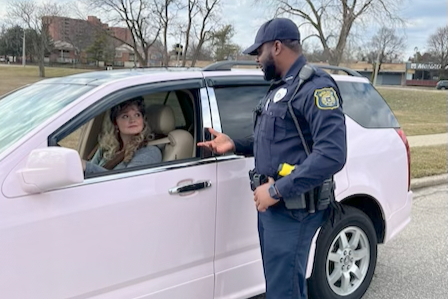
In the United States, 1 in 31 children eight years of age has autism spectrum disorder (ASD).1 ASD is a neurodevelopmental disorder characterized by impairments in social interaction and communication and the presence of restricted, repetitive patterns of behaviors, interests, or activities.2 These impairments can cause difficulties in everyday social interactions, communication, and daily functioning. The ways in which the impairments impact a person on the spectrum vary from person to person. Some autistic individuals live independently, drive, and hold various jobs (e.g., doctors, lawyers, police officers), while others have limited functional skills and require constant support for daily functioning. An autistic individual who is more independent may function at a lower level during times of heightened stress, such as interacting with police officers, as research suggests higher stress levels in autistic individuals is associated with poorer social functioning.3
Autistic individuals have a high rate of contact with police officers, with one study reporting 20 percent of autistic individuals had contact with police officers at least once by the time they were in their mid-twenties.4 These interactions are typically safety related and not criminal.5 For example, autistic individuals are more likely than the general population to elope or wander.6 Onlookers may report autistic behaviors (e.g., stimming—repetitive vocal or motor movements) as suspicious when, in fact, the autistic individual may not be doing anything wrong; the behaviors just look different to someone unfamiliar with autism.7 Police officers may also be called when the autistic individual is engaging in self-harm or exhibiting aggression.8 Misunderstandings during these interactions can escalate unnecessarily, especially if officers are unfamiliar with the unique ways autism may present.
Police training on autism is becoming more common, and sensory and communication bags are emerging as practical tools to improve these encounters.9 These bags, stocked with items to reduce sensory stress and support nonverbal communication, can help de-escalate situations and facilitate safer interactions. Sensory needs vary among autistic individuals. Autistic individuals can be hypersensitive, hyposensitive, or experience a combination of both. Hypersensitivity occurs when they receive too much sensory input from the environment, which can make surroundings feel overwhelming or even physically painful. Hyposensitivity occurs when they receive too little sensory input, leading them to seek out additional sensory input .Every autistic individual is different, and support must be individualized. To date, little research has been done on the most advantageous items to include in sensory and communication bags. However, with the growing adoption of sensory and communication bags by police agencies, insights guided by research can aid agencies in selecting effective items for inclusion and practical recommendations for their use.
Data Source
The items recommended herein for inclusion in sensory and communication bags for police officers to use with autistic individuals were identified through a survey study. The survey was distributed to various individuals who live or work with autistic individuals (i.e., teachers, occupational therapists, speech therapists, family members,autistic individuals). These individuals have a unique understanding of effective communication and calming strategies, allowing them to lend an expert perspective on what to include in a sensory and communication bag for police personnel to use with autistic individuals in the field.
A total of 92 participants completed the survey. Among them, 3 identified as autistic, 60 as teachers, 10 as family members, 1 as a caregiver, 26 as service providers (e.g., speech therapist), and 7 selected “other” (e.g., advocate, higher education faculty), with some participants identifying with multiple categories. The majority of respondents identified as female (n = 89), with two identifying as male and one as gender nonbinary/nonconforming. Racial identities reported included White (n = 89), American Indian or Alaskan Native (n = 1), Asian (n = 1), and “Other” (n = 1).
Participants were presented with nine items commonly used with autistic individuals to help de-escalate situations, redirect attention, adjust sensory stimuli, and support communication. These items included noise-canceling headphones, sunglasses, a stress ball, a fidget puzzle, a pop-it, a communication board, a sensory tube, a weighted blanket, and a notepad with a writing utensil. Survey participants were asked whether each item should be included in a sensory bag for police use. Additionally, participants could suggest other items not listed and provide comments or general feedback.
The survey responses were analyzed by counting how often each answer appeared and calculating the percentage for each response category. Items were selected based on two criteria:
- Any item for which more than 70 percent of respondents selected “yes” was retained.
- Qualitative feedback from respondents was considered to refine and add items.
For example, based on feedback, a whiteboard and marker were included instead of a notepad and pencil and a stuffed animal with sequins was added. The authors aimed to select items that were cost-effective, functional during police interactions, and not overwhelming for autistic individuals. Items that posed safety risks, such as oral items due to choking hazards and potential allergies, were excluded. Additionally, items that required laundering (e.g., weighted blanket), could retain odors over time (e.g., hat), or could break or cause harm if thrown (e.g., liquid motion bubbler) were also omitted.
Creating Sensory Bags
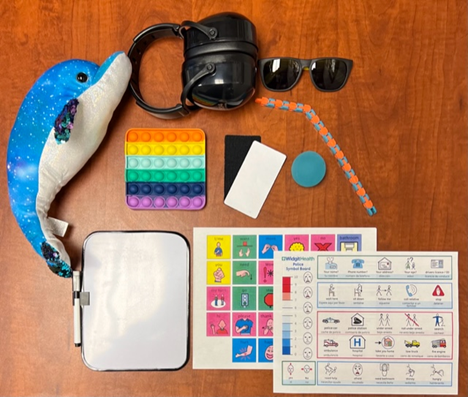
Based on answers from the survey, Figure 1 presents a recommended list of sensory items police officers can carry in their vehicles. Table 1 provides steps police officers may consider when using the sensory and communication bags, as well as items included in the bag, when the police officer would present the item to the autistic individual, how the police officer could present the item, and why the item might be helpful. The sensory and communication items are optional for the autistic individual to use if they choose. Therefore, the items should be offered but not forced upon them.
|
Sensory Bag Items and Implementation Steps to Support Autistic Individuals During Safety Interactions |
|||
| Step 1- Support audio/visual needs. Individuals with autism are often hypersensitive to sensory stimuli (i.e., events received by the senses), which means their body has an overreaction to the sensory environment. Often, individuals without autism do not recognize the stimuli in the environment, yet for autistic individuals the sounds/smells/lights/colors can be painful. Offering noise-canceling headphones and/or sunglasses can help reduce the auditory/visual sensory input they are experiencing. Reducing sensory input can help prevent challenging behaviors from occurring and/or help the autistic individual de-escalate. | |||
| Item | When would an officer provide this item to the individual? | How would an officer introduce the item to the individual? |
Why might this item be helpful? |
|
Noise-canceling headphones |
If the individual is in a situation that is loud or includes high-pitched sounds (such as sirens), or the officer notices the individual covering their ears or commenting on the noise, noise-canceling headphones may help. |
Ask the individual if they would like the noise-canceling headphones. Be sure to show them the headphones, as it may be difficult for them to hear you or process what you are saying because of the background noise. If they indicate they need help putting them on, slowly assist them. |
Some autistic individuals are sensitive to loud or high-pitched noises, and some have reported particular noises to be physically painful. Hearing and/or processing what people are asking them may be difficult. In some cases, individuals may try to run away or push away people who are trying to help to ease their discomfort caused by the noise. |
|
Sunglasses |
If an individual is in a situation with bright lights, either from the sun or emergency vehicles, or if an officer notices squinting or other signs of discomfort, sunglasses may help. |
Ask the individual if they would like the sunglasses, holding the sunglasses for them to see. Let them take the sunglasses or set the glasses nearby so they can take the glasses later if they want. |
Some autistic individuals are particularly sensitive to lights, colors, and/or flashing lights. Lights can be distracting, making it difficult to focus on interactions with people trying to help. |
| Step 2- Offer tactile/calming support options. Individuals with autism may find safety interactions particularly stressful due to a change in their routine, the unknown, difficulty processing information, difficulty communicating their needs/wants, and sensory stimuli in the environment. Providing a tactile/calming support option may help calm the autistic individual, prevent behaviors from escalating, and/or redirect the individual. | |||
|
Stress Ball Fidget puzzle Pop-it Stuffed animal with flipped sequin Velcro strips |
If an officer notices the individual seems anxious, one of these items might be helpful for relieving stress while talking with the officer or during a break. |
Select two items from the list (e.g., stress ball and fidget puzzle). Hold the two items up so the individual can see them and say, “Would you like to hold the ball or the fidget puzzle while we talk?” Or if there is time for a break, say, “Would you like to hold the ball or fidget puzzle and take a break?” Wait at least 15 seconds to see if the individual responds. If the individual is not interested in either option, consider taking out two other options and asking the same question. |
These items can provide an outlet for nervous energy and can provide sensory input. This can result in a calming effect for some people. |
| Step 3- Alternative communication options. If the individual is not responding to questions or commands, alternative methods of communication may help. First, try using a whiteboard. If that does not work, try a communication board and/or the police symbol visual board. | |||
|
Whiteboard and marker |
If the individual seems like they do not understand what the officer is saying or if the individual is not speaking, using a whiteboard to communicate may be helpful. |
To clarify what needs to be communicated, write the message on the board. Then, show the board to the individual. It the individual needs to respond, ask the question or write the question on the board and hand the board and open marker to the individual. Point to the whiteboard to signal the individual to write on the board. |
Some autistic individuals have difficulty processing verbal input, especially during high -stress situations. Reading instructions or questions can sometimes be easier than responding to verbalizations. Some autistic individuals may not communicate verbally especially in high- stress situations or with strangers. The white board allows them to write what they want to say if they prefer and are able. |
|
Basic communication board |
If the individual communicates nonverbally or is having a difficult time communicating verbally due to the stressful situation, a basic communication board can be used. It provides pictures and words for general communication. |
Hold the communication board in front of the individual at an angle where they can read and reach it (or they may prefer to hold the board). Allow the individual to point to the words they want to say. |
Some autistic individuals have difficulty processing verbal input, especially during high -stress situations. Reading instructions or questions can sometimes be easier than responding to verbalizations. Some individuals communicate nonverbally or have difficulty verbalizing in stressful situations. A communication board can provide a way for them to communicate with people around them. |
|
Police symbol visual supports board (Widget Health, 2023) |
When individuals communicate nonverbally or are having difficulty communicating verbally due to the stressful situation, a visual support board can also be used. It provides pictures and words specific to emergencies. |
Hold the visual support board in front of the individual at an angle where they can read and reach it (or they may prefer to hold the board). Allow the individual to point to the words they want to say. The board may also be used to ask questions and give commands. For example, point to the picture that says, “your name” and say, “What is your name?” The board might also be used to better understand if the individual is hurt. Using the pain scale, ask the individual to point to how they feel. |
Some autistic individuals have difficulty processing verbal input, especially during high -stress situations. Reading instructions or questions can sometimes be easier than responding to verbalizations. Some individuals communicate nonverbally or have difficulty verbalizing in stressful situations. A visual support board can provide a way for them to communicate with the people around them. |
|
Note: The steps above may be implemented when using a sensory and communication bag to support autistic individuals during safety interactions. When it is safe to do so, it is suggested that officers start by using items that reduce sensory stimuli and help calm the individual (i.e., steps 1 and 2), because this will likely make it easier to communicate and help keep the individual calm. However, police officers must use their training. If the individual is hurt or at risk, the officer might move right to communication strategies. The sensory and communication tools should be used only when it is safe to do so. |
|||
Conclusion
There is limited research on what should be included in sensory and communication bags for use by police officers and how these items should be employed. Given the increasing interest in incorporating these bags into police procedures, this article provides crucial guidance for selecting and using items effectively. Police agencies should choose items that support various sensory needs while ensuring safety and ease of use. Officers should avoid items that pose choking hazards, allergenic risks, or any other safety threats to themselves and the individuals they assist. Furthermore, training on autism and the proper use of sensory and communication bags is essential. While the guide provided in this article is helpful in knowing when and how to introduce items in the bag to autistic individuals, training on autism is essential to understand the multifaceted needs of autistic individuals and how to support them during safety encounters. d
Notes:
1Katherine A. Shaw, Suzanne Williams, Melissa E. Patrick, et al., “Prevalence and Early Identification of Autism Spectrum Disorder among Children Aged 4 and 8 Years—Autism and Developmental Disabilities Monitoring Network, 16 Sites, United States, 2022,” MMWR Surveillance Summaries 74, no. SS-2 (2025): 1–22, https://doi.org/10.15585/mmwr.ss7402a1.
2American Psychiatric Association, Diagnostic and Statistical Manual of Mental Disorders, 5th ed. (Arlington, VA: American Psychiatric Pub, 2013).
3Lauren Bishop-Fitzpatrick et al., “The Relationship Between Stress and Social Functioning in Adults with Autism Spectrum Disorder and without Intellectual Disability,” Autism Research: Official Journal of the International Society for Autism Research 8, no. 2 (2015): 164–173.
4Jasmin A. Rava et al., “The Prevalence and Correlates of Involvement in the Criminal Justice System Among Youth on the Autism Spectrum,” Journal of Autism and Developmental Disorders 47 (2017): 340–346.
5Dennis Debbaudt, Autism, Advocates, and Law Enforcement Professionals: Recognizing and Reducing Risk Situations for People with Autism Spectrum Disorders,(London, UK: Jessica Kingsley Publishers, 2002).
6Connie Anderson et al., “Occurrence and Family Impact of Elopement in Children with Autism Spectrum Disorders,” Pediatrics 130, no. 5 (2012): 870–877.
7Emily Ball and Jaclyn Jeffrey-Wilensky, “Why Autism Training for Police Isn’t Enough,” Spectrum November 26, 2020.
8Daniel Wallace et al., “Interactions Between Individuals on the Autism Spectrum and the Police: The Fears of Parents, Caregivers, and Professionals,” Policing: A Journal of Policy and Practice 15, no. 2 (2021): 950–964.
9Melissa A. Sreckovic, Christopher Kenney, and Mitchell Wallace, “Autism Training for Law Enforcement Officers: A Scoping Review,” Journal of Autism and Developmental Disorders 52 (2022): 1–15; Abiha Patel, “Michigan State Police to Carry ‘Calming Bags’ in Their Patrol Cars,” WLNS News, April 6, 2021.
Please cite as
Melissa Sreckovic et al., “Effective Sensory Bags for Safer Interactions: Supporting Autistic Members of the Community,” Police Chief Online, August 20, 2025.