

Decisions made by the U.S. Congress have a direct impact on how policing professionals serve their communities. These legislative actions can influence state and local law enforcement assistance programs, funding levels and priorities for federal agencies, the authorization and regulation of new technologies, and the direction of national public safety priorities.
To ensure these decisions are informed by operational realities, the International Association of Chiefs of Police (IACP) maintains a dedicated Legislative Affairs team that focuses on advancing thoughtful and practical policy solutions on behalf of the policing profession.
The association’s advocacy efforts begin with a clear strategy: track legislative activity, assess how proposed laws affect policing, engage with lawmakers, and empower IACP members to raise their voices and take action when needed. This work is grounded in continuous communication with the U.S. Congress through support letters, one-on-one meetings with congressional offices, and policy fact sheets.
On a biweekly basis, when the U.S. Congress is in session, the IACP publishes a Legislative Update summarizing recent federal developments. These updates include information on the federal budget process, legislative bills the association supports, and executive branch activity. They are carefully crafted to provide U.S. policing professionals with timely, relevant insight into how national policy discussions intersect with local operations. Whether a bill proposes changes to grant programs or introduces new regulatory obligations, the IACP delivers the tools members need to stay informed and respond effectively.
The IACP regularly engages with congressional offices through both in-person and virtual meetings. These meetings provide opportunities to offer technical assistance, share operational insight, and discuss the potential impact of proposed legislation. These conversations go beyond explaining what a bill does; they focus on how it would work in practice.
A key part of the IACP’s advocacy strategy is the development of support letters for pending legislation. These letters reflect the association’s policy priorities and can help influence how members of Congress vote on or mark up a bill. They are sent directly to bill sponsors, committee chairs, and congressional committee staff. Drafted with input from IACP policy staff and members, each letter explains how proposed policies will affect agencies on the ground and why the bill is needed.
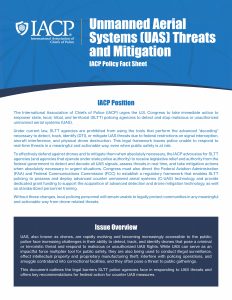 To support these efforts, the IACP’s Policy and Governance team also produces issue-specific policy fact sheets. The most recently released policy fact sheet (as of September 2025) is on counter-UAS, which outlines legal and operational challenges that prevent state, local, tribal, and territorial agencies from mitigating and addressing drone threats. These resources are distributed to members of the U.S. Congress, key committees, and relevant federal agencies. They also include actionable legislative recommendations. To further support member engagement, the fact sheets are paired with talking points to help policing professionals serve as subject matter experts when meeting with their elected officials.
By developing accessible and consistent messaging, the IACP ensures that policing organizations, regardless of size or location, have a unified and informed voice in Washington, DC.
Through sustained communication with the U.S. Congress and a commitment to equipping members with timely information, the IACP Policy and Governance team is helping shape legislation that supports the needs of the policing profession.d
Please cite as:
Leenah Hegazy, “Navigating the Legislative Landscape,” IACP@Work, Police Chief 92, no. 11 (November 2025): 70–71.