

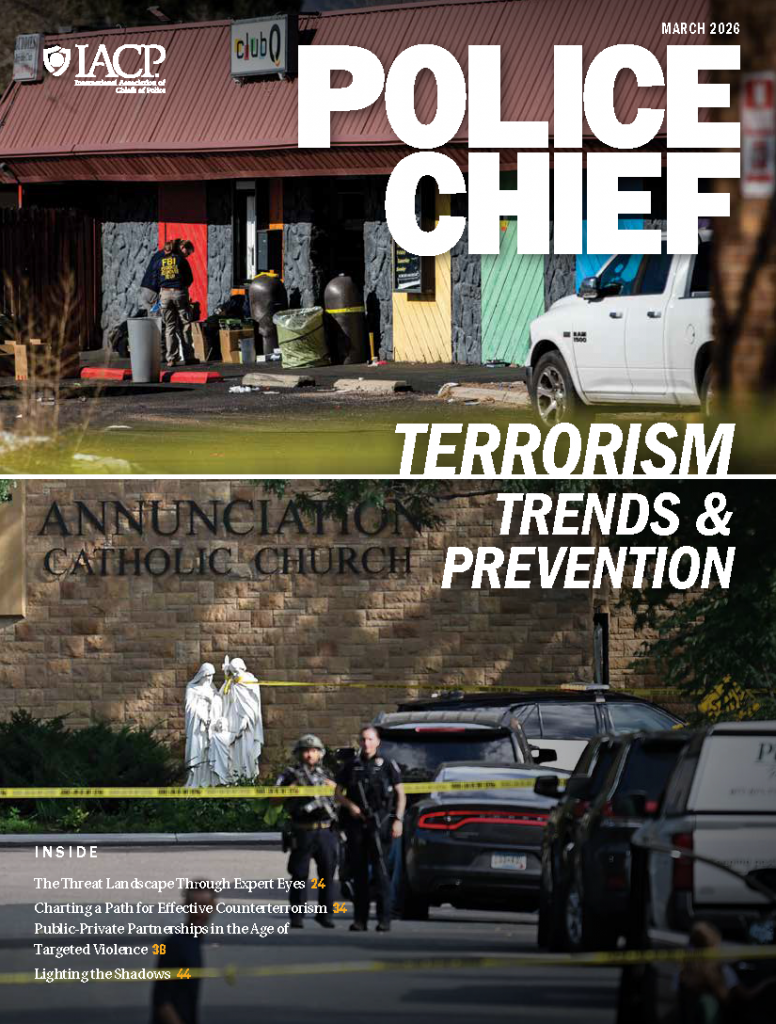
March 2026: Terrorism Trends and Prevention
The terrorism landscape is rapidly shifting due to decentralized actors, self-radicalized extremists, and increasingly complex digital pathways to violence. Analyzing past counterterrorism wins and failures shows how stronger partnerships and prepared responders can drive more adaptable, trust-driven strategies suited to today’s evolving threats.
GUEST EDITORS: Nismal Iqbal and Quenten Vereen
Articles
-
The Threat Landscape Through Expert Eyes
I think my experiences as a local patrol officer, a detective, a patrol sergeant, and a detective sergeant are the baseline for everything I’ve done in my 37 years in law enforcement. That work taug... -
Charting a Path to Effective Counterterrorism
Responses to terrorism remain a huge priority for police and governments around the world. Recent years have reinforced this painful reality. The Hamas attack in Israel on October 7, ... -
Public-Private Partnerships in the Age of Targeted Violence
Corporations have long faced a spectrum of complex risks. From cyberattacks to geopolitical challenges, the speed and depth of crises handled by security teams have increased dramatically in r... -
Lighting the Shadows
Global terrorism is an abstract phenomenon that becomes concrete mostly at the local level, particularly for first responders like police and firefighters whose core mission is to protect public safet...
Columns
- President's Message: Fostering Information and Intelligence Sharing
- Chief’s Counsel: The Price of Readiness
- Focus on Officer Wellness: Bring Unprepared Is Not an Option
- Traffic Safety Initiatives: Beyond the Manuals
- Spotlight: Stopping the Cycle
- 2026 IACP Technology Conference
- Tech Talk: From Call Intel to Command Decisions
- Product Feature: Outfitting Today’s Officer
- Exposition: March 2026
- IACP@Work: Introducing CRIS
- The Brief: Uniting Against Threats
- Perspectives: March 2026
- Roll Call: Vincent H. Vleesenbeek
- Ad Index: March 2026