

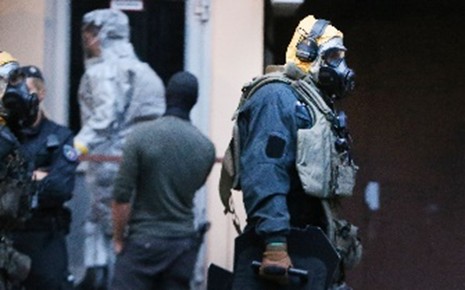
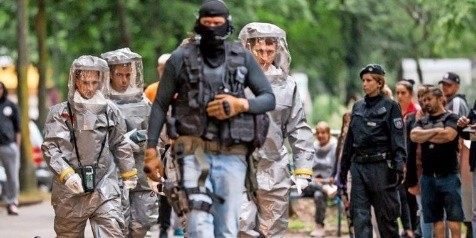
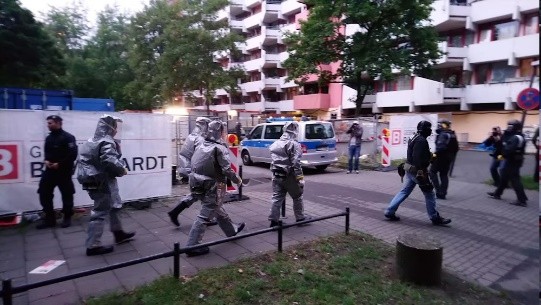
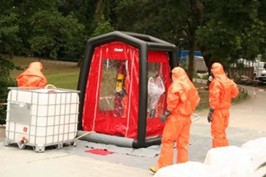
Special operations Police forces and Analytical Task Force of the Cologne fire department, each with personal protection equipment, ©DPA
The specter of bioterrorism represents a growing challenge for global security. In an era of rapid technological advances and digital interconnectedness, the ability of malicious actors to exploit biological agents for nefarious purposes has expanded significantly. Bioterrorism is not a distant theoretical concern but a tangible and evolving threat.
The Bioterrorism Landscape
Jihadist terrorist groups have significantly increased the dissemination of chemical, biological, radiological, and nuclear (CBRN) propaganda in recent years. A particularly alarming trend emerged in 2018, with an unprecedented spike in bioterrorism-related online materials. These resources ranged from simple posters to comprehensive publications, such as tutorials and videos providing detailed guidance on synthesizing, weaponizing, and disseminating biological agents. Toxins derived from plants, such as ricin, have been prominently featured in these propaganda campaigns.
Terrorist organizations, particularly those aligned with ISIS, have actively encouraged lone actors to utilize biological weapons in attacks against civilian populations. In many cases, online radicalization plays a key role in the recruitment of individuals willing to engage in such plots. The accessibility of instructions on the dark web and encrypted communication platforms has made it significantly easier for would-be attackers to acquire the necessary knowledge to develop and deploy biological agents.
The appeal of biological agents like ricin lies in their availability, high toxicity, and ease of production. Unlike bacterial or viral pathogens, plant toxins require minimal expertise and infrastructure, allowing perpetrators to rapidly progress through the six key stages of a CBRN attack: (1) procurement of agents or their precursors, (2) knowledge acquisition, (3) equipment assembly, (4) synthesis or extraction, (5) weaponization, and (6) dissemination. The rapid timeline from procurement to execution presents serious challenges in the detection and intervention for law enforcement and intelligence agencies.
Ricin is a potent proteinaceous toxin found in the seeds of the castor bean plant (Ricinus communis). It is a controlled chemical under Schedule 1A of the Chemical Weapons Convention (CWC), and is a Category B substance under the Biological and Toxins Weapons Convention (BTWC). Ricin has attracted interest as a military chemical/biological warfare agent and as a poison for criminal and terrorist use.1
The German Ricin Case: A Watershed Moment
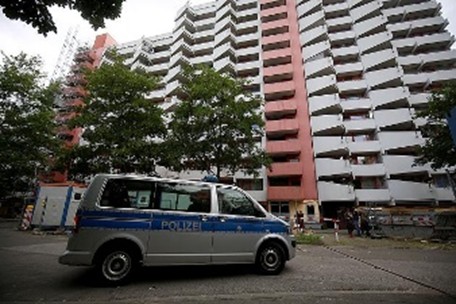
On June 12, 2018, German authorities disrupted a terrorist plot involving the use of ricin in Cologne. This marked the first recorded attempt in Germany to deploy ricin as a biological weapon. The arrest of 29-year-old Tunisian national Sief Allah H. and his wife, Yasmin H., revealed the intricacies of bioterrorism plots and underscored the operational challenges faced by law enforcement agencies in dealing with bioterrorist threats.2
Intelligence and Investigation
The investigation originated from intelligence indicating that Sief Allah H. had links to ISIS and had expressed intentions to conduct an attack. Further inquiries revealed that he had procured at least 1,000 castor bean seeds (the raw material for ricin), an electric coffee grinder, and metal ball bearings—items commonly listed in terrorist manuals for constructing biological weapons and improvised explosive devices (IEDs).
Rapid and Coordinated Response
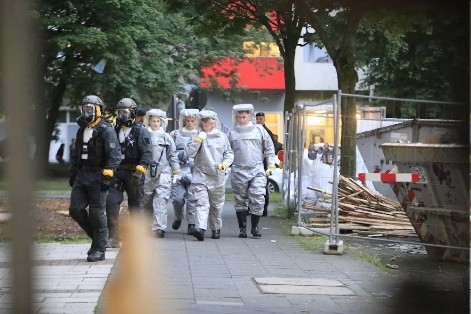
A swift and coordinated multiagency response ensued. The German Federal Criminal Police Office (Bundeskriminalamt) took charge of the investigation, collaborating with local police, specialized CBRN units, and the Robert Koch Institute’s Centre for Biological Threats and Special Pathogens. This multidisciplinary approach ensured efficient crime scene management, evidence collection, and threat mitigation.
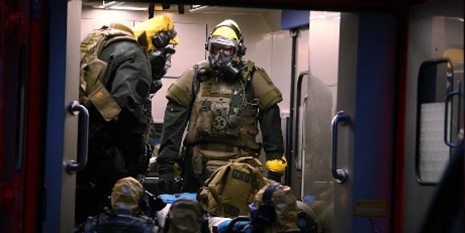
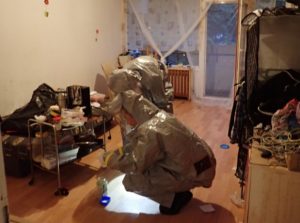
First responders faced unprecedented operational risks in a contaminated crime scene. Securing the crime scene in a potentially contaminated environment requires specialized training and equipment. Ensuring the safety of personnel required the use of full-body protective suits, which limited their mobility and work durations due to physiological constraints. Handling highly toxic substances necessitated real-time expert consultation, while decontamination protocols had to be implemented on-site. The use of live video feeds from the hot zone proved crucial in aiding decision-making and optimizing coordination between specialized units.
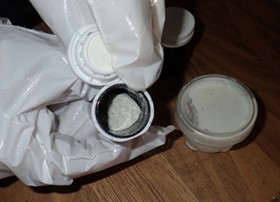
Inside the suspects’ residence, authorities uncovered 3,150 castor bean seeds, 85 milligrams of refined ricin (both in powder and paste form), coffee grinders, approximately one kilogram of gunpowder extracted from fireworks, 250 metal balls, and electronic components consistent with an IED assembly. Digital forensic analysis of mobile devices revealed direct communication with an ISIS operative abroad who provided step-by-step instructions on ricin production and potential attack methodologies.
Legal Outcomes and Lessons Learned
In March 2020, the Higher Regional Court in Düsseldorf sentenced Sief Allah H. to 10 years in prison for preparing a serious act of violence endangering state security and violating the War Weapons Control Act through the production of a biological weapon. His wife, Yasmin H., was sentenced to eight years for complicity in the crime. The court ruled that the couple had acted with intent to support violent jihad and planned to use the weaponized ricin in a terrorist attack on German soil.
The case highlighted critical operational lessons for first responders. One major challenge was the need to maintain crime scene integrity while operating in hazardous conditions. The necessity of specialized training for forensic teams, CBRN units, and conventional police forces became evident, as conventional crime scene protocols were inadequate in a contaminated environment. Additionally, the limited availability of specialized laboratories capable of handling biological threat agents underscored the need for expanded bio-forensic capabilities.
Broader Implications and Challenges
The Cologne ricin case is indicative of a shift in the bioterrorism threat landscape. Analysis of CBRN-related intelligence collected by Europol suggests that biological agents remain a preferred choice among terrorists due to their high-impact potential and relative accessibility. The proliferation of jihadist propaganda advocating ricin production, coupled with cases in France and Germany following similar methodologies, underscores the persistent risk.
Online dissemination of bioterrorism-related instructional materials remains a significant challenge. In response, Europol has coordinated multiple referral action days targeting digital platforms hosting such content. In 2019 alone, 1,733 pieces of extremist content related to CBRN threats were flagged for removal.[3] However, persistent online accessibility and the ease of cross-border procurement of precursor materials complicate prevention efforts.
Investigations into biosecurity-related crimes are further hampered by disparities in national laws, inconsistencies in forensic sampling procedures, and varying laboratory capabilities. Ensuring seamless cross-border cooperation remains an essential component of effective counter-bioterrorism strategies.
Enhancing Bioterrorism Countermeasures
A comprehensive, proactive counter-bioterrorism approach must integrate the following key elements:
- Robust Online Monitoring and Content Removal: Strengthening Europol-led initiatives to detect, report, and eliminate extremist content promoting bioterrorism.
- Cross-Sectoral Cooperation: Enhancing collaboration among law enforcement, intelligence agencies, public health authorities, and emergency response teams.
- Capacity Building: Conducting frequent joint training exercises to refine operational readiness and crisis response capabilities.
- Legal and Procedural Harmonization: Aligning legislation and standardizing forensic procedures across jurisdictions to facilitate cross-border investigations.
- Advanced Detection and Forensic Capabilities: Expanding research and investment in rapid biological agent detection tools and high-security biohazard forensic laboratories.
Conclusion
Bioterrorism represents an evolving and complex challenge that demands a coordinated and multidisciplinary response. The Cologne ricin case serves as a critical reminder of the potentially catastrophic consequences of biological weapons and the need for constant vigilance, preparedness, and international cooperation and information exchange. For first responders, lessons learned underscore the importance of specialized training, appropriate protective measures, and interagency coordination in responding to biological threats. By leveraging cutting-edge investigative tools, intelligence sharing, and regulatory advancements, security agencies can enhance their ability to detect, deter, and neutralize bioterrorism hazards—ultimately safeguarding public safety in an increasingly interconnected world. d
Notes:
1Organisation for the Prohibition of Chemical Weapons, Scientific Advisory Board. (2014, February 28). Ricin fact sheet (SAB-21/WP.5; CS-2014-8415(E)). Organisation for the Prohibition of Chemical Weapons.
2Florian Flade, “The June 2018 Cologne Ricin Plot: A New Threshold in Jihadi Bio Terror,” CTC Sentinel 11, no. 7 (2018): 1–4.
3Europol, 2019 EU IRU Transparency Report (2019).
Please cite as
Jasmin Kluge et al., “The Rising Threat of Bioterrorism: Challenges and Responses for Law Enforcement and First Responders,” Police Chief Online, March 11, 2026.