


Walk into any patrol car today and a fully functioning mobile office is immediately visible. The modern police vehicle is no longer just a mode of transportation; it has become a digital command center, a lifeline to real-time intelligence, and the central hub for nearly every workflow an officer touches.
From dispatch and records access to evidence collection, reporting, and situational awareness, policing has become intertwined with computing systems.
This shift emerged not from technological trends but from operational necessity. Officers require instant access to information, reliable communication, and tools capable of performing despite the unpredictable realities of the field. A laptop that fails during a pursuit, a tablet that overheats at a crash scene, or a device that loses connectivity in a rural area is more than an inconvenience—it can compromise safety and disrupt critical operations.
Purpose-Built Hardware
As the policing profession has grown more complex, the hardware behind the badge has evolved just as rapidly. “Rugged computing in law enforcement in the early days was simply about survivability,” said Charlie Gibbs, director of product solutions at Getac North America. “The technology has evolved from a durable alternative to a desktop into a genuine tool.”1 Rugged computers, purpose-built tablets, and integrated accessories have become the backbone of modern policing. These devices are engineered to withstand vibration, weather, and drops. They are designed to run mission-critical applications without lag.
Before rugged computing systems became mainstream, PatrolPC was developing devices for individuals who needed technology that could survive extreme conditions. The company’s origins trace back 27 years to specialized tablets designed for those with severe disabilities. These devices had to be intuitive, durable, and adaptable. “As it turned out, [we] soon realized that many of these unique features would be applicable in other specialized markets—first responders in particular,” said PatrolPC’s Sales and Marketing Director W. Stuart Schneider Jr.2
Today, PatrolPC builds a mission-specific, purpose-built mobile computing system exclusively for first responders, which is manufactured entirely in the United States. Its flagship product, the UltraRugged RhinoTab Mobile Computing System, is engineered for the harshest environments encountered in policing.
A one-piece aircraft-aluminum chassis, fanless and ventless design, and a precision-machined RhinoDock ensure reliability in extreme heat, cold, dust, or vibration. Officers frequently highlight features such as bezel-mounted hot keys and a physical dimmer slider—small but meaningful design choices that reduce distraction and improve nighttime safety. Optional embedded components, including dual-SIM modems, 2D barcode scanners, FLIR thermal cameras, FAP 30 fingerprint readers, and RFID modules, allow agencies to tailor the device to specific missions.
PatrolPC’s hardware extends well beyond patrol cars. The company has outfitted boats, all-terrain vehicles, bicycles, snowmobiles, and motorcycles, enabling e-ticketing and mobile reporting in environments where consumer electronics typically fail. Its patented UltraRugged Printer Mount further streamlines in-car workflows by positioning printers for fast, ergonomic access.
If PatrolPC represents purpose-built specialization, Panasonic Connect represents scale and longevity. For 30 years, Panasonic’s TOUGHBOOK line has been synonymous with rugged computing systems in public safety. A defining element of Panasonic’s approach is its Law Enforcement Advisory Council, a long-running collaboration with police leaders that directly shapes product design. This ensures TOUGHBOOK devices reflect real operational needs rather than assumptions about the field.
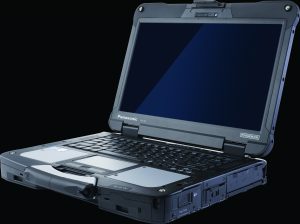
The centerpiece of the current lineup is the TOUGHBOOK 40, a fully rugged, TAA-compliant laptop. The model’s key feature is modularity; eight user-replaceable locations, including four expansion areas, allow agencies to choose from more than 9,600 configurations. Barcode readers can be added for patrol work, DVD drives for detectives, and fingerprint readers can be swapped for smartcard readers as security needs evolve. The TOUGHBOOK 40 adapts to the mission and continues adapting throughout its service life.
Powered by Intel Core Ultra processors, optional Intel Arc graphics, and support for Wi-Fi 7 and Bluetooth 5.3, the device is built for artificial intelligence–driven workflows, real-time video, and large datasets. Extended battery life ensures it remains operational through long shifts.
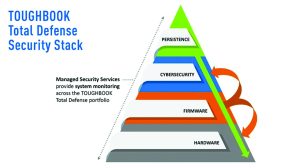
As cyber threats escalate, Panasonic introduced TOUGHBOOK Total Defense, which is a layered security stack protecting devices at the hardware, firmware, OS, and endpoint levels. With CJIS Security Policy Version 6.0 introducing stricter requirements, including mandatory firmware and supply-chain protections by 2027, Total Defense helps agencies remain compliant and secure.
Panasonic envisions the future patrol car as a mobile command center, with rugged computers serving as the integration point for connected vehicle systems and real-time data. The goal is a shift from reactive response to proactive, intelligence-driven policing.
While Panasonic brings legacy and scale, Getac brings rapid innovation and a strong foothold in frontline mobility. Its rugged laptops, tablets, and body-worn cameras are built to military standards and designed for officers who move constantly between the vehicle and the field. Getac devices feature sunlight-readable displays, hot-swappable batteries, red backlit keyboards, and robust multifactor authentication for CJIS compliance. Their demountable designs make them well-suited for on-scene reporting and real-time intelligence exchange.
Getac’s newest products—the F120 fully rugged tablet and V120 fully rugged laptop—represent a significant leap forward. “The idea for both products stems from a simple but urgent reality: most police officers use their vehicles … as mobile offices and are routinely required to carry computing devices outside of those vehicles to incident scenes,” said Gibbs. “Getac’s responses for this need was to develop devices that not only survive but thrive and actively enhance what officers do.”3
Both devices integrate edge artificial intelligence, enabling tasks such as license plate recognition, facial recognition, audio analysis, and real-time transcription directly on the device.
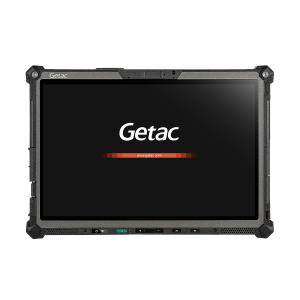 Powered by an Intel Core Ultra 200V Series processor with Intel AI Boost, the F120 delivers up to 48 trillion operations per second of neural processing unit acceleration. This means the tablet can handle complex tasks instantly and on scene, without relying on cloud connectivity or external servers. Connectivity options include Wi-Fi 7, Bluetooth 5.4, dual Thunderbolt 4, optional 4G LTE/5G, and dedicated GPS. Its 12.2-inch, 1,200-nit LumiBond display remains visible in direct sunlight, while Smart Touch technology automatically adapts to gloves, fingers, or stylus input. A keyboard dock allows the device to function as a laptop when needed.
The V120 builds on the popular V110 model, adding Intel Core Ultra 200H processors, Intel Arc graphic processing units, and a convertible hinge for seamless transitions between laptop and tablet modes. It has similar features to the F120 tablet such as a LumiBond widescreen display and Smart Touch auto-sensing technology. Optional Getac Voice enables real-time transcription and digital signatures, a valuable capability during witness interviews.
The Bigger Picture
Across all three companies, a clear pattern emerges: rugged computing systems have evolved from durability solutions into mission-critical operational platforms. “With advancements in connectivity and AI-powered solutions, the patrol car is evolving into a mobile command center,” said Mike Sarallo, director of the public sector at Panasonic Connect.4 Reliability has become a safety requirement rather than a convenience. Agencies are investing in platforms that can evolve with policy, technology, and mission needs.
As 5G and artificial intelligence matures, rugged devices will take on more of the administrative and analytical workload, allowing officers to focus on the human-centered work that only they can perform. The future of policing is not defined solely by software or data. It is defined by the hardware that makes those tools possible—the rugged computers, tablets, and accessories that officers trust with their safety, decisions, and mission.d
Notes:
1Charles Gibbs (director – product solutions, Getac North America), email interview, March 4, 2026.
2W. Stuart Schneider Jr. (director – sales & marketing, AED | PatrolPC), email interview, March 9, 2026.
3Gibbs, email interview.
4Mike Sarallo (director – public sector, Panasonic Connect), email interview, March 9, 2026.
Source ListPlease click on the companies’ names to go to the companies’ websites. |
|
Please cite as
“The New Backbone of Policing,” Product Feature, Police Chief 93, no. 4 (April 2026): 94–98.