
While the policing profession is often measured by crime rates, response times, and operational outcomes, the reality is that every call for service, investigation, and community interaction depends on the individuals behind the badge. Today’s police leaders recognize that an agency’s effectiveness relies on a well-managed team. Recruitment challenges, evolving professional standards, officer wellness concerns, and heightened public expectations have fundamentally changed the demands placed on police leadership.
As a result, personnel management is undergoing a quiet transformation; paper processes, disconnected systems, and informal oversight structures are being replaced by integrated, purpose-built tools designed to improve accountability, wellness, and trust. These solutions give administrators the tools they need to make informed decisions, reduce risk, and support officers more effectively.
Hiring Under Pressure
Across the profession, recruitment has become one of the most urgent and complex challenges. Between 2019 and 2023, there was a 40 percent increase in the number of job openings for police officers. At the same time, the number of applications per job decreased by 39 percent.1 Agencies are facing fewer applicants, increased industry competition, and greater external scrutiny of hiring decisions, all while trying to maintain the staffing levels necessary for public safety.
NEOGOV, which supports more than 13,000 public sector organizations, addresses this challenge through an integrated workforce management platform. Within public safety, PowerDMS by NEOGOV delivers tools designed specifically for police, fire, and emergency communications agencies. One of its most impactful hiring solutions is Vetted, a fully digital background investigation platform.
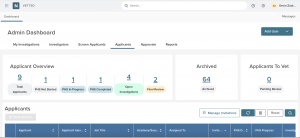
Traditional background investigations were slow, manual, and often frustrating for candidates and investigators alike. Paper packets, PDF forms, and disconnected workflows extended hiring timelines and caused agencies to lose qualified candidates to faster-moving departments. Vetted digitizes and centralizes the entire background investigation process, enabling recruiters and background investigators to work from a single, secure platform.
Integrated with NEOGOV’s applicant tracking system, Insight, Vetted allows candidate information to flow automatically from application to investigation, reducing the need for duplicate data entry and the administrative burden. Candidates can complete forms and upload documentation from anywhere, improving completion rates and maintaining engagement. Investigators benefit from real-time visibility into progress, clear documentation of qualifiers and disqualifiers, and a complete audit trail for every hiring decision. The addition of artificial intelligence–generated summaries for character reference responses further reduces workload by condensing large volumes of data into clear, professional summaries.
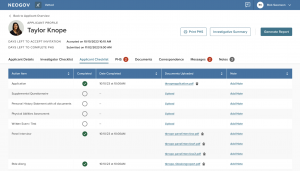
Agencies using Vetted report significantly shorter hiring timelines—often making the difference between securing strong candidates or losing them to another agency. “Since moving off paper, we’ve reduced our hiring process from 131 days to 39 days,” said Detective Ryan Stiltz of Cobb County, Georgia, Police Department.2
Once candidates successfully enter the profession, the focus quickly shifts from recruitment to accountability and daily performance.
Accountability in Practice
Professional standards have long been a cornerstone of policing; however, the way agencies manage accountability has changed dramatically. For decades, incidents such as use-of-force events, pursuits, or community complaints were documented through paper reports that moved slowly through the chain of command. That lack of speed and consistency affected not only oversight but transparency and trust.3
Versaterm’s Professional Standards Suite reflects the profession’s evolution. Built as an integrated ecosystem, the suite connects frontline documentation with investigative oversight and community engagement through four applications: Versaterm IAPro, Versaterm BlueTeam, Versaterm ElPro, and Versaterm Public Portal.
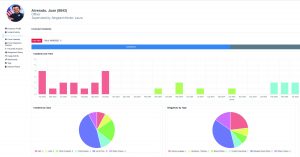
The core platform of the suite, IAPro, which is used by more than 1,100 agencies worldwide, provides a structured system for managing internal affairs and professional standards cases. Supervisors and command staff can streamline investigations, manage caseloads, and deliver advanced analytics on disciplinary actions, trends, and clearance rates.
IAPro’s frontline companion, BlueTeam, allows officers and supervisors to document incidents digitally and in real time. This paperless solution improves accuracy by capturing details while events are still fresh, reduces administrative duplication, and ensures reports are routed automatically for supervisory review. For officers, this means less uncertainty about whether reports were received or processed; For supervisors, it creates a consistent, auditable workflow.
The addition of EIPro reflects a growing recognition within the policing profession: Accountability and wellness are closely linked. Using real-time peer group analysis, ElPro identifies statistical outliers relative to comparable roles and assignments. This enables earlier awareness of patterns that may signal the need for intervention, training, or support, often before issues escalate.
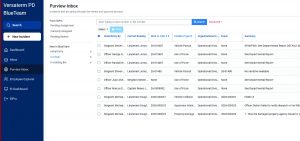
The workflow begins when staff or community members submit incidents and feedback through Public Portal, which are then routed to the appropriate intake supervisor for review. Public Portal is a public-facing website that extends beyond the agency by providing a transparent, structured way for community members to submit compliments or complaints and track their progress. This visibility helps reduce confusion, improve communication, and reinforce public confidence in how agencies handle feedback.
As systems like these become more embedded into daily operations, professional standards no longer exist solely within internal affairs. They become part of routine policing. Over time, that daily accountability intersects with another critical reality of police work: cumulative stress and trauma exposure.
The Weight of Calls
Every call for service leaves an impression. While individual incidents may seem manageable, the cumulative effect of repeated exposure to trauma can quietly shape an officer’s well-being, behavior, and long-term career. Whether they are officers, dispatchers, or support staff, historically, the expectation was that personnel would recognize when they were struggling and ask for help on their own. “However… many public safety professionals will continue to serve quietly through significant stress and trauma due to the culture of endurance and service that defines the profession,” said Reuben Ramirez, the strategic industry advisor of health and wellness at Versaterm.4
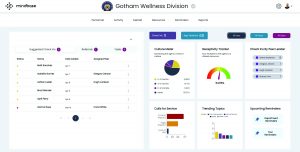
Versaterm Mindbase was developed to address this gap by providing visibility into cumulative exposure rather than relying on self-reporting. The platform integrates directly with existing computer-aided dispatch and records management systems to identify high-impact or potentially traumatic incidents automatically. Over time, the data build a picture of exposure patterns at the individual and organizational level.
This information is processed and displayed through an intuitive dashboard that indicates when proactive check-ins from peer support or wellness coordinators may be appropriate. This shifts wellness support from a reactive model to an approach that is thoughtful, timely, and normalized, ensuring outreach happens before stress compounds into burnout or crisis. “If we continue to wait for officers to come forward and tell us when they’re struggling or when a call is affecting them adversely, we’re never going to move the needle in the crucial space of officer health and wellness,” said Ramirez. The Mindbase app delivers wellness resources directly to personnel in a secure, accessible format. Content is designed specifically for first responders and supports individuals before, during, and after exposure to stressful events.
Mindbase has changed how wellness conversations occur within agencies. Exposure to traumatic events is no longer an abstract concept or something discovered after the fact. It becomes measurable, visible, and shared, allowing responsibility for wellness to shift from the individual to the organization.
Beyond the Assigned Shift
Off-duty employment has long been an important opportunity that supports officer income and community safety. Yet for many agencies, off-duty programs have operated separately from other personnel systems, creating administrative burden and limited visibility.
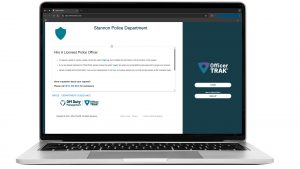
OfficerTRAK, developed by Off Duty Management, was created to bring structure, oversight, and efficiency to off-duty work. Founded by individuals with extensive law enforcement experience, the company designed its platform to be free to public safety agencies and to reflect real agency policies, collective bargaining agreements, and operational needs.
From job requests and vetting to scheduling and invoicing, OfficerTRAK manages the entire off-duty life cycle. Agency-specific rules governing allowable venues, staffing levels, supervisory requirements, and hour limits are automated directly into the customizable system. For officers, the platform provides a straightforward way to view, select, and manage off-duty assignments via mobile devices. For administrative staff, web-based dashboards offer real-time and historical visibility into when and where off-duty work is occurring. During large events, interactive map-based views enhance situational awareness and coordination.
By handling payroll, billing, and collections—and providing general liability insurance and state statutory workers’ compensation coverage—OfficerTRAK reduces financial risk for agencies while ensuring officers are paid promptly. It closes a long-standing gap by incorporating off-duty work into broader workforce analysis.5
Supporting the Profession
While these tools address different aspects of personnel management, they share a common aim of strengthening policing by supporting the people who serve. Modern personnel management products do more than streamline administration; they influence culture, wellness, and trust.
As the policing profession continues to evolve, effective personnel management will remain central to its future. Agencies that invest in tools designed for the realities of modern policing are better equipped to adapt, retain talent, and maintain public trust. The work behind the badge is complex and supporting it effectively has become a core responsibility across the profession.d
Notes:
1NEOGOV, The Fragile Future of Recruitment: 2024 Public Sector Hiring Report.
2Ryan Stiltz (detective, Cobb County Police Department), email interview, March 27, 2026.
3Steve Gatterman (product and training specialist, Versaterm IAPro), email interview, April 3, 2026.
4Reuben Ramirez (strategic industry advisor health and wellness, Versaterm), email interview, April 3, 2026.
5Brian Manley (president, Off Duty Management), phone interview, April 1, 2026.
Source ListPlease click on the companies’ names to go to the companies’ websites. |
|
|
49N, A Division of Techwerks LLC CRIMEWATCH Technologies, Inc. eSOPH by Miller Mendel, Inc. Ferretly International, Inc. |
Off Duty Management Performance Protocol PowerDMS by NEOGOV Versaterm |
Please cite as
“Managing the Profession from Within,” Product Feature, Police Chief 93, no. 5 (May 2026): 48–51.