

Walk through any major investigation today and somewhere in the case file, there’s likely a vehicle involved. Whether a suspect was driving one, a victim was in one, or a witness saw one—that vehicle is no longer just a vehicle. It’s a rolling data source.
Just like mobile phones, cars are an integral part of life. They go everywhere with us, connect to our devices, and record what we do. For investigators, a vehicle’s infotainment data can be a gold mine, answering some of the most important questions in a case: Where was the suspect? How long were they at a location? What were they doing at the time of the incident?
Modern infotainment systems hold three key categories of evidence that can play a pivotal role in an investigation:
1. Where the vehicle went: GPS points, historical coordinates, and trip logs can place vehicles at a crime scene and help build the sequence of events leading up to and following an incident.
2. Who was in the vehicle: Paired-device information with contacts, text messages, and call logs can link individuals to the vehicles under investigation.
3. How the vehicle was used: Events, actions, and system interactions show what happened in and around the car at key moments.
When overlaid with mobile data, call detail records, automatic license plate reader hits, and warrant returns, vehicle data can help reconstruct timelines, confirm involvement, and corroborate statements from suspects and witnesses.
And yet, in many agencies, critical vehicle data is still being left unexamined.
Why Vehicle Evidence Gets Overlooked
Most examiners know the value of vehicle data. The challenge is that until recently, getting to the data has been one of the hardest, slowest, and most damaging things a forensic lab can do.
The most invasive legacy approach to acquiring the evidence requires physically removing the infotainment unit from the dashboard, disassembling it, and performing a chip-off extraction. Police leaders have described single vehicle cases routinely consuming days of skilled examiner time before any data is reviewed. Another agency had to absorb the cost of replacing an infotainment unit after a destructive extraction yielded no usable evidence, and the case did not move forward.
It’s not surprising that many agencies don’t see vehicle data extraction as a viable option.
The Risks Most Police Leaders Aren’t Tracking
For police leaders, the risk side of the equation deserves a closer look.
When destructive extraction damages a vehicle that belongs to a victim, a witness, or an owner who is ultimately not charged, the agency is often the one that pays for the replacement. Modern infotainment systems can run several thousand dollars per unit before labor costs for installment are added.
Destructive extraction also concentrates vehicle casework in the hands of a small number of specially trained examiners. Chip-off extraction requires specialized hardware, soldering skills, and experience that takes years to build. Many agencies don’t have anyone with that skill set on staff, and even those that do see vehicle cases stall when the few qualified examiners are unavailable.
There’s also the risk to the lab itself. Every long, destructive extraction is examiner time not spent on the phones, computers, and cloud accounts backlogged in the queue.
Skipping vehicle forensics carries its own risk: cases that move forward without evidence the vehicle could have provided, timelines with gaps in them, and answers sitting in the evidence yard.
The Technology Keeps Advancing
The deeper challenge is that vehicle technology is evolving along the same path mobile devices have already traveled. Today’s infotainment systems leverage the same kinds of data encryption that protect modern smartphones. As infotainment systems become more advanced, the value of the data they hold continues to grow. So do the barriers to acquiring data through legacy methods.
Modern cases are often built from more than one device or data source. Investigators are building timelines from phones, cloud accounts, surveillance video, IoT devices, and vehicles all at once. The strength of a case comes from how those sources line up. Without vehicle data, that timeline is missing one of its richest sources and teams can’t see the full picture.
A Better Path Forward
Modernizing vehicle forensics does not require building a dedicated chip-off program or training a new generation of specialists. Examiners and investigators need a workflow that brings vehicle data within reach as a routine part of every digital investigation.
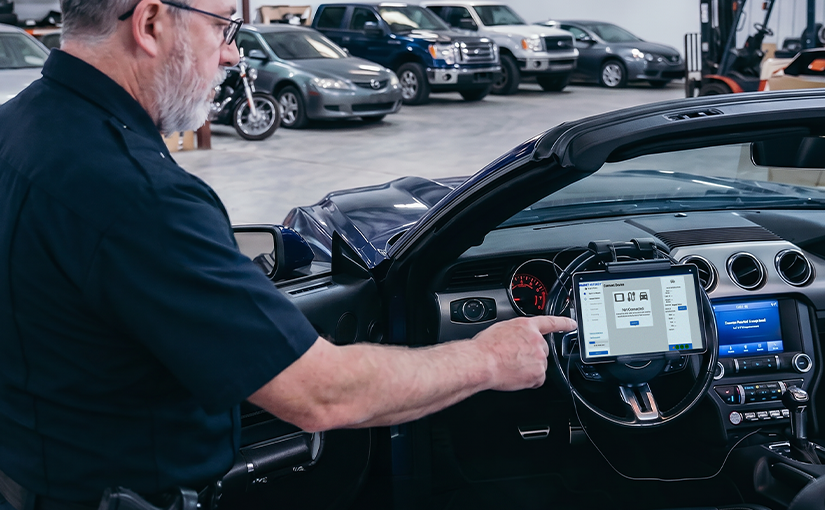
Modern vehicle forensics solutions are changing what’s possible. Magnet Autokey, for example, plugs directly into the vehicle’s USB port, extracts evidence in minutes rather than hours. It removes the need for specialized vehicle forensics expertise, so more examiners can perform an acquisition. These types of solutions bring vehicle evidence within reach of far more labs than chip-off ever could. And they place vehicle evidence into the same review and analysis environment as the rest of the case.
The result is a fundamentally different approach. The vehicle stays intact. The case timeline comes together in one place. And evidence that used to be left unexamined makes its way into the record where it belongs.
Access to the right data at the right time is increasingly what determines how quickly the truth comes into focus. Bringing vehicle evidence into investigations earlier helps investigators move faster, collaborate sooner, and accelerate the path to justice for the victims and communities they serve.
For police leaders, the question is no longer whether vehicle data belongs in modern investigations. It already does. The question is how quickly and efficiently the agency can acquire it—and whether the answers waiting in the evidence yard make it into the case.
| Founded in 2010, Magnet Forensics is a developer of digital investigation solutions that acquire, analyze, report on, and manage evidence from digital sources, including mobile devices, computers, IoT devices and cloud services. Magnet Forensics products are used by more than 6,000 public and private sector customers in over 100 countries and help investigators fight crime, protect assets, and guard national security. To learn more about how Magnet Autokey is helping agencies bring vehicle evidence into modern investigations visit magnetforensics.com/products/magnet-autokey. |