
Dialogue to Drive Public Safety
How the Columbus Model Is Redefining Public Order Policing
When civil unrest swept across the United States in 2020, the scale and intensity of demonstrations rivaled anything seen in decades. Nearly every major city experienced conflict that strained relationships between police and the communities they serve. Columbus, Ohio, was no exception. The legitimacy of the Columbus Division of Police (CPD) was challenged, and the events of 2020 fundamentally reshaped expectations for how public order policing must operate in a modern democracy.
 In the aftermath, after-action reviews, civil litigation, and public pressure forced a meaningful reassessment. A federal court injunction ultimately restricted CPD’s ability to rely on long-standing tools, such as tear gas, knee-knockers, wooden batons, and other traditional crowd control devices. The message was clear: The historic model was no longer acceptable. The public demanded a new strategy.
Chief Judge Algenon Marbley of the U.S. District Court for the Southern District of Ohio issued a federal injunction against CPD in Alsaada v. City of Columbus. The injunction prohibited the use of tear gas, pepper spray, flash-bang grenades, wooden and rubber projectiles, and batons during protests. It also required officers to keep body-worn cameras activated and badge numbers displayed at all times, including while in riot gear. These restrictions significantly limited the CPD’s ability to rely on traditional crowd control tactics and required an immediate shift in approach.
The Columbus City Council codified these requirements into city code to ensure they remained in place regardless of future leadership changes. As part of that transition, CPD formally removed batons from its public order response—physically destroying them—marking a clear departure from prior practices. These legal and policy changes did not just influence the Columbus Model; they forced its development, pushing the CPD toward a strategy built on communication, facilitation, and proportional response rather than force.
In response, CPD updated its Division Directives and Emergency Operations Manual to reflect these legal constraints. The policy shift moved away from crowd control tactics and toward a model focused on targeted enforcement, with use of force tied directly to lawful arrests and a communication-driven response. [/pullout-wide]
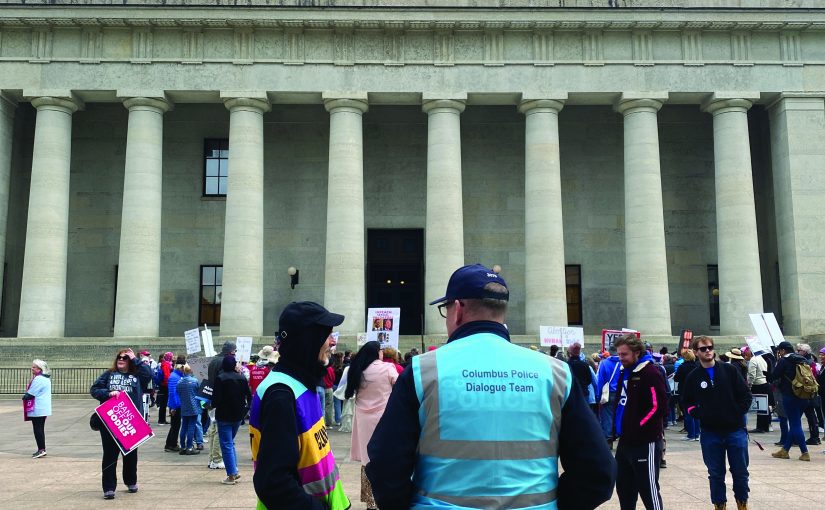
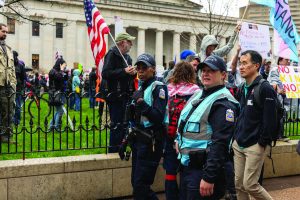
As the 2020 demonstrations continued, CPD recognized that its existing strategy was often too reactive and escalatory. The CPD began to experiment with a different posture—officers in traditional, non-tactical uniforms walking within the crowd and engaging people directly. An after-action review conducted by the John Glenn College of Public Affairs at the Ohio State University (OSU) later captured protesters’ perspectives on this shift, noting that “protesters we interviewed felt that police in traditional, non-tactical uniforms walking among, and engaging, protesters directly was effective in calming tensions between the two groups.”1 That independent assessment confirmed what officers were experiencing on the ground—when police focused on dialogue, tension decreased and escalation became far less likely.
Columbus set out to find a better way forward and, in doing so, helped build what is rapidly becoming known as “the Columbus Model.”
In order to access the rest of the article, sign in with your IACP or Subscriber credentials.