

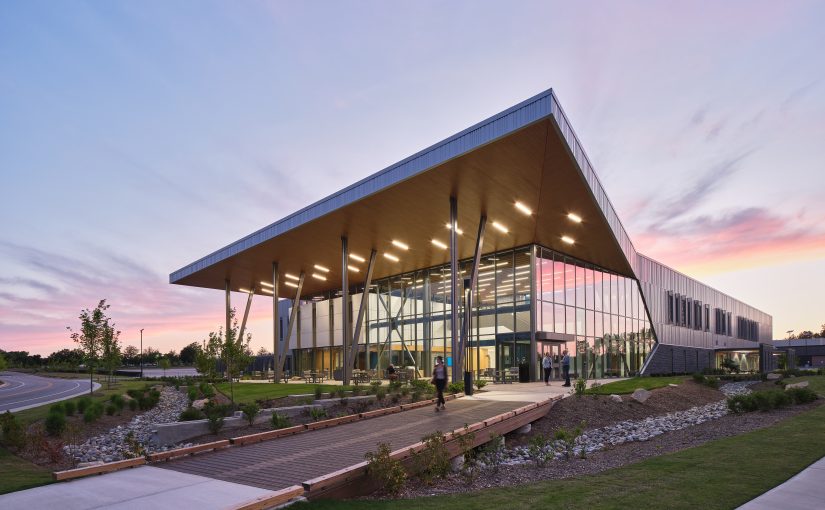
As policing evolves over the 21st century, so does training. The mental, physical and tactical training available to officers today vastly differs from even a decade ago. Improved virtual reality (VR) and advanced immersion technologies allow for officers to be better prepared for real-life scenarios. Trends in policing require a different kind of physical and spatial environment, integrating crisis intervention and de-escalation techniques with traditional skills-based learning.
From a modest renovation to an all-new training facility, architecture and technology can work together to create spaces and opportunities that enhance training outcomes. Modern facility design and best practices in skills instruction can increase confidence, increase retention of learned knowledge, improve recruitment campaigns, and enhance community relations.
When tackling a building project aimed at improving training, three key areas to consider include access, reality-based training, and health and wellness.
Spaced Learning to Optimize Training Outcomes
Across industries and areas of learning, research shows that “spaced learning” is the most effective way to learn.1 This means that the best learning experiences occur when the learners receive training in frequent, often short segments, repeatedly over a period of time. To put this another way, studying a little bit each week rather than cramming at the end of semester will yield better results. This approach also keeps the subject matter at hand more directly in the mind of the officer while on the street. For police, spaced training contributes to retention, application, and successful outcomes on the streets.
Assessing Training Demands in Terms of Distance, Time, and Facility Availability
Many factors can limit the ability to implement spaced learning, including the travel required for various courses, the amount of time personnel spend away from field duties, the elimination of distractions, and the availability and suitability of training facilities.
A comprehensive inventory of the full training plan—evaluating how far attendees must travel, how long they are away from operational responsibilities, and what those hours represent in salary—provides a picture of where to prioritize both training budgets and facility investments. This type of assessment also equips facility design teams with a deeper understanding of the department’s training needs and pressures. By reviewing each training session in relation to its location and physical environment, design teams can better evaluate not only the efficiency of the department’s use of time and resources but also how effectively the environment supports desired training outcomes. For instance, do officers have to travel 40 miles one way to a shooting range, only to train without the ability to employ group movements, 180-degree shooting, or the use of vehicles during training sessions? Is that that travel time well spent? Not really, if the facility doesn’t enable officer training to be held with the real world in mind.
Such an inventory ultimately reveals the real financial impact of properly training personnel and highlights opportunities to improve both the learning experience and the infrastructure that supports it.
Breaking Down Access Barriers with Technology
Technology can help reduce barriers. Many departments seek classrooms equipped to support remote training to expand access to high-quality instructors from across the country (or even around the world) while still allowing for in-person sessions that strengthen internal collaboration. Other technologies and space support informative cross-agency or multijurisdictional emergency management exercises, which often require audiovisual solutions different from those used in standard classroom environments.
When these needs are discussed collaboratively with the design team, each instructional format—whether a classroom lesson, a hands-on exercise, or a multiagency simulation—can be enhanced through thoughtful technology integration and spatial planning. The overarching objective is to remove barriers to participation, broaden access for instructors and learners alike, and expand the range of training experiences the department can effectively deliver.
From Classroom Training to Reality-Based Training Environments
Reality-based training immerses participants in realistic, scenario-driven environments to develop technical skills and to improve decision-making and critical thinking. Unlike traditional classroom learning, reality-based training uses simulations, role-playing, and hands-on exercises that closely replicate real-world situations that participants are likely to encounter in their professional roles. Training scenarios might include mock car stops or domestic situations, crisis negotiations, medical simulations, or tactical exercises, all designed to mirror the complexity and unpredictability of actual events.
The benefits of reality-based training are well-documented.2 It provides officers with the necessary tools to prepare for physically or psychologically difficult scenarios in a safe environment. Trainees receive real-time feedback about functioning in stressful situations, improving their actions and performance in the field.
VR and Augmented Reality Training Tools
A state-of-the-art decision-making simulation lab allows for immersive, scenario-based training that replicates real-world situations within relatively small footprints (usually between 600 and 1,300 square feet).
At the North Metro Public Safety Training Facility in Minnesota, the simulation lab allows officers to face real-time scenarios with life-size video and realistic audio. The trainer controls the scenario, so an officer might encounter a person in a mental health crisis in one iteration and an aggressive subject in the next. Other goggle-based technologies exist that emphasize enhanced reality to replicate decision-making scenarios. Still others rely upon images projected on walls and audio reinforcement to provide contextual realism for live role-playing scenarios. Each technology requires careful consideration of lighting, trainee flow, equipment configuration, storage requirements, acoustic isolation and absorption, and floor finish materials. For best results, these spaces should be considered black box environments designed for the technology to shine.
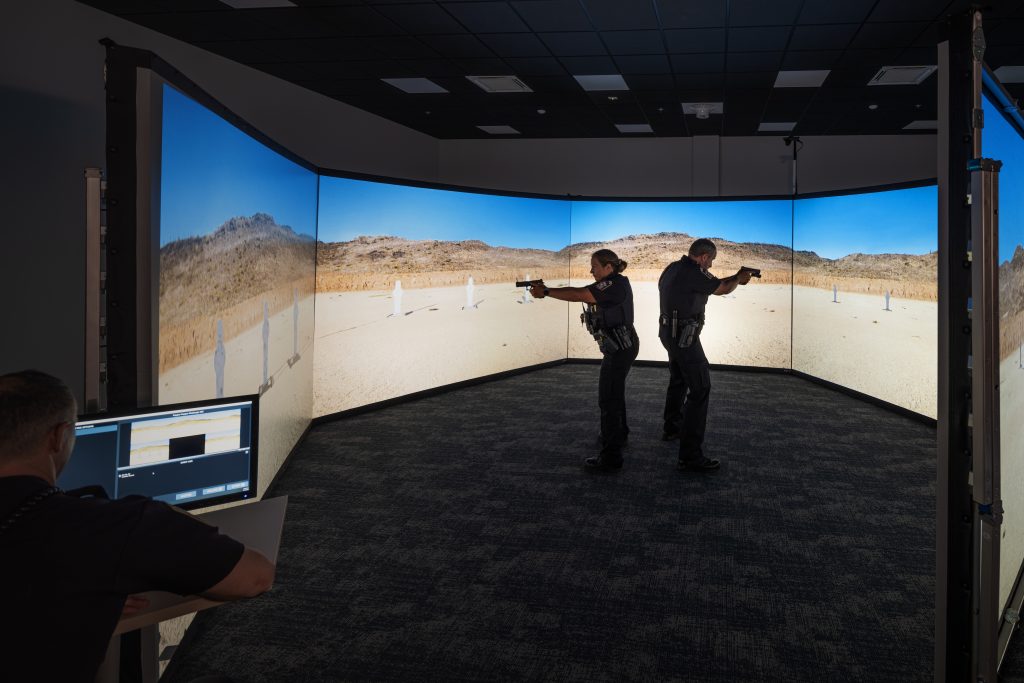
VR equipment can range in cost from $50,000 to $500,000 or more, not including the cost of the space to use the equipment. Federal grants can help pay for the equipment, or neighboring agencies can work together to offset the costs through rental usage or capital contributions. In smaller to midsized agencies, this equipment may not be fully utilized even with expanded training programs, so it can be judicious to find partners that can benefit and help pay for the equipment or utilize the available training hours to augment the investment. If sharing space and equipment makes sense, consider the location of the room and storage of accessories to allow visiting agencies to access shared equipment and spaces without interrupting day-to-day operations.
A 2025 study in Scientific Reports found that VR-based training “considerably enhances safety knowledge, risk perception, and overall performance compared to traditional training techniques.”3 However, considering the speed at which these technologies are changing, departments may want to consider leasing options that allow for the ability to adapt to emerging technologies without being tied to equipment that eventually become expensive places for coats to hang.
Hands-On Reality-Based Training
At Wake Tech Community College in Wendell, North Carolina, the Public Safety Simulation Complex features a signature indoor streetscape designed to provide immersive, reality-based training for first responders. This full-scale, two-story simulation village is designed to include a real streetscape that accommodates fire trucks, ambulances, and police vehicles, complete with sidewalks, curbs, gutters, and overhead obstacles. The streetscape is lined with simulated urban environments such as a bank, retail spaces, a school, a two-story town home, and a hotel with a bar and restaurant. The design incorporates realistic furnishings, props, and environmental controls. Many of the structures are permanent, but within each are opportunities to change the scene simply by reconfiguring furniture or entering the scene from a different door. Integration of modular wall systems in the facility also allows for the creation of new scenes once a situation has played itself out with departments. The facility provides opportunities for multiagency command training and supports a wide range of scenarios, from de-escalation and crisis response to tactical operations and community engagement.
The streetscape is a central element in preparing police, emergency medicine, and fire professionals for the complexities of real-world emergencies in a safe, controlled environment. Often overlooked, sound and lighting design induce physiological arousal by providing additional complexity and varied realities within a training scenario. Sound can be a powerful inducer of stress. Noisy traffic, a baby crying, people shouting, or sirens blaring can dramatically raise the stress levels of the trainee. Adding and varying these types of inputs have been shown to significantly improve an officer’s ability to learn decision-making skills, perform more optimally under stress and adapt to a variety of situations.4 This will put the trainee in a better situation the next time the officer finds themselves in a similar real situation.
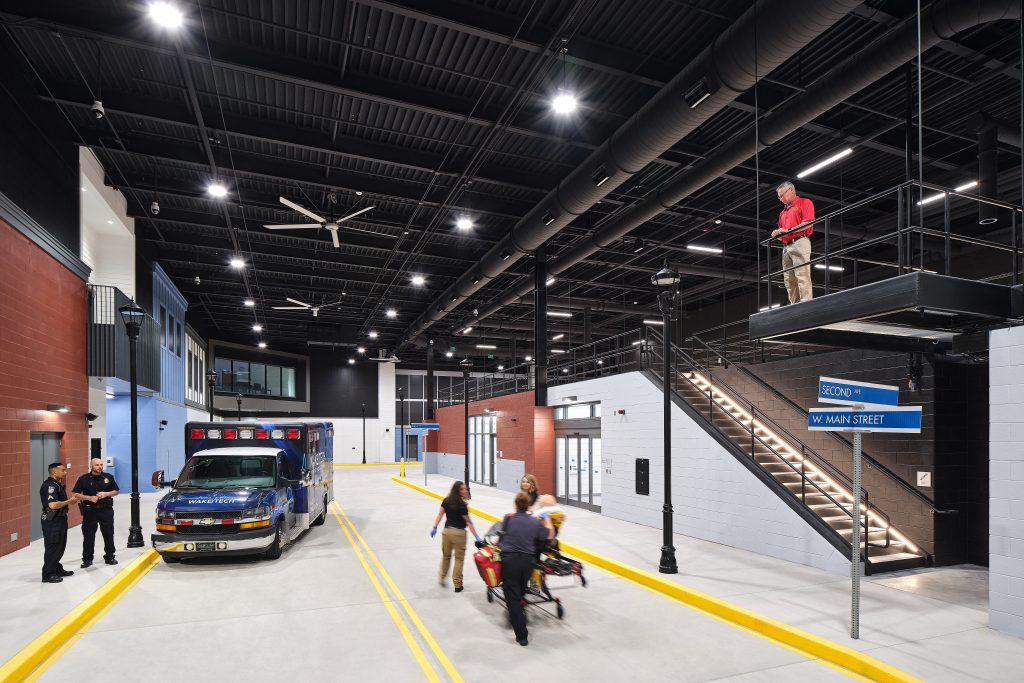
The nature of this type of facility—open and applicable to different kinds of first responders—means that police, firefighters, EMTs, and others can all train together to ensure smooth operations in a crisis but also allows for simultaneous, separate training events. Whether in a community college setting, police station, or a multijurisdictional facility, design that allows for multiple agencies to train at the same time without interrupting each other while still allowing for larger cross-agency training is essential to the fiscal performance of the facility. While rarely built to function as a money-making enterprise, the fiscal responsibility of facilities like these lies in their utilization. Each training opportunity designed into the facility, whether it is a reality-based training exercise grounded in a mock environment, shooting ranges, a mats room, or a VR space, should be able to function independently so as not to inhibit others from training at the same time. This extends to the check-in process and navigation to the training areas.
Reality-Based Training on a Smaller Scale
Realistically, most departments don’t have the space or funds to build an entire streetscape. There are other opportunities to bring advanced training spaces into a department on a smaller scale.
Dedicated mats rooms are simple, safe solutions that can enhance training both in a traditional sense and in new ways to expand on defensive tactics or force-on-force skills training. Providing a dedicated room saves set-up time to bring mats into a classroom or worse, into a garage, where air quality is likely poor. A space carefully designed with wall padding and wall-to-wall recessed floor mats protects trainees from unnecessary exposure to injuries and eliminates the risk of combaters carrying an exercise off the mats and onto a hard surface. Ample adjacent storage keeps training props from causing tripping hazards during training. Other basic things to consider include providing a space for floor scrubbers and cleaning supplies to keep the floor mats clean and hygienic and providing a vestibule or nook for walk-off flooring material to keep shoes clean and the mats in good shape.
Technology can enhance the training experience. Monitors placed high on each wall provide access for trainers to play short instructional videos or present scenarios to set a scene for trainees, allowing them to understand the situation for which they are training. Robust audio equipment allowing environmental or acoustic “stage setting” again creates an immersive experience amping up the trainee’s tension levels. Acoustic ceiling and wall treatments above the wall mats also help instructors clearly verbalize instructions. Dedicated mechanical equipment and ceiling fans also keep trainees comfortable. Last, controlled lighting and emergency lighting installations aid in creating realistic scenarios for training.
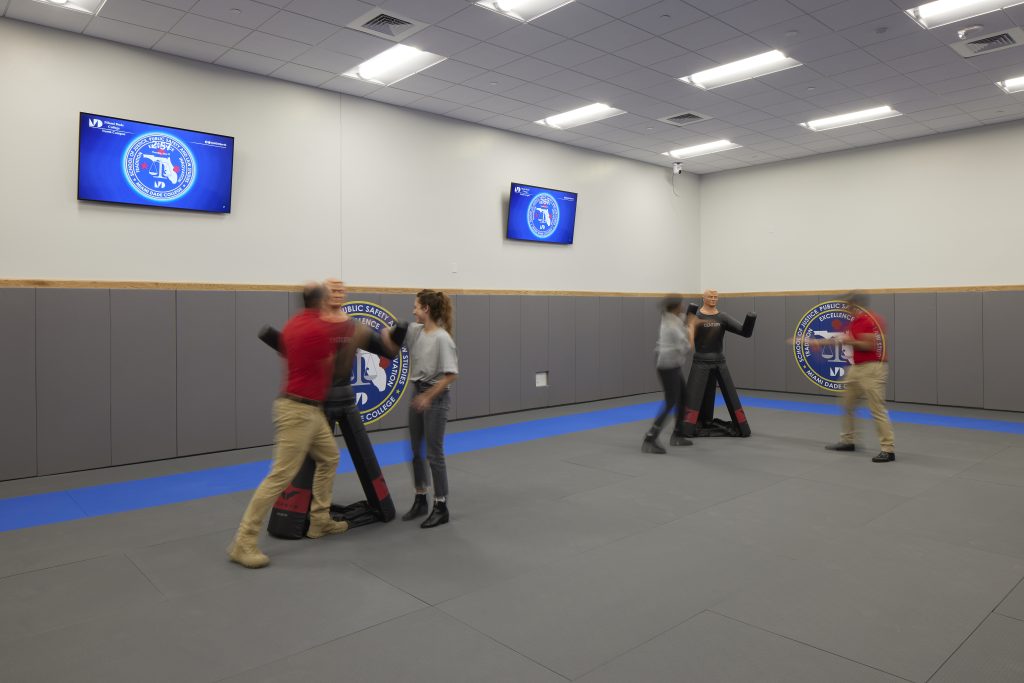
Beyond equipping the room properly, mat room placement can drastically expand training opportunities. Multiple door placements (center fed and corner fed) into the mats room from a hallway or adjacent room that can be used to add room-clearing techniques into the training curriculum without needing additional space. If space allows, a VR room adjacent to the mats room allows one training scenario (virtual) to transition into another (physical), expanding and varying the types of instructional techniques available to instructors.
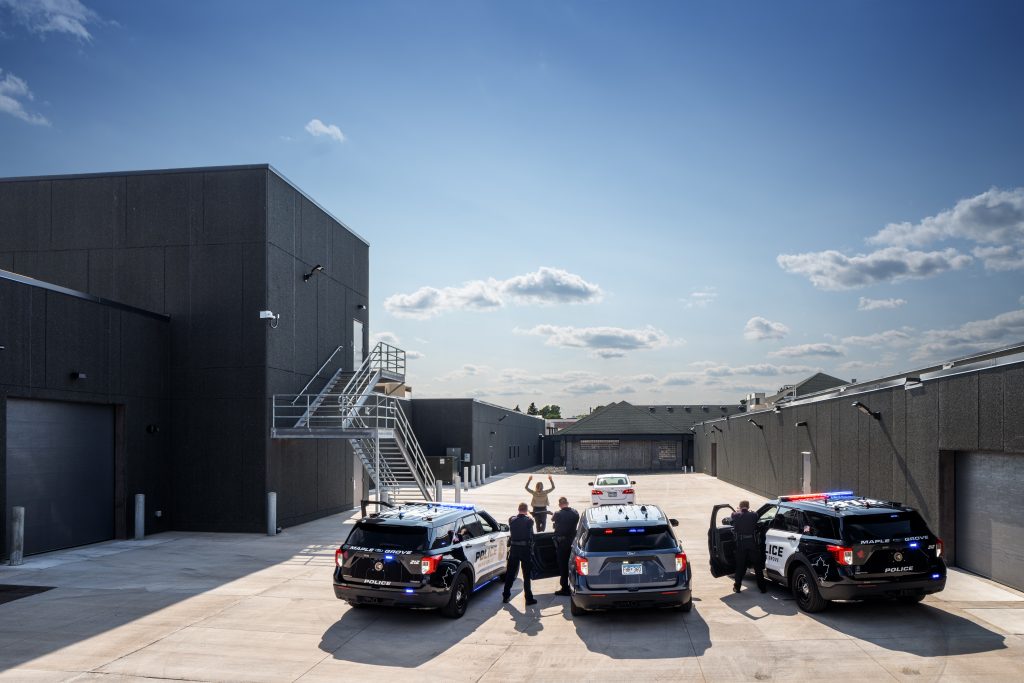
While it is not recommended to have a mats room directly accessible to the exterior to avoid bringing in dirt and debris from the outside and onto the mats, having a small to medium room outfitted with a few modular wall panels and directly adjacent to a secured exterior parking lot offers door-breaching or room-clearing training opportunities, as well as building approaches and situational training. An exterior space, shielded from the public either as part of the building exterior or by fencing can allow for in-house vehicle stop training, building approaches, or field force operations. Fire station designers for years have been building training opportunities into fire station design to utilize the station itself in simple ways that create inexpensive training opportunities. The preceding ideas for using in-house space are similar, keeping officers closer to home and cutting down on accessibility issues and travel costs.
Incorporating Drones and Other Emerging Technology
As much as policing has changed in the past few decades, newer technologies and trends are still continually evolving. A modern training facility should be technologically and physically flexible to accommodate future needs.
“Designing a public safety training space for the future requires a holistic approach that balances technological innovation, operational flexibility, the well-being of trainees, and community needs.”
Many departments and training facilities are incorporating space for drones or unmanned aerial vehicles, and robotics. Today, agencies are using drones for search and rescue, crime scene photography and reconstruction, investigating armed suspects, disaster response, traffic collision reconstruction, and more.5 As the drone/robotics industry advances, there will likely be more police uses. Dedicated repair, maintenance, and training space means that officers will be more comfortable with the technology when the time comes to use it. The Wake Tech facility’s planned drone room includes space for base operations, drone practice, storage, and training within the simulation streetscape space described previously.
There will be technological advances that have yet to be even imagined. Ensuring flexible technology infrastructure will enable nimble adoption of future robotics, virtual/augmented realities, or other technologies as they become available.6
Mindfulness, Wellness, and Officers
Wellness elements can help a training facility inspire teamwork and build trust within a department and in the community. As reality-based training inserts more stress into the training process, those trainees require spaces to reflect upon what was experienced. Space to examine performance in small and large groups or to discuss how the emotional aspect of the job is important to the learning process. Further, easy access to water, ice, and nutritious food prioritizes the importance of hydration and metabolic health during times of exertion and stress, reducing burnout and contributing to the overall effectiveness of public safety personnel.
Community
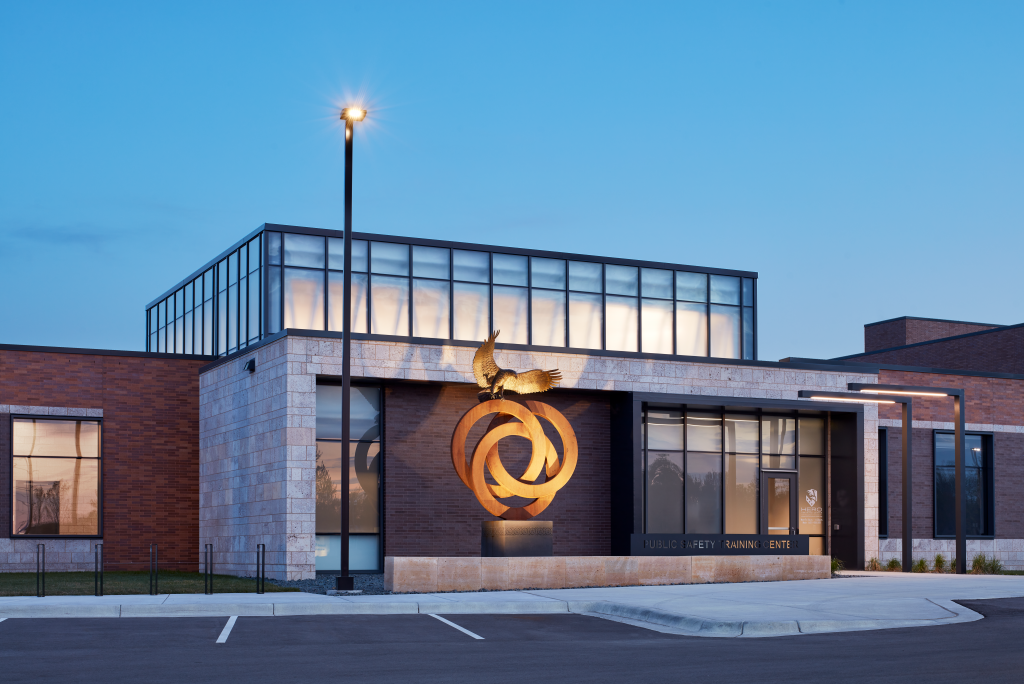
These facilities can create connections to the community if designed as inspiration, feeding continued improvement. Many scenarios involve “extras” or role players. Most of the time these individuals come from within police circles, but on occasion, they come from the public. What if these participants were invited into a facility that showcases learning with a focus on community safety? For external visitors, training facility design can enhance overarching community engagement goals. For trainees, reminders of the importance and goals of training can be highlighted through design that favors elegance over militarism and the use of symbolism thoughtfully implemented throughout the facility.
A Facility for Modern Policing Needs
Designing a public safety training space for the future requires a holistic approach that balances technological innovation, operational flexibility, the well-being of trainees, and community needs. By prioritizing access—both physical and virtual—departments can ensure that training is available to be held often and adaptable to the evolving needs of police professionals. Integrating audio/video technologies, virtual and augmented reality, modular design elements, and dedicated spaces for emerging tools like drones not only enhance the realism and effectiveness of training but also prepares officers for the unpredictable challenges of modern policing.
Flexible facility layouts and infrastructure also ensure that training environments can evolve alongside advancements in technology and best practices, future-proofing investments for years to come.
Finally, a thoughtfully designed training facility serves as a bridge between the police and the community. Modern and accessible spaces (when appropriate) can foster public trust, encourage community engagement, and demonstrate a department’s commitment to progressive, responsible policing. Ultimately, strategic facility design is about empowering public safety professionals to serve their communities with skill, empathy, and confidence. d
Notes:
1Robert Anderson et al., “Optimal Training Frequency for Acquisition and Retention of High-Quality CPR Skills: A Randomized Trial,” Resuscitation 135 (2019): 153–161.
2Ernest Fitchett, Reality Based Training and Its Importance to Law Enforcement (The Bill Blackwood Law Enforcement Management Institute of Texas, 2016).
3Yousef Qawqzeh et al., “Exploring the Effectiveness of Virtual Reality-Based Training for Sustainable Health and Occupational Safety in Industry 4.0,” Scientific Reports 15, no.1 (2025): 28930
4Simon Baldwin et al., “A Reasonable Officer: Examining the Relationships Among Stress, Training, and Performance in a Highly Realistic Lethal Force Scenario,” Frontiers in Psychology 12 (2021): 759132; Judith P. Andersen et al., “Highly Realistic Scenario Based Training Simulates the Psychophysiology of Real World Use of Force Encounters: Implications for Improved Police Officer Performance,” Journal of Law Enforcement 5, no. 4 (2016): 1–13.
5Police Executive Research Forum (PERF), Drones: A Report on the Use of Drones by Public Safety Agencies—and a Wake-Up Call About the Threat of Malicious Drone Attacks (Office of Community-Oriented Policing Services, 2020).
6PERF, Drones: A Report on the Use of Drones by Public Safety Agencies.
Please cite as
Todd LaVold, “Enhanced Training Through Facility Design,” Police Chief Online, July 7, 2026.