
Police and military personnel are prepared for high-risk, quick-reaction operations through tactical training, a meticulously planned practice of teaching. To increase the chances of operational success and physical safety in challenging circumstances, team members must be able to act quickly and decisively.
Although tactical training is crucial, many leaders might not understand the specific techniques and planning required to prepare their teams for the high-pressure decision-making they encounter in real-world settings. There is more required than technical expertise alone to react correctly under duress; resilience to physiological stress and extraordinary cognitive agility are also necessary.
The Los Angeles, California, Police Department (LAPD) and industry leaders have highlighted in recent definitions that 21st-century tactical training goes beyond physical skills such as defensive tactics and firearm proficiency. The latest training opportunities increasingly incorporate cognitive stress inoculation, an essential element that helps responders function well in the face of extreme physiological strain during critical incidents. With this in mind, certain training techniques better prepare tactical teams for the erratic demands of operational environments such as stress inoculation and immersive simulation.
Tackling Real-World Situations
The OODA loop (observe, orient, decide, and act) is a cognitive framework designed to assist practitioners in responding immediately to dynamic threats, and it is a fundamental component of such training. Researcher Lisanne Kleygrewe and her colleagues in the Netherlands claim that immersive simulations are a key aspect of contemporary tactical programs that connect theoretical education with real-world application.1 These courses foster quick situational awareness and de-escalation-first strategies. This method develops more than just technical skills. It also develops mental toughness, legal knowledge, and the capacity to handle complex public safety situations outside of simple use-of-force situations.
The Body’s Response to Stress
One example of the challenges faced by responders in dynamic situations is the body’s fight-or-flight response. Controlled by the sympathetic nervous system, the fight-or-flight response is physiologically activated during a tactical response. The brain’s emotional alarm center, the amygdala, causes the endocrine system to release stress hormones, particularly cortisol and adrenaline, when it senses a threat. This hormonal spike increases heart rate and muscle group oxygenation, preparing the body for instant survival. But the prefrontal cortex, which is in charge of rational thought and conscious decision-making, is frequently taken over by this survival mode.2 This change can compromise the quality of decisions made in complex situations by favoring quick reflexive actions over deliberate thought.
Stress may also cause significant distortions of the senses. Officers may have tunnel vision, which limits their field of vision to a small portion of the surroundings, and auditory exclusion, which causes the brain to focus only on the perceived threat and stop registering background sounds.3 Although these reactions were developed for pure combat effectiveness, they frequently result in a loss of accuracy in basic abilities like handling weapons or using communication devices. As a result, there is a gap between professional performance and biological instinct that must be bridged through specialized tactical training.
Training Officers in Various Scenarios
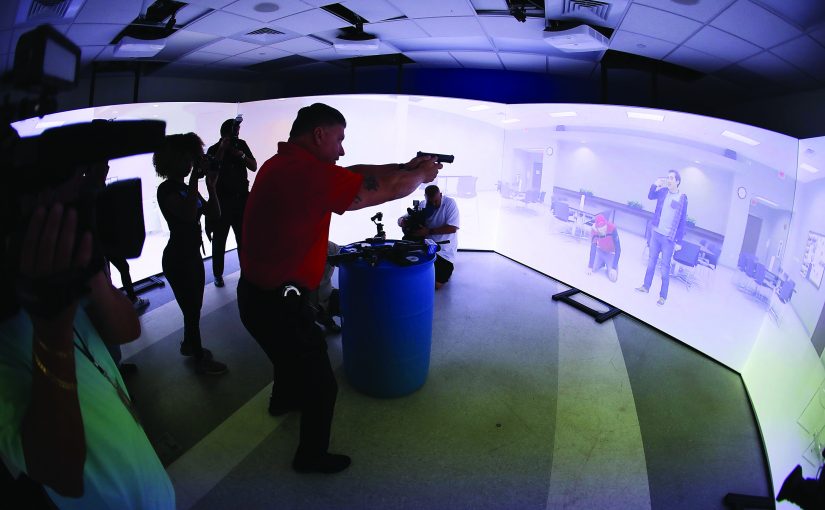
Many police trainings (e.g., SWAT, tactical response, active shooter response) place a strong emphasis on teamwork and the practical application of skills that are essential to tactical success.4 Police agencies are sometimes unable to take advantage of these opportunities due to financial constraints, remote locations, and the high costs of travel, ammunition or gear, and specialized facilities.5 This challenge makes virtual reality (VR) tactical training a ground-breaking, expandable solution. VR makes stress inoculation more affordable by giving officers repeated exposure to life-saving situations to hone their skills in a safe immersive setting.6
“According to some research, VR improves mental focus and subjective stress when compared to in-person exercises.”
In recent years, agencies have experienced problems with recruitment and retention. This may increase as seasoned officers retire or change careers and organizations, increasing the need for field trainers and seasoned staff to train new hires.7 VR is being used by innovators to bridge training gaps, and train-the-trainer models are being used to effectively increase reach.
Police organizations use VR technology to train both recruits and experienced officers in a variety of scenarios and skill sets including mental health crisis response, de-escalation tactics, use-of-force decision-making, tactical communication in high-stress situations, traffic stops, active shooter scenarios, mass casualty events, crisis intervention, building searches, crowd control, hostage rescue, and improving situational awareness under pressure. The wide range of uses highlights VR’s adaptability in resolving practical operational issues.
Immersion VR technology is supplied to local, county, state, federal, and tribal agencies around the globe by a variety of vendors. Each system offers specialized advantages catered to agency needs, through shared core capabilities. Features range from artificial intelligence–enhanced adaptable scenarios to team-based scenarios to large-scale scenarios. While some systems use headsets, some permit officers to wear their own gear, and some use mixed technologies—all allowing police agencies to select the solutions that meet their specific needs.9
VR Offers Safe Training Methods
VR technology has been used by the police for years, giving evidence to its creativity, effectiveness, and affordability. VR provides training in realistic scenarios that are extremely challenging to replicate in real life. It quickly exposes officers to a variety of tactical challenges by condensing a wide range of scenarios into manageable, repeatable sessions. Officers, instructors, and the general public are less at risk thanks to VR training’s safe, controlled environment. Most importantly, VR improves decision-making under stress. Until proficiency is attained, instructors can dynamically alter virtual environments and repeatedly test officers in a variety of complex levels. Resilience under pressure is developed through such deliberate repetition.
According to research, VR can elicit physiological stress responses similar to those of live training, mimicking hormonal shifts and heart rate increases indicative of actual events.10 This feature guarantees that trainees receive valuable experiences that are difficult to replicate elsewhere, making it ideal for continued study and improvement. Additionally, VR enhances communication and de-escalation skills. Officers can practice tactical communication, empathy, and verbal negotiation with suspects, victims, coworkers, and other stakeholders in repeatable team scenarios. During tense situations, this training lessens the need for forceful instruments like guns or tasers. Research shows that incorporating realism, introspection, and repetition into VR exercises improves training efficacy.11
“VR provides controlled settings in which teachers can observe and evaluate how officers manage their stress responses and decision-making under duress.”
VR platforms allow hundreds of officers to receive high-frequency training across a variety of scenarios in less time, despite requiring significant upfront investments in hardware, software, and licensing. Because of its scalability and lower logistical costs, sophisticated tactical training is now available to more agencies, offsetting initial costs. Furthermore, many VR systems collect comprehensive performance data and analytics, enabling agencies to monitor training outcomes and guide ongoing improvements.12
VR has been adopted by large urban agencies with promising outcomes. According to the LAPD survey, 94 percent of trainees rated VR training as excellent, and 72 percent wanted more variety in scenarios.13 Similarly, the Phoenix, Arizona, Police Department found that 81 percent of officers felt more prepared following VR sessions, 60 percent reported improved perspective-taking skills, and more than half used VR-learned tactics during actual service calls.14 These results show that the advantages of VR training are clearly applied in the real world, and officers are satisfied. According to the Dutch National Police, VR scenarios require more mental effort and engagement than similar live exercises.15 Higher engagement suggests deeper cognitive involvement during training, which supports sustained knowledge gains, even though it does not guarantee better results.
VR training offers several benefits, most notably putting officers in stressful, emotionally complex scenarios that are otherwise challenging to replicate. About 80 percent of the 40 officers who participated in a study on mental health crisis response training reported feeling completely immersed, and many described increased empathy. Furthermore, more than half picked up new skills they thought would improve performance in real life.16 A significant difference from conventional training techniques is the emotional impact, which aids in developing useful skills.
The impact of VR scenarios on participant decision-making based on dispatch information was investigated in more detail. Officers performed better than civilians on shoot/no-shoot decisions despite the lack of priming evidence, indicating that VR preserves expertise differences rather than homogenizing responses.17 According to some research, VR improves mental focus and subjective stress when compared to in-person exercises. This could be advantageous because learning efficacy increases with moderate, well-managed stress.18 VR can replicate intense, emotionally charged encounters and give officers multiple opportunities to take different perspectives, according to earlier research.19
Although not all studies produce the same results, the body of research indicates that VR training consistently improves empathy, decision-making, and skill development. Real-time monitoring of physiological reactions is a clear benefit of VR systems. Increases in heart rate and decreases in heart rate variability have been shown in full-body VR simulations aimed to train officers during mental health crises reflect stress responses seen in real-world settings.20 Officers report little discomfort during VR sessions, but electrodermal activity, a measure of sympathetic nervous system arousal, increases. This tolerability is essential for facilitating the repeated exposure required to strengthen skills.
Similar physiological patterns during stressful situations have been observed in more extensive first-responder studies.21 Nevertheless, the collection of physiological data remains limited, indicating a need for further study to improve training in efficiency and realism. By examining officers’ physiological reactions in operational environments, field studies provide context for these findings. Cardiovascular changes are brought on by routine police work: High-priority calls raise the heart rate by about seven beats per minute (bpm), seeing a weapon raises it by bpm, making an arrest raises it by 6.5 bpm, and drawing a firearm raises it by 8.3 bpm.22 Rather than physical effort, psychological stress is the main cause of these reactions. According to a study on lethal force scenarios, officers,’ heart rates could reach 150 bpm, causing tunnel vision and cognitive impairment.23 Importantly, officers who showed quicker or more severe stress reactions tended to perform worse, highlighting the significance of training that exposes them to stress in a controlled, manageable way to develop coping skills. With continuous exposure, research has shown that VR training produces the “stress inoculation” that helps police personnel manage the cognitive and sensory impairments associated with high-stress encounters.24
Effective Tactical Preparedness
In conclusion, VR training is a viable, empirically supported strategy for police organizations looking to enhance productivity, judgment, and operational readiness. Officers embrace VR because it offers a unique combination of physiological monitoring and immersive experience-driven learning. VR can improve readiness, , and the application of skills to real-world situations, according to consistent research findings. Additionally, VR provides controlled settings in which teachers can observe and evaluate how officers manage their stress responses and decision-making under duress. VR training is a reliable and widely used solution as agencies seek scalable, scientifically validated ways to improve de-escalation, crisis response and tactical preparedness. d
Notes:
1Lisanne Kleygrewe et al., “Virtual Reality Training for Police Officers: A Comparison of Training Responses in VR and Real-Life Training,” Police Practice and Research 25, no. 1 (2024): 18–37.
2Lisa M. Dario and Joshua D. Saginor, “Exploration of a Virtual Reality Exercise to Help Train Police with Responding to Mental Health Crises in the Community,” Criminal Behaviour and Mental Health 34, no. 6 (2024): 539–554.
3Hunter Martindale et al., “Can a Virtual Reality Training Scenario Elicit Similar Stress Response as a Realistic Scenario-Based Training Scenario?” Police Quarterly (2023): 1–21.
4National Tactical Officers Association, “NTOA Training Courses.”
5 Axon, “VR Police Training: 4 Benefits and Use Cases for Leveraging VR Training Tools.”
6Axon, “VR Police Training.”
7International Association of Chiefs of Police (IACP), The State of Recruitment & Retention: A Continuing Crisis for Policing—2024 Survey Results (IACP, 2024).
8Axon, “De-escalation Training: What It Is and Why Elite Agencies Prioritize It.”
9Axon, “De-escalation Training”; VirTra, “VirTra Simulators: Immersive Training for the Real World”; FAAC, “Simulators for Combat & Tactical Training”; Operator XR, “Virtual Reality Training Systems for Police and Military”; Paul Grajek, “VR Training Transforms Law Enforcement Preparation,” V-Armed, August 15, 2025; Street Smarts VR, “Air Force Installation and Mission Support Center.”
10Martindale et al., “Can a Virtual Reality Training Scenario Elicit Similar Stress Response as a Realistic Scenario-Based Training Scenario?”
11Markus Murtinger et al., “Sound of the Police: Virtual Reality Training for Police Communication for High-Stress Operations,” Multimodal Technologies and Interaction 8, no. 6 (2024).
12National Urban Security Technology Laboratory, United States Department of Homeland Security Science and Technology Directorate, Virtual Reality (VR) Training Systems for First Responders (2024).
13Joanna Putnam, “LAPD Survey Finds Officers Rated VR Training ‘Excellent,’ Want More,” Police1, March 7, 2024.
14Axon, “How Virtual Reality Is Transforming the Way Phoenix PD Trains.”
15Lisanne Kleygrewe et al., “Virtual Reality Training for Police Officers: A Comparison of Training Responses in VR and Real-Life Training,” Police Practice and Research 25, no. 1 (2024): 18–37.
16Lisa M. Dario and Joshua D. Saginor, “Exploration of a Virtual Reality Exercise to Help Train Police with Responding to Mental Health Crises in the Community,” Criminal Behaviour and Mental Health 34, no. 6 (2024): 539–554.
17Joseph Potts et al., “Virtual Reality for Law Enforcement Training: A Demonstration and Implication for Dispatch Priming,” Police Practice and Research 23, no. 5 (2022): 623–632.
18Lisanne Kleygrewe et al, “Changing Perspectives: Enhancing Learning Efficacy with the After-Action Review in Virtual Reality Training for Police,” Ergonomics 67, no. 3 (2023): 1–11.
19Nicola Barnes, Maria V. Sanchez-Vives, and Thomas Johnston, “On the Practical Use of Immersive Virtual Reality for Rehabilitation of Intimate Partner Violence Perpetrators in Prison,” Frontiers in Psychology 13 (2022): article 787483,
20Juan E. Muñoz, Julie A. Lavoie, and Alan T. Pope, “Psychophysiological Insights and User Perspectives: Enhancing Police De-Escalation Skills through Full-Body VR Training,” Frontiers in Psychology 15 (2024): article 1390677.
21Lucie Leová et al., “Monitoring of First Responders Biomedical Data During Training with Innovative Virtual Reality Technologies,” Big Data and Cognitive Computing 9, no. 10 (2025): article 251.
22Simon Baldwin et al., “Stress–Activity Mapping: Physiological Responses During General Duty Police Encounters,” Frontiers in Psychology 10 (2019): article 2216.
23Simon Baldwin et al., “A Reasonable Officer: Examining the Relationships Among Stress, Training, and Performance in a Highly Realistic Lethal Force Scenario,” Frontiers in Psychology 12 (2022): article 759132.
24Axon, “How Virtual Reality Is Transforming the Way Phoenix PD Trains”; Axon, “VR Police Training”; Baldwin et al., “A Reasonable Officer”; Kleygrewe et al., “Virtual Reality Training for Police Officers”; Grajek, “VR Training Transforms Law Enforcement Preparation.”
Please cite as
Jeanette Loudy et al., “Readying Officers for Reality: Virtual Reality Offers Safe, Effective Tactical Training,” Police Chief Online, August 5, 2026.