


For an understaffed police agency, every decision about where to place an officer is also a decision about which community need must wait. These choices are especially consequential in smaller and more rural agencies, as having limited personnel plays an increased role in different aspects of policing, ranging from emergency response, investigations, traffic safety, school engagement, and community outreach simultaneously. The decision in how police leaders make and communicate those choices can shape not only the agency’s service delivery but also the agency’s reputation, credibility, and standing within the community they serve.
When Capacity Becomes Visible
Police staffing shortages are often discussed in terms of current vacancies, or by the total number of authorized positions within an agency. While those numbers matter, when the veil is lifted, they do not truly represent the capacity in what an agency can place on the street during a given day. Officers may be unavailable due to training, court appearances, injury or illness, military leave, or scheduled time off. Furthermore, others may be assigned to investigations, schools, administrative responsibilities, or other fixed posts within their jurisdiction. An agency that may appear adequately staffed on paper may have far fewer officers available to answer calls for service, conduct necessary case follow-up, and maintain a visible presence in the community that garners attention from the public.
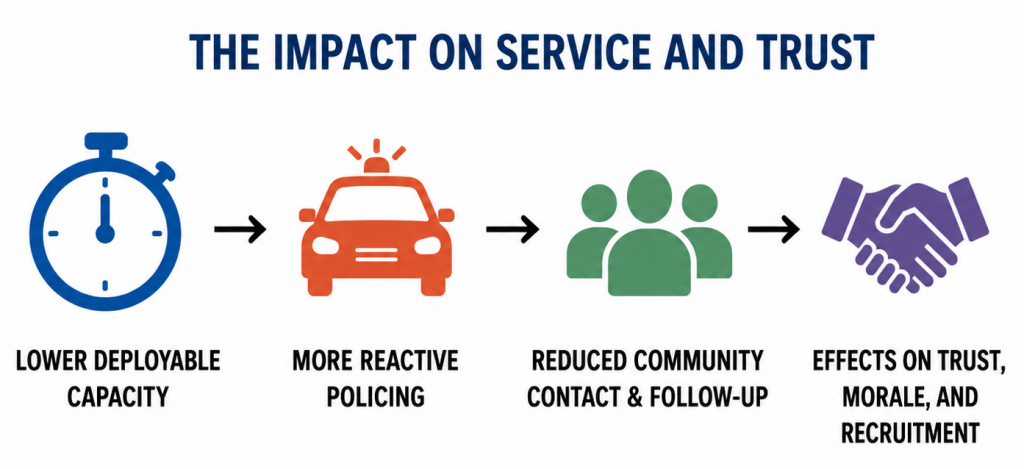
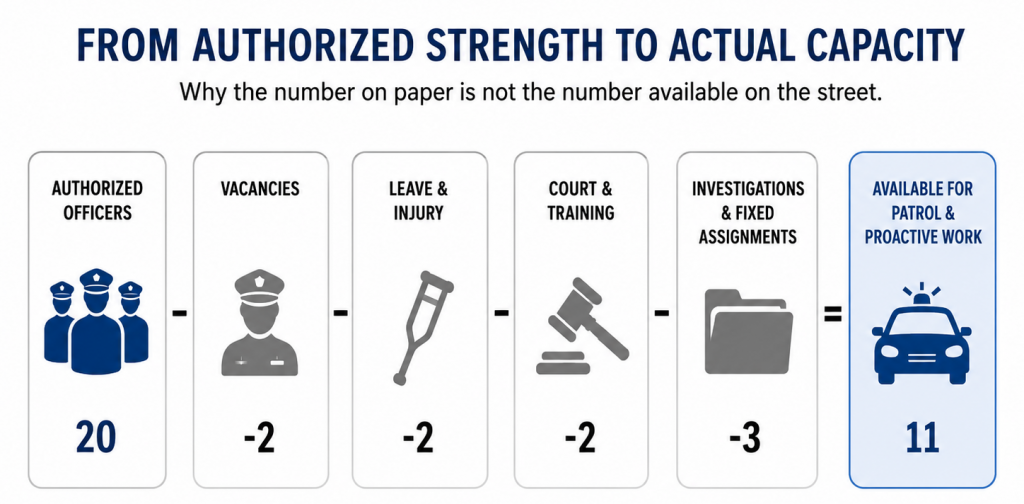 The effects of short staffing become visible as the remaining officers spend a greater share of their shifts moving from call-to-call. The road patrol an agency maintains is paramount, as they are the immediate emergency response. Activities without an immediate deadline, or seen as optional, such as business checks, foot patrols, informal conversations, or community outreach, are often reduced in understaffed agencies as there is not adequate staff to perform them. However, these activities can build familiarity with the members of a community and strengthen relationships before a crisis occurs.
Along with road patrol, an agency’s investigative services feel similar pressures in relation to an agency’s inability to provide adequate staffing. While serious felony or violent criminal cases receive the attention they require, lower-level or misdemeanor cases, such as property crimes, retail theft, or repeated quality of life crimes, may receive far less follow-up. While case prioritization is necessary, public perception may interpret delayed communications or delayed investigation as a signal that they are not important. For police leaders, the challenge becomes less about staffing in terms of the number of sworn officers and more about an agency’s reduced capacity altering the public’s perception of their agency. Through this, staffing becomes an agency image issue when the community repeatedly encounters consequences of limited capacity without understanding the conditions behind them.
Why Small Agencies Feel It First
Staffing shortages affect agencies of every size, but smaller or more rural agencies often have less room to absorb these vacant positions. In larger police organizations, the loss of one officer can be more easily absorbed, spreading their loss across multiple shifts, units, or districts within the agency. However, in agencies with only a handful of personnel, the same loss of only one or two officers places a more substantial strain on the remaining agency resources.
The impact of low staffing in smaller agencies is rarely limited to the simplistic mindset of having one or more open positions. Officer vacancies, even in a single position, may mean a reduction in the number of officers available to cover necessary patrol operations. The need to staff officers in a patrol capacity can affect numerous aspects of police services, such as the impact to new or ongoing investigations, the ability for officers to take time away from regular duties to attend training, decreased direct officer supervision, reduction in school resource officers, traffic enforcement availability, and community outreach events. Small agencies often depend on individual officers to fill these roles and functions all at once. When an officer leaves, whether that is for paid time off, training, military service, or resignation, there may not be additional employees to assume the additional workload.
 In smaller agencies, police chiefs and executive-level supervisors are often needed to cover these gaps. They may be required to answer calls for service, complete reports, and handle follow-up investigations, while simultaneously carrying out their necessary administrative responsibilities. While this flexibility is helpful in keeping essential services running, it has limitations. The time spent filling operational needs reduces the time spent on strategic planning, employee development, policy review, grant management, community partnerships, or agency recruitment.
In addition to the number of officers an agency employs and the population they serve, a neglected aspect of staffing considerations is the geographic size the police agency is responsible for. Rural officers may cover vast service areas, where backup is farther away and routine calls for service involve increased travel time. A single arrest, crash investigation, or prisoner transport can remove an officer from patrol and from the community for an extended period. When only one or two officers are working, a single lengthy event can consume much of the agency’s available capacity to respond to incoming calls for service.
Outside assistance, in the form of memorandums of understanding or mutual aid, can greatly benefit those experiencing low staffing but does not provide a long-term solution for existing staffing problems. Neighboring agencies, sheriff’s offices, and state police may provide needed backup during emergencies or upon request, yet many of those agencies may be experiencing similar staffing and coverage issues of their own, potentially limiting their involvement. Given this, it is difficult to rely on outside agency assistance, as they may be preoccupied by their own calls for service. While mutual aid is beneficial in managing critical incidents, it is not a viable substitute for the daily relationship-building, follow-ups to investigations, and local knowledge that the local agency provides a community. Furthermore, while citizens can be appreciative of immediate emergency response from outside agencies, it can also bring unforeseen risks. An outside agency that becomes involved in a critical, high-profile incident may draw criticism from the public as to why that agency was there. Additionally, outside agencies may not share the same policies or standards as the local jurisdiction, giving the outward public appearance of not being able to be held accountable to the local populace.
In smaller agencies, civilian employees are also fewer in number, and the agencies may have less specialized personnel, such as crime analysts, evidence technicians, public information officers, victim advocates, or other positions common to police agencies. These responsibilities then fall to those few sworn officers operating within the agency, further reducing the time available for visible patrol and positive community contact. These pressures are of particular import in a smaller agency, as the expectations and opinions of the public are often personal in nature. Constituents in smaller jurisdictions may know the officers by name, operate closely with the agency head, and have expectations that the agency will participate in certain community affairs, such as school events, civic meetings, festivals, and other community-building activities. That community relationship can be a police agency’s greatest strength when it comes to supporting and building public trust. This strength can also become the agencies’ most glaring weakness if reductions in services due to staffing shortages become publicly noticeable.
What the Community Sees
Most residents do not know how many positions a department is authorized for, how many of those positions are currently vacant, or how many officers are available to respond to incidents during a given shift. Furthermore, the public may remain largely unaware of the magnitude and consequences an agency faces when short-staffed. To the public, an agency’s effectiveness, and therefore their image, is based upon the remembrance of agency activities in the eyes of the public. This can include how long it took an officer to respond to their complaint, whether an officer returned a phone call, whether a recurring problem received adequate attention, and whether the agency was present during events that the community expects them to attend.
In police agencies experiencing a staffing shortage, this public distinction is crucial. A chief or supervisor may be aware that an officer is tied up at a serious crash, while another is in court testifying, and a third is on military leave, however, this is not seen or known by their constituents, who have their own expectations of police services and responsibilities. To them, they are awaiting a follow-up on a theft that occurred, a call back regarding updates on case investigations, and more. An agency’s inability to address problems in a timely manner can drastically impact their perception from the public. A group of individuals residing in a quiet neighborhood may request police presence to deter speeding or loud motorists and ultimately conclude that the department is dismissing their concerns, when, in reality, the agency is dealing with an adjacent neighborhood’s vehicle break-in problem.
The interpretation the public makes and the image they conjure of an agency’s operational effectiveness and efficiency is not always fair, but it can be understandable. Much like regular consumerism, residents will evaluate their local police agency based on the services they receive, not the internal conditions that shape it. When certain conditions are not met or properly explained, the public often fills the gaps themselves. A delayed response to a call for service may be viewed as an agency’s indifference to that individual’s problem. Reduced visibility in certain neighborhoods may be viewed as the agency deeming them as unimportant. An officer’s rushed interaction with a citizen may be seen as disrespectful, and limited follow-up may leave a victim feeling like they do not matter. In all these cases, the citizens may be unaware of the staffing challenges being faced and the impact it has on their police agency’s ability to handle calls. If the public is made aware of the problem, they may feel sympathetic toward the agency, however, questions will arise about what attempts are being made to mitigate these challenges and how long it will last.
Agency image can be further shaped by the condition of the workforce. Officers who are regularly working overtime, moving consistently from call-to-call, or carrying additional responsibilities left behind by vacant positions may have less time or patience during public encounters. Repeat exposure to that strain can change how the public views the agency, as well as how officers view their organization. These same conditions can also become visible to a prospective employee. Potential applicants often learn of an agency through current officers, agency reputation, social media, and informal conversations. An agency that has the image of continuously demanding officer overtime, having limited backup, high turnover rates, decreased opportunities for specialized trainings, or constant operational strain may struggle to convince applicants that the agency offers a suitable career opportunity, and a long-term place to invest their lives in.
For police leaders, the issue is not whether every unmet public expectation can be avoided, as many understaffed and under-resourced agencies cannot meet that standard. The issue instead lies in whether the community understands why services have changed and whether the department is taking deliberate steps, which then preserves trust. It is not enough to convey the issue for the public to understand. There is also a community expectation that the agency is taking the necessary and proactive steps to fix the problem. In some instances, the community may be aware of and understand the effects of low staffing but question why the agency is not taking more steps to effectively fill open positions. When limited staffing repeatedly shapes public encounters without adequate explanation or visible response from agency leadership, an operational shortfall can become more of a reputation and agency image problem.
Protecting Community Trust With Limited Staffing
 Police leaders cannot always eliminate every vacancy, control the quality of the applicant pool, or guarantee that additional funding will be made available for adequate staffing. Leaders can, however, control how their limited capacity is measured, where it is directed, and how those decisions are effectively communicated. Protecting an agency’s image during a staffing shortage does not require pretending that services have remained unchanged. Instead, it requires agency leadership to make deliberate choices and then ensure that those decisions are clearly and effectively communicated to their own employees, as well as the public.
An agency’s authorized strength is an important budgetary figure, but it does not adequately represent how many officers are truly available at any one time. Chiefs must create a realistic picture of their deployable capacity that accounts for vacancies, leave/time off, training, court appearances, and other tangible demands on an officer’s time. This internal assessment should also include geography, call volume, investigative responsibilities, and the necessary proactive time an agency desires to maintain. The shift from being a proactive agency to a reactive agency is greatly influenced by a reduction of officers and the availability of existing resources. While an agency may meet a technical minimum staffing standard per shift, they have little room and capacity for issues such as traffic concerns, case follow-up, or community engagement and visibility. A clear understanding of an agency’s true response and follow-up capacity allows leaders to explain where the pressures exist and what additional staffing would make possible. It also helps prevent an agency from continuing services at an unsustainable level simply because they have always been provided in the past.
When staffing becomes tight, agencies often reduce the activities that do not involve an immediate response to a call for service. While some reductions may be unavoidable, the elimination of nearly all proactive and community-facing work can create long-term consequences. As all communities and their expectations are different, each agency leader must prioritize which activities are of the greatest value to the community and protect those whenever possible. The goal of this should not be to have a presence at every community engagement request but instead have enough meaningful community contacts that the agency image is not built around being visible only during emergencies or during enforcement actions.
Residents may be more likely to understand service limitations when the agency explains and publicly highlights them prior to them becoming a problem and before the growth of community frustration. Chiefs should communicate what services they will give priority to and identify which requests may take longer or how residents can report concerns or receive updates. This communication should sound direct without sounding defensive. The purpose of the communication is not to blame inadequate staffing for every delay or to ask the community to lower their expectations. Instead, it should provide context and show that the agency is operating with limited resources, along with how the agency plans to address these deficiencies.
An agency’s staffing should be seen as two-fold. While there exists a need to hire new officers and expand an applicant pool to draw from, agency leadership must also be cognizant of the need to retain the officers currently working. This retention can become strained if an agency’s continual response to an open vacancy is to place additional responsibilities on the remaining officers. Overtime and schedule changes may be seen as a short-term necessity, but they can become harmful if they are implemented as an indefinite staffing model.
Leaders from every agency should monitor repeated overtime, canceled paid time off, training delays, the workload of the immediate supervisors, and the equal distribution of potentially undesirable assignments. Effective communication should also be disseminated as to what is being done to address the staffing shortage and invite officers from all levels to participate in identifying practical changes that could reduce unnecessary workload. The feeling and perception of involvement in the decision-making process can increase an officer’s internal perception of their agency and promote a positive work environment and agency image when conveying it to potential applicants.
Questions for Police Leaders
Staffing shortages rarely affect only one part of an agency. Given this, police leaders must evaluate and assess the effects that low staffing has on the agency by asking themselves practical questions to better understand their current situation.
1. What can the agency’s current workforce truly sustain?
Leaders should look beyond authorized strength and determine what the available workforce can reasonably provide after accounting for vacancies, leave, training, court appearances, investigations, and administrative duties among other responsibilities. These considerations can often be forgotten about when the backbone of policing is patrol operations. If an agency is maintaining services only through repeated overtime, postponing follow-ups, delaying training, or supervisor absorbing increased line-level responsibilities, the current model may be unsustainable.
2. What does the community observe and experience during periods of low staffing?
Internal staffing explanations do not always match the public’s experience with the agency. Residents may not know why an officer is unavailable, why a recurring problem receives less attention, or why follow-up or case clearance timelines take longer than expected. Agency’s executive leadership should identify which services should be reduced first, how those reductions will be perceived, and whether the agency remains visible to the public outside of emergency and enforcement encounters.
3. What can be protected or improved right now?
Even when vacancies cannot be filled quickly, agency leadership can still identify and protect key relationships, essential services, and existing employees. Preserving selected community contacts, maintaining communication with victims, supporting the existing workforce, and using internal and external partnerships more strategically can help prevent a staffing shortage from turning into a broader crisis of a decline in community trust and support. Visible action is necessary as employees, residents, and local officials need to see that leadership is not simply waiting for staffing conditions to improve.
While these questions will not eliminate workforce challenges, they can help leaders recognize its effects earlier and respond more deliberately. Agencies that understand their capacity, effectively communicate their priorities, support their existing officers, and actively work to strengthen recruitment are better positioned to maintain credibility while moving toward long-term staffing stability.
From Strain to Strategy
Staffing shortages evolved from an internal workforce problem to an external one when service delivery effects began to be observed by the public. In small and rural police agencies, those changes can emerge more quickly than in larger, more structured ones who can better absorb staffing shortages. Smaller departments can feel the effects of even a single vacancy and how it impacts shift flexibility, increased overtime, and delayed follow-ups—forcing agency leadership to triage existing services with what the community continues to expect.
Police leadership rarely possesses the ability to immediately fill every vacancy. Instead, their response to staffing shortages must be both visible and deliberate. Agency employees must see that leadership understands the burden that low staffing is placing on the officers and how leadership is enacting strategies to mitigate these burdens. Simultaneously, community members and local government leaders need to be effectively communicated with to assist them in better understanding how decreased staffing conditions affect service delivery, determining which agency responsibilities must receive priority, and recognizing the active steps the agency is taking to bolster recruitment efforts.
 The goal of a police agency should not be to create the appearance that staffing shortages have little to no impact on police services. Instead, leadership should effectively communicate that they recognize those consequences of low staffing and how they are responding to it. Communities may be more likely to maintain confidence in their police organization when leadership identifies the problem, explains the goals to be met, showcases the steps being taken toward a solution, and clearly articulates how existing resources will be prioritized during periods of low staffing.
Particularly for small and rural police agencies, credibility—the image an agency has in the eyes of the public—remains one of the most valuable tools available. Protecting agency image is more complex than simply filling vacant positions. It instead requires the protection of existing employees, maintaining a meaningful connection with the community, and the showcase that staffing decisions are tied to a clear purpose and a sustainable vision for service. In environments where resources are limited, effective leadership is not measured by what resources they have available to them but instead how they efficiently and transparently manage those limitations. d
 Nathan Cronin is a graduate research assistant in the School of Criminal Justice at Michigan State University and serves as a partner within the Police Staffing Observatory. His research centers around policing, with a specific focus on police staffing, retention and morale, and practitioner-research partnerships.
 Sergeant Dalton Sack serves as a patrol supervisor with the Pierre, South Dakota, Police Department. He began his law enforcement career in 2016 and has previously held roles as a detective, field training officer, and patrol officer. Additionally, he has served as a federal task force officer specializing in fugitive apprehension and as a member of a multiagency SWAT team in central South Dakota.
Please cite as
Nathan Cronin and Dalton Sack, “Visible Strain: How Staffing Shortages Affect Agency Image and Public Trust in Small/Rural Agencies” Police Chief Online, October 14, 2026.