

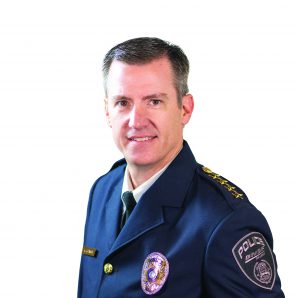
It is the honor of my career to serve as the 114th president of the International Association of Chiefs of Police. As I begin this year, I do so knowing that we share a common vision for the future of our profession.
We believe in the mandate of our calling: to protect the vulnerable and support the courageous officers serving on the front lines every day. We do not accept that policing is fundamentally broken, devoid of public trust, nor do we believe it has reached its full potential.
Our commitment is clear. We are stronger together, and we must leverage our collective influence to promote human rights and provide the resources, policies, training, and guidance our public servants need. We will use our power to convene, advance research-validated policies, and engage in the legislative process. We will also collaborate with chiefs across the globe because criminal actors exploit gaps in law and professional cooperation. Make no mistake: our adversaries are very good at what they do.
Two Nations, One Purpose
In 1893, police chiefs from the United States and Canada came together in Chicago, Illinois, and asked a simple question: What if we did not have to face our hardest problems alone?
They founded what was then called the National Association of Chiefs of Police of the United States and Canada. From the beginning, leaders from two nations stood shoulder to shoulder to solve shared problems.
They understood something that remains true today: Crime does not respect political boundaries. If criminal enterprises can cross borders, then police cooperation, intelligence, and investigations must do the same.
From its first meeting, this association embraced the powerful premise that transnational crime requires transnational policing relationships.
More than 130 years later, the IACP remains resolute in this commitment.
Every nation represented in the IACP strengthens this association and is essential to our shared mission.
Today, members from across the world bring different experiences and a common commitment to advancing policing. In the year ahead, I want to deepen our global partnerships so we can share what works, learn from one another, and stand together against threats no single agency or nation can confront alone.
Strong Runs Deep
The theme of the 2027 IACP Annual Conference in Philadelphia, Pennsylvania, “Strong Runs Deep,” will guide us throughout the coming year.
Those words speak to the depth of our purpose, the strength of our relationships, and the responsibility we inherit from the leaders who came before us.
Strong does not run deep simply because the IACP has existed for more than 130 years. It runs deep because people choose to serve something larger than themselves.
We arrived in policing by different paths, but many of us give the same answer when asked why we chose this profession: We want to help people, protect the vulnerable, and make our communities safer. We believe in public service and putting the needs of others before our own. Policing is more than a profession; it is a calling to serve, sacrifice, and accept responsibility for people we may never know.
The badge is not the mission. The title is not the mission. The mission is the people, and we must earn the right to police every day.
That commitment connects us to the chiefs who built this association. Their uniforms and challenges were different, but their motivation was familiar: strengthen the profession, protect their communities, and come together to act.
Our history is a story of action. Again and again, chiefs identified what the profession needed, brought leaders together, and advanced solutions that continue to guide policing today.
In 1897, the IACP established the United States’ first national criminal identification repository, allowing agencies to exchange identification records, photographs, and criminal information across jurisdictions.
In 1915, the IACP supported the International Association of Women Police, five years before women gained the right to vote in the United States, recognizing that policing is stronger when it welcomes all who are called to serve.
In 1922, the IACP began the crime statistics project that became the FBI’s Uniform Crime Reporting Program. Chiefs did not simply call for a solution. They helped develop one.
In 1924, the national identification function became part of the U.S. Department of Justice. Police chiefs had recognized the need and acted first.
In 1935, the IACP and the FBI established the FBI National Academy, strengthening leadership and professional education far beyond any single agency.
That is our legacy: Chiefs identifying a need, convening the right people, and turning professional judgment into action. They acted because the profession needed leadership and our communities needed support. That is what our brand represents.
Our brand is policing at its best.
It represents police leaders coming together to advance solutions that improve the communities we serve and strengthen the profession.
“That is our legacy: Chiefs identifying a need, convening the right people, and turning professional judgment into action.”
In 1905, the IACP distributed lapel pins bearing its new monogram. The insignia became a visible symbol of membership, and our predecessors deliberately protected its use because they understood that unrestricted use would diminish its meaning.
That responsibility belongs to us now.
Today, one of the IACP’s most valuable assets is its credibility. When we place the IACP name and insignia behind a policy position, professional standard, research initiative, or legislative priority, we place the credibility of this association behind it.
That endorsement means something because it is informed by police leaders to benefit the communities we serve and directed toward strengthening the profession.
Why This History Is Not History
I share all of this because sometimes we forget how deliberate our founders were.
They protected this brand the same way we are called to protect three things today: the vulnerable people we serve, our officers, and our brand.
Our brand. Every time an officer puts on a badge bearing our profession’s trust, they draw on the credibility that our predecessors built and defended one decision at a time. That trust is not renewable by default. It is renewed by action: how we lead, how we hold ourselves accountable, and how carefully we guard the credibility of our profession.
Our officers. The men and women who wear the badge every day carry forward something earned and something that must be protected. Supporting them is not a slogan. It is providing wellness resources when the job wears them down. It’s volunteering to take the holiday shift, so they can be with their families. It is ensuring access to training that keeps them safe on shift. It is standing beside them publicly and correcting them privately, when we must. Our founders extended that same duty of care, and we owe our own officers nothing less today.
Leadership is not measured solely by crime statistics or operational outcomes. Leadership is measured by whether our people know they are valued. It is measured by the cultures we create that show our officers their wellness matters, their families matter, and their sacrifices matter.
If we want trust from our communities, we must first build a culture of trust within our agencies. When we invest in our officers, support their wellness, and build healthy cultures, we strengthen our ability to fulfill the mission that called us to this profession in the first place.
The mission to protect the vulnerable.
Every chief who signed onto this association in 1893 did so because policing exists to protect people who cannot protect themselves and because they understood that a vulnerable person doesn’t stop being vulnerable at a border crossing. That mission has not changed in 133 years, and it will not change under our watch. Most of us can remember our hiring process, and somewhere along the way, we were asked why we wanted to become police officers. For so many of us, the answer was simple: We wanted to help people. We can never lose sight of that motivation.
That legacy did not end with our early leaders. Since joining the IACP in 2005, I have watched our members, volunteer leaders, presidents, and professional staff meet the challenges facing our profession time and again.
We have expanded the IACP’s reach and influence to more than 35,000 members in more than 180 countries. That growth also strengthens our advocacy voice.
Beginning in 2009, the IACP helped reshape the profession’s response to mental health crises through national summits, model policies, guidance, and the One Mind Campaign.
In 2017, we brought law enforcement leaders and labor organizations together to develop the National Consensus Policy on Use of Force, grounded in law, training, officer safety, and the protection of human life. The policy has helped guide agency policy, training, and public discussion, demonstrating that our profession can lead difficult conversations rather than simply react to them.
We advanced human and civil rights and supported the profession’s work to prevent hate crimes, protect targeted communities, and reinforce equal protection under the law.
In 2019, the IACP helped secure the President’s Commission on Law Enforcement and the Administration of Justice, the first comprehensive U.S. commission on law enforcement and criminal justice in more than 50 years.
The IACP has elevated officer safety and wellness into a central leadership responsibility through advocacy, the Officer Safety and Wellness Conference and Section, suicide prevention partnerships, and practical resources.
Most recently, during a period of significant tension surrounding federal, state, and local public safety responsibilities, the IACP once again stepped forward to convene leaders around a pressing issue. We brought together law enforcement leaders, prosecutors, and elected officials representing 19 organizations for a facilitated discussion focused on shared responsibilities and public safety. While participants did not agree on every issue, they identified common ground that resulted in the Shared Principles of Agreement that strengthened relationships and renewed partnerships.
We also expanded professional development through the Chiefs Leadership Certificate Program, Global Executive Leadership Summit, IACPlearn, Women’s Leadership Institute, First Line Leadership, and Leadership in Police Organizations.
These accomplishments do not belong to one president, one board, or one generation. They belong to thousands of volunteer leaders, dedicated members, and extraordinary professional staff.
That is the legacy we inherit. And it is the responsibility we now carry forward.
Our Charge
So, as we begin this year, here is my charge to every member of this association:
Protect our brand. Not out of self-interest, but because every community deserves equal protection under the law delivered through professional policing services. We must guard the credibility generations of police leaders worked to build and remember that our influence depends upon the trust others place in our name and our work.
Support your officers with passion and purpose that lead to action-based outcomes, with resources, not just rhetoric. Carry that commitment into policy and legislative action.
Protect the vulnerable. Be the strongest defenders of people’s rights, especially for children, older adults, underserved communities, Tribal Nations, and others who rely on us. Continue confronting the tragedy of Missing and Murdered Indigenous Women and Girls and strengthen the cross-border relationships our founders began in 1893.
Our strength runs deep. It ran deep in 1893, when chiefs from two nations recognized that their problems were shared. It ran deep as generations of leaders built and protected the IACP’s credibility. It ran deep after 9/11, as policing adapted to a changed threat environment. And it runs deep today in every leader who believes that a badge earned is a badge that must be protected.
Our legacy is not behind us—it is in front of us. Leading will not be easy. Difficult days are ahead. But the IACP has proven time and again that our strength runs deep.
In the year ahead, I look forward to seeing what we will accomplish together. d
Please cite as
Will D. Johnson, “Strong Runs Deep: Our Legacy, Our Future,” President’s Message, Police Chief 93, no. 11 (2026): 6–8.