“Who’s going to clean this up?”
It is a question that many families find themselves asking in the aftermath of a suicide, homicide, overdose, or unattended death.
Once investigators have documented a scene and completed their work, the visible and invisible signs of a tragedy may remain behind. Biological contamination, drug residue, and other environmental risks often persist long after the crime scene tape has come down, creating challenges for property owners, families, and in some cases, public safety agencies.
Although crime scene remediation is not typically the responsibility of police agencies, it remains closely connected to the policing profession. Officers are often the first point of contact for individuals seeking guidance after a traumatic event. Investigators may process scenes contaminated by blood or bodily fluids. Even agency vehicles, holding cells, and other operational spaces can occasionally require decontamination following exposure to biohazards.
As concerns surrounding fentanyl exposure, infectious diseases, and other environmental hazards continue to grow, crime scene cleanup has become an increasingly specialized field. Understanding that process can help agencies better protect personnel, support affected families, and ensure that environments are safely returned to their former state.
The Hazards That Remain
Crime scene cleanup is often viewed as the final step in a case, but remediation professionals frequently see it as the beginning of recovery. Drawing on decades of law enforcement experience and biohazard remediation, Larry Douglas—president and CEO of Xtreme Cleaners—has learned that some of the most dangerous scenes are not necessarily the most dramatic.
Overdose incidents are a prime example. At first glance, a room may appear relatively untouched. Emergency responders may have departed, evidence may have been collected, and there may be little outward indication of danger. Yet significant hazards can still remain. Discussing fentanyl contamination, Douglas offered a reminder that speaks directly to both remediation and policing personnel: “You can’t see a couple little grains of salt-size pieces of fentanyl.”1 Small amounts of contamination, discarded syringes, and hidden drug paraphernalia can all present risks to future occupants and anyone entering the space after the incident.
Those concerns are not limited to residences. Patrol vehicles, prisoner transport units, interview rooms, booking facilities, and evidence-processing areas may all encounter contamination by hazardous substances during routine operations. Agencies are increasingly recognizing that seemingly isolated incidents can create broader environmental and occupational safety concerns if they are not properly addressed.
Blood and bodily fluids present similar challenges. Contamination does not simply remain on visible surfaces; it can seep beneath flooring, penetrate drywall, and spread into porous materials throughout a structure.
Remediation intersects with policing more often than many agencies realize. Xtreme Cleaners’ technicians are often trained to recognize items that may have evidentiary value and understand the importance of preserving scene integrity. Because they often spend hours working within environments after investigators have departed, remediation professionals may encounter items that were not immediately apparent during the initial response. While they may not be conducting the investigation, their specialized training and close coordination with the police can help ensure that potentially significant evidence is preserved rather than inadvertently discarded.
When Cleaning Isn’t Enough
One challenge for agencies evaluating recovery options is understanding the difference between cleaning, disinfecting, and remediating a scene. While the terms are often used interchangeably, they serve different purposes. Cleaning focuses on removing visible dirt, debris, and objects from a surface. Disinfecting involves applying products designed to reduce or eliminate harmful microorganisms on treated surfaces. Remediation is the broader process of identifying hazards, removing contaminated materials, restoring affected environments, and ensuring they can be safely reoccupied. Decontamination goes a step further by addressing biological contamination that may remain after initial cleanup has been completed. As Dr. Halden Shane, CEO of TOMI Environmental Solutions, explains, “A site that appears clean, especially after the presence of narcotics or decomposition, does not mean that it is safe for reentry.”
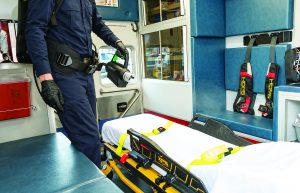
As contamination-control practices have evolved, many organizations have adopted technologies designed to supplement traditional cleaning and remediation efforts. One example is the SteraMist iHP disinfection platform from TOMI Environmental Solutions. Originally developed with funding from the Defense Advanced Research Projects Agency to address biological threats in sensitive environments, the technology was later utilized during response efforts related to the 2001 anthrax attacks. It has since been adopted across health care, life sciences, food safety, commercial, and emergency services environments. Today, TOMI’s Binary Ionization Technology converts a low-concentration (7.8 percent) hydrogen peroxide solution into ionized hydrogen peroxide mist for environmental decontamination.
The technology was developed in response to some of the limitations associated with traditional cleaning methods. Areas that are difficult to reach may receive less attention, while repeated use of aggressive chemicals can create concerns about corrosion or damage to sensitive equipment.
Designed to supplement rather than replace manual cleaning processes, SteraMist is deployed after gross contamination has been removed and evidence collection has been completed. The system produces a mist that disperses throughout a treated environment, making it suitable for the facilities and vehicles used during daily enforcement operations where biological contamination may be a concern. Material compatibility is another factor that may appeal to public safety agencies. Modern police vehicles and facilities contain specialized electronics that are costly to replace. TOMI emphasizes that its decontamination approach was developed to provide broad environmental treatment while minimizing the risk of damage to sensitive equipment, helping agencies restore operational spaces while protecting critical assets.2
For agencies evaluating recovery options, environmental decontamination technologies offer an additional layer of protection that can help reduce biological risks before personnel return to an affected area.
Protecting Personnel from Hidden Risks
The hazards that necessitate remediation can also affect the officers, investigators, and technicians who enter those environments.
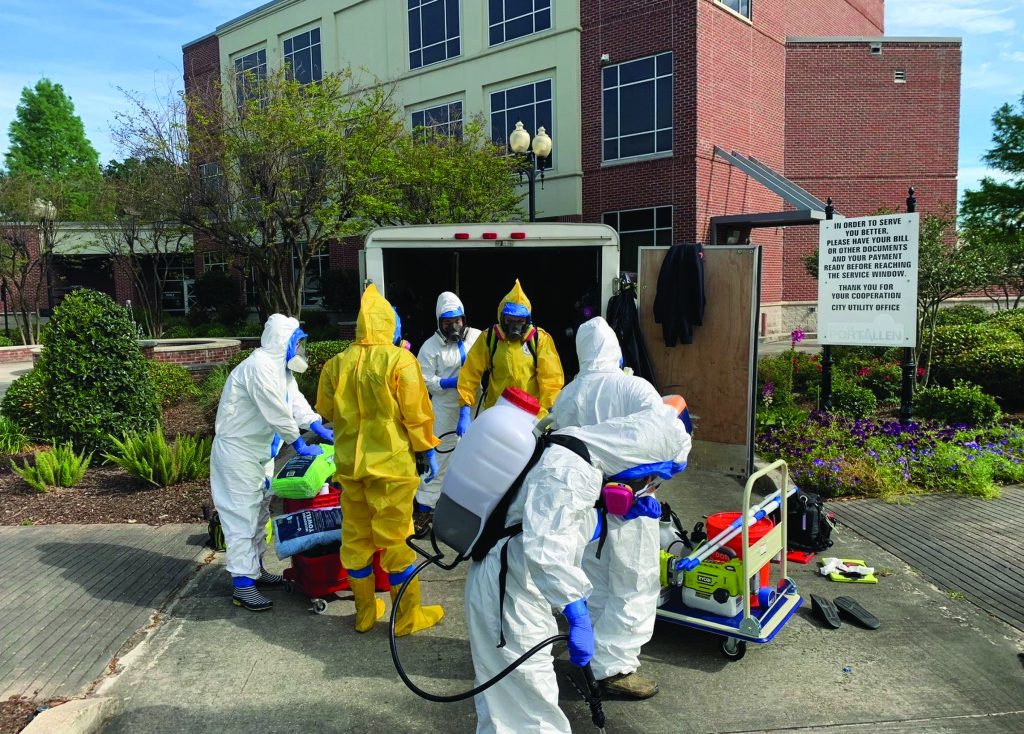
At Xtreme Cleaners, every project begins with a job safety analysis to identify biological, chemical, and physical risks. The process helps determine what protective equipment is necessary and what procedures should be followed to minimize exposure. Much like police professionals’ risk assessment process before entering a potentially dangerous scene, the goal is to understand the environment before personnel step into it. Depending on the scene, personnel may require respirators, puncture-resistant gloves, protective suits, or other safeguards.
Those same concerns have influenced the development of modern respiratory protection systems. As agencies contend with fentanyl contamination, biological hazards, and airborne particulates, manufacturers have increasingly focused on solutions designed specifically for public safety personnel.
One of the greatest challenges is ensuring that protection does not interfere with an officer’s ability to do the job. “Protection performance will always be fundamental, but agencies should also consider how equipment will function once it is placed in the hands of the wearer,” said Mike Corle, director of North American sales for Avon Protection.3 Officers still need to communicate, maintain situational awareness, and operate effectively while wearing protective equipment. Respiratory protection, for example, must integrate with helmets, communications equipment, and other mission-critical systems while remaining practical enough to be carried and deployed when needed.
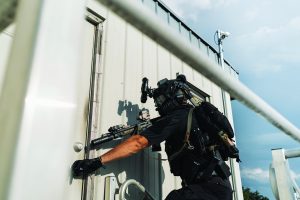
That philosophy is reflected in Avon Protection’s MITR System, a modular respiratory and ocular protection platform designed to provide scalable protection in dynamic environments. The system was developed to address a challenge many agencies face when responding to uncertain environments. Officers do not always know exactly what hazards they will encounter when arriving at a scene. Potential threats may include airborne drug particulates, firearm residue, smoke, or other hazards. Those situations may not require a full threat (chemical, biological, radioactive, nuclear) respirator, but they can still warrant respiratory or ocular protection. The MITR platform was designed to bridge that gap by providing a scalable approach that can be adapted as operational requirements change.
The same concerns that require remediation can affect patrol officers, investigators, evidence technicians, and other policing personnel who encounter contaminated environments during the course of their duties. Effective risk management requires agencies to think about environmental recovery and personnel protection as part of the same strategy.
Recovery as Part of the Public Safety Mission
Crime scene cleanup remains fundamentally about people. Families affected by violent crime, suicide, overdose, or unattended death are often dealing with grief while simultaneously managing funeral arrangements, insurance claims, and countless other responsibilities. The physical condition of a property can become a constant reminder of the event itself. Professional remediation removes one burden from that process and allows recovery to begin.
For police agencies, helping families connect with reputable remediation providers can be an important part of the recovery process, particularly when victims are unsure where to turn for assistance after a scene has been released.
Douglas described crime scene cleanup as “an important piece of the puzzle” because “it helps bring the family back to some sort of normalcy.”4 That perspective reflects why remediation remains so closely tied to the broader public safety mission.
Crime scene cleanup is often viewed as something that happens after police work is finished. In reality, it remains connected to officer safety, victim services, environmental health, and community recovery efforts. The investigation may conclude when a scene is released, but the responsibility to protect people does not. d
Notes:
1Lawrence Douglas (president and CEO, Xtreme Cleaners), phone interview, October 2, 2026.
2Marketing Team (TOMI Environmental Solutions), email interview, October 5, 2026.
3Mike Corle (director of North American sales, Avon Protection), email interview, October 1, 2026.
4Douglas, phone interview, October 2, 2026.
|
Source List Please click on the companies’ names to go to the companies’ websites. |
||
|
|
|
|