


Effective interviewing is at the heart of any investigation and is essential to achieving justice in society, but it is a skill that must be learned and practiced. Research studies over the past decade have demonstrated that an AI solution can provide better, smarter, and more cost-effective results than current methods.1 Now that research is being developed by a New Zealand-based investigations and training company, OSACO Group, into an avatar simulation training tool that promises to deliver cost-effective, scalable investigative interview training for police forces across the globe.
The Limitations of Current Investigative Interview Training
Traditional methods of investigative interview training generally feature classroom-based lectures and role-plays. Their effectiveness is inherently limited by the number of participants, time, cost, and distance and has been proven to produce only brief improvements that are soon eroded.2
Given these constraints, it is unsurprising that these modes of training cannot offer the objective, timely, and targeted feedback that can help an interviewer/trainee learn and embed appropriate, effective question techniques.
Without adequate and ongoing interview training, studies have observed that interviewers typically default to questions that limit answers; for example, questions that can only be answered yes or no, offer a limited number of alternatives, or are in other suggestive or closed-questioning styles.3 Unfortunately, such questioning has been proven to
-
- hinder accurate recall,
- inflate false-positive reporting, and
- undermine courtroom credibility.
What Is Effective Interviewing?
Following good practices within police departments across the world, the acknowledged method of effective interviewing promotes a focus on the use of open-ended questions and techniques to build rapport and trust, as used in the PEACE model. Yet, while acknowledged as essential for successful interviewing, these are not natural skills for everybody; they must be learned, developed, and continually practiced.4
Research into the effectiveness of investigative interviewing was initiated by Professor Pekka Santtila and his colleagues at Åbo Akademi University in Finland in 2015 and continues under his guidance at New York University. It initially focused on forensic interviewing of child sexual abuse (CSA) victims, a very specific skill, although studies have also shown benefits when these techniques are applied to adult witness interviews.5
Although suggestive or closed-ended questions make accurate recall difficult for CSA victims, both question types are still regularly employed by interviewers.6 The most likely reason for this is that police academies and departments lack the resources to provide ongoing, quality learning environments within which to hone more effective investigative interviewing techniques.
Such a learning environment would allow for practice and objective, personalized feedback; in fact, this type of feedback has been proven by studies to be absolutely essential in developing effective interviewing skills.7 Feedback specific to each interviewer/trainee helps change interviewer behavior by enabling them to understand the type of questions they use most (effective open questions or response-limiting closed/directive/suggestive questions), as well as the accuracy and completeness of the information that their usual question style elicits.
As police agencies know all too well, such learning opportunities are not currently feasible within the operating constraints of budget and time. However, AI offers a very effective alternative. Multiple studies have conclusively demonstrated that “avatar-based simulation, when paired with immediate, evidence-based process and outcome feedback, will deliver more effective interviewing,” particularly in relation to the use of open-ended questions.8
“Participants more than doubled their use of open questions.”
Professor Santtila’s studies demonstrated that before training with avatars, participants (whether new or professional interviewers) used about 35 percent open questions; after one-hour of training with avatars (four interviews with feedback), this dramatically increased to 80 percent.9 In short, participants more than doubled their use of open-ended questions. This demonstrates a robust improvement in questioning skills, significantly enhancing interview quality related to both use of recommended question type and the reliability and accuracy of information received.
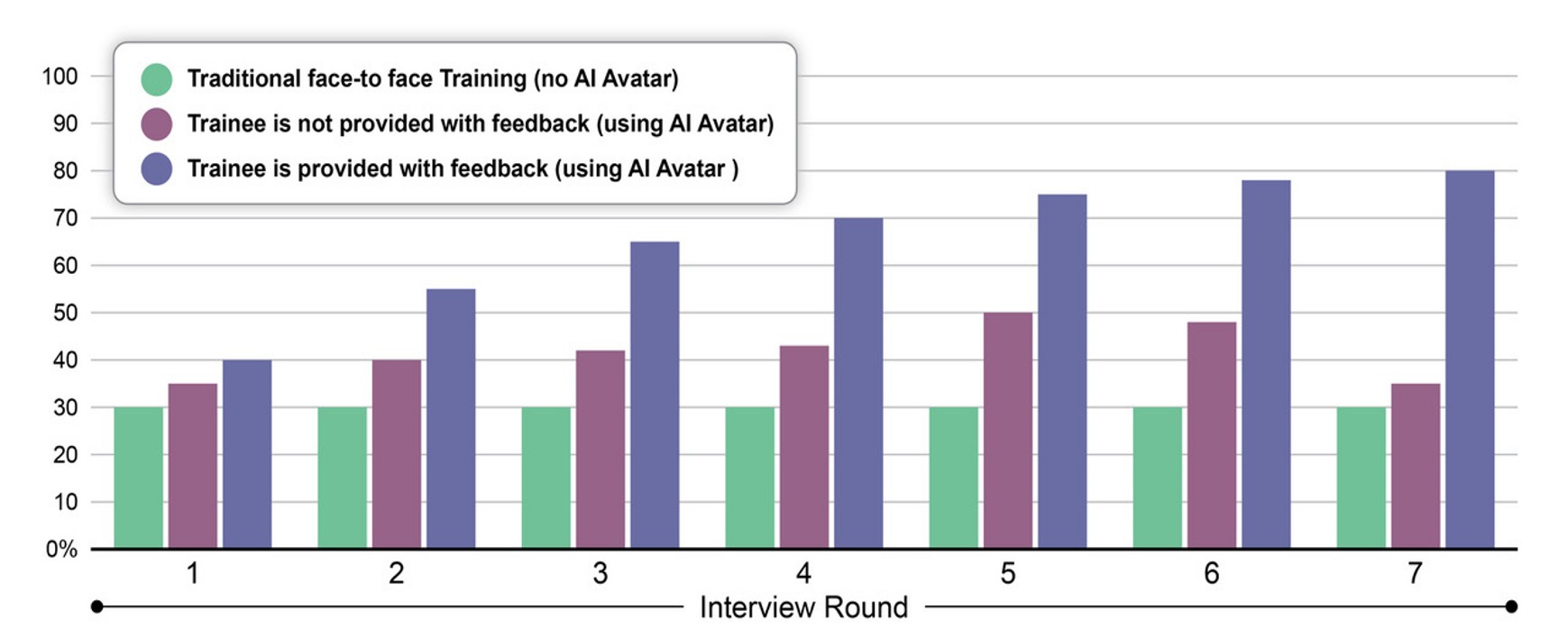
Not only that, but the last 10 years of research has shown that avatar-based simulations with feedback
-
- Are as effective remotely as when taking place in the lab/classroom10
- Provide the largest gains when modeling clips are added to feedback11
- Are sensitive to cognitive influences, particularly related to bias12
- Enable the successful transfer of skills learned through avatar training, (particularly when supported by monthly training “boosters”) to real-world interview scenarios with both children and adults13
Delivering on the Promise of Avatar-Based Training
Following a conversation in early 2024 with Professor Santtila, OSACO Group founders Jaydene and Sean Buckley immediately recognized the potential of a scalable large language model (LLM) avatar-based training solution to revolutionize interview training. Drawing on their 30+ years of real-world policing, investigations, and training expertise, they committed themselves to developing such a tool for investigative interview training—EchoMind.
“We understand the demanding conditions investigative interviewers work under,” says Sean, OSACO Group’s global director of operations.
They need to elicit accurate information through a robust and ethical process, whilst simultaneously navigating cultural sensitivities, language barriers, and the emotional or psychological state of interviewees. Effective interviewing is absolutely key, and a platform like this can help the interviewer become better at what they do.
Both have had personal experience of being trained in traditional training methods, such as role play and acted scenarios, and know their limitations. “You’re in a class of people with probably one or two instructors, and each person is trying to go through a scenario, but you’re not going to get the full attention of the trainers” says Jaydene, OSACO’s managing director. Role-play is also unrealistic and uncomfortable. “As much as peers and colleagues are supportive, you are not being your true self in that environment.”
This style of training has not evolved in decades and only produces about a 30 percent improvement rate. It does not allow for ongoing practice, provide detailed feedback for each participant, or advance learning in a guided way.
Automated LLM-driven avatar training simulations that offer consistent, objective feedback to each trainee change all that. Instead of classroom role-plays, interviewers—whether police cadets or experienced investigators—interact directly with an avatar who is trained to respond verbally and emotionally as an interviewee would. These sophisticated avatars can auto-classify questions; generate infinite, multilingual scripts; exhibit emotional expressions; and allow on-the-fly variations of age, cultural background, and abuse type. Their realistic emotional responses also train interviewers to respond to nonverbal cues appropriately and create environments in which interviewers can practice and build essential rapport and trust-building skills.
“This is all a no-brainer from a police academy perspective” says Jaydene. “Newly trained officers are sent out on the job, having only limited practice of interviewing, and are expected to utilize interview skills straight away.” That can lead to mistakes such as wrongful convictions, victim traumatization, and low case clearance rates.
Practice, Learn, Improve
Offering repeatable and diverse simulations, the latest AI technology offers an immersive and responsive online training environment within which interviewers can practice interviewing techniques.
That training is freed from the classroom—as long as an interviewer/trainee has internet access, they can continually practice and improve their effectiveness. They receive real-time feedback, including visual cues from the avatar; instant transcription of both sides of the interview; and an end-of-session report, which facilitators can review to provide further feedback. And then, they can practice again—now with more understanding.
These multiple feedback layers enable interviewer/trainees to make real-time adjustments to develop better rapport with their interviewee. Developing a confident and effective interviewer creates a better-quality interaction, which increases the chance of obtaining comprehensive and quality information. The technology supports development of multiple scenarios and witness, victim, and suspect avatars, and, as an interviewer increases their capabilities, the avatars and scenarios can advance in complexity.
“A better quality interaction… increases the chance of obtaining comprehensive and quality information.”
“OSACO’s team are all investigators or have a legal background; we know what it’s like to need to extract personal information from vulnerable victims,” Jaydene says. “We’re trying to determine the facts as the interviewee sees them, and by building rapport, we can get the best result.”
“Usually, the more seasoned interviewer you are, the fewer opportunities you have to practice,” says Sean, “but this technology is proven to test and evaluate your techniques, helping you to discard negative methods. You are able to practice more complex scenarios, or more difficult interviewees. Imagine being able to practice prior to a difficult investigative interview?”
None of this is possible with traditional training methods. Luckily, advanced AI training options are here to help.
| OSACO Group are international specialists in training and investigations. They help organizations across the world to minimize and manage the impact of human risk factors such as fraud, corruption, sexual exploitation and abuse, and ethics breaches. OSACO has brought together its practical knowledge and experience in training and investigation, the latest academic research, and cutting-edge technology to create EchoMind. This avatar-driven training solution enables investigative interviewers of any level to learn easily, improve quickly, and deliver more effective interviews. To find out more, visit www.osacogroup.com/echomind-ai-interview-training or contact our head of North America, Zahida Varani, directly. |
Notes:
1Francesco Pompedda et al., “A Mega-Analysis of the Effects of Feedback on the Quality of Simulated Child Sexual Abuse Interviews with Avatars,” Journal of Police and Criminal Psychology 37, no. 3 (2022): 485–498; Shumpei Haginoya et al., “Scalable Training for Child Sexual Abuse Interviews in Japan: Using AI-Driven Avatars to Test Multiple Behavioral Modeling Interventions,” Child Protection and Practice 5 (2025): 100188.
2Michal E. Lamb et al., “Is Ongoing Feedback Necessary to Maintain the Quality of Investigative Interviews with Allegedly Abused Children?” Applied Developmental Science 6, no. 1 (2002): 35–41.
3Julia Korkman et al., “White Paper on Forensic Child Interviewing: Research-Based Recommendations By The European Association Of Psychology And Law,” Psychology, Crime & Law (2024): 1–44.
4Korkman et al., “White Paper on Forensic Child Interviewing.”
5Mari-Liss Tohvelmann et al., “Providing Feedback in Simulated Investigative Interviews with Adult‑Witness Avatars Increases the Use of Free‑Recall and Open Questions,” International Journal of Police Science & Management (in press.)
6Ann-Cristin Cederborg et al., “Investigative Interviews of Child Witnesses in Sweden,” Child Abuse & Neglect 24, no. 10 (2000): 1355–1361; Kathleen J. Sternberg et al., “Use of a Structured Investigative Protocol Enhances Young Children’s Responses to Free-Recall Prompts in the Course of Forensic Interviews,” Journal of Applied Psychology 86, no. 5 (2001): 997–1005.
7Pompedda et al., “A Mega-Analysis of the Effects of Feedback on the Quality of Simulated Child Sexual Abuse Interviews with Avatars.”
8Pompedda et al., “A Mega-Analysis of the Effects of Feedback on the Quality of Simulated Child Sexual Abuse Interviews with Avatars.”
9Pompedda et al., “A Mega-Analysis of the Effects of Feedback on the Quality of Simulated Child Sexual Abuse Interviews with Avatars.”
10Shumpei Haginoya et al. “Online Simulation Training of Child‑Sexual‑Abuse Interviews with Feedback Improves Interview Quality in Japanese University Students,” Frontiers in Psychology 11 (2020): 998.
11Shumpei Haginoya et al., “The Combination of Feedback and Modeling in Online Simulation Training of Child Sexual Abuse Interviews Improves Interview Quality in Clinical Psychologists,” Child Abuse & Neglect 115 (2021): 105013.
12 Yikang Zhang et al., “Confirmation Bias in Simulated CSA Interviews: How Abuse Assumption Influences Interviewing and Decision-Making Processes?” Legal and Criminological Psychology 27, no. 2 (2002): 314–328.
13Kristjan Kask et al., “Transfer of Avatar Training Effects to Investigate Field Interviews of Children Conducted by Police Officers,” Frontiers in Psychology 13 (2022).