


Often criminal activity involves a motor vehicle to get the actors to or from a criminal act or to carry out the crime. In the case of vehicle theft, the vehicle is the central element of the crime, whether it involves stealing or trafficking of vehicles or parts. In situations of fraud, a vehicle may be used to commit lien or title fraud, odometer fraud, or salvage and brand fraud. Alternatively, the crime may involve concealing the vehicle’s true identity. These fraudulent activities provide criminals with multiple ways to generate revenue.
For police officers and investigators, the ability to locate information about a vehicle such as its location history, who may have had access to the vehicle, and the vehicle title history can significantly enhance an investigation. This information can be crucial in solving cases by providing leads and evidence that might otherwise be difficult to obtain.
National Motor Vehicle Title Information System
The Anti-Car Theft Act of 1992 provides a mechanism for U.S. motor vehicle titling agencies (MVAs) to verify vehicle title information directly with the prior titling MVA upon being presented a vehicle title for transfer. This act also requires MVAs to input vehicle title information after issuing a vehicle title, creating a title record that other MVAs can verify. The main purpose of this act is to prevent vehicle fraud and to stop the buying and selling of stolen vehicles and vehicle parts. This information is also valuable for a variety of investigative purposes. The system created by this act is known as the National Motor Vehicle Title Information System (NMVTIS).1
A vehicle inquiry conducted through the NMVTIS by MVAs also includes a stolen vehicle record check. This check compares the vehicle identification number (VIN) against the National Crime Information Center (NCIC) Stolen Vehicle File operated by the Federal Bureau of Investigation’s Criminal Justice Information Services.2 If a stolen vehicle record is found by an MVA, they will contact their investigative staff or other police agency to investigate. A vehicle cannot be titled until it is no longer reported as stolen.
NMVTIS Consumer Reports
The NMVTIS vehicle history reports and other vehicle history reports containing NMVTIS data are available from approved NMVTIS data providers and offer valuable information to consumers, lenders, vehicle dealers, and others. These reports provide insight into the history of the vehicle which may impact the value and safety of the vehicle.3 The NMVTIS consumer reports contain much of the same information used by MVAs when making titling decisions, such as current title information, title and brand history, odometer reading, and titling dates. These reports also include information from auto recyclers, vehicle salvage and junkyards, and insurers who are required to report the acquisition of a junk, salvage, or total loss vehicle. Consumer reports do not include NCIC Stolen Vehicle File information.
This information is valuable when making a vehicle purchase or a lending decision and can prevent individuals or businesses from becoming victims of fraud. Additionally, it helps buyers and lenders make a more informed decision and may deter them from spending or lending more than the vehicle truly is worth.4
Police and Investigator Use of the NMVTIS and Law Enforcement Access Tool
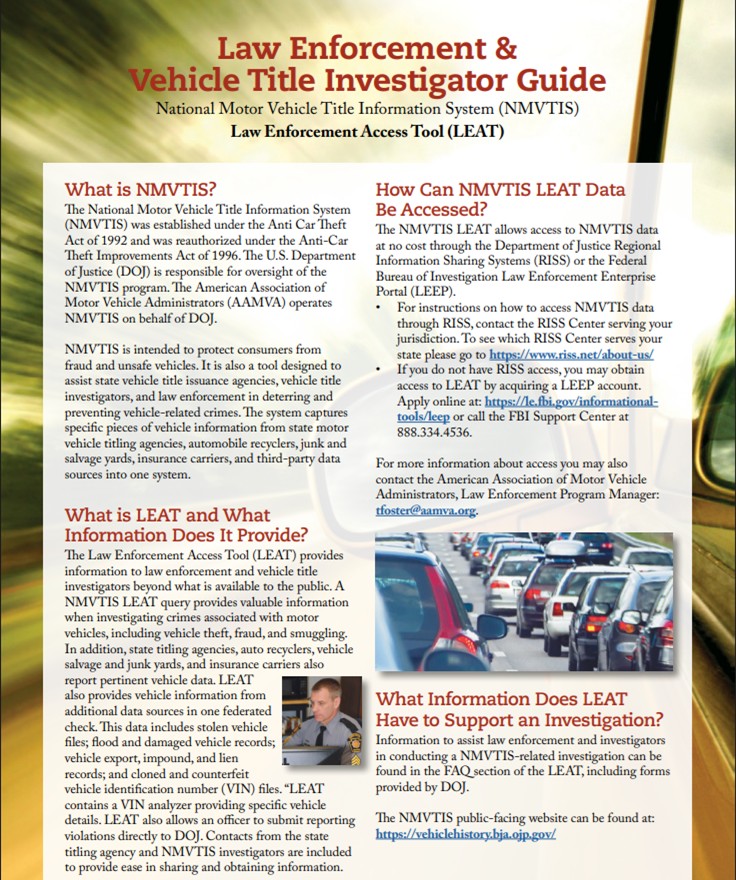
As criminal activity often involves a vehicle, the NMVTIS information is also a valuable resource for investigations. This NMVTIS access is provided at no cost to any certified law enforcement officer or investigator employed by an MVA. In addition to the NMVTIS information, several other vehicle-related resources are available through the NMVTIS Law Enforcement Access Tool (LEAT). These vehicle resources can be invaluable in locating details about a specific vehicle, its history and location, and who may have had access to the vehicle.
The NMVTIS LEAT and Central File Vehicle Records
The NMVTIS LEAT provides vehicle title history that includes the vehicle title number, title issue date, title jurisdiction, and odometer reading. In addition to these main title data elements, NMVTIS information includes applicable title “brand” history such as records indicating if the vehicle has been damaged from a flood or classified as a salvage or junk vehicle. This brand information will also include details about the odometer history and whether the mileage is indicated as true mileage or not actual mileage.
If police officers or investigators have questions about a particular title record, each title record contains a direct contact for the MVA that issued the title. These contacts are invaluable for obtaining specific information about a title transaction and copies of official title records. These MVA contacts may also provide referrals to officers and investigators within the jurisdiction who may be able to assist with specific details about the vehicle and vehicle ownership. All NMVTIS title information is noted as information from the NMVTIS Central File Record and is available to download and apply to a case file.
The NMVTIS LEAT Junk, Salvage, and Insurers Database Results
Auto recyclers, vehicle salvage and junkyards, and insurers are examples of entities that are required to report pertinent vehicle data to the NMVTIS upon acquisition of a junk or salvage vehicle.5 The data reported includes the name and contact information for the business who acquired the vehicle; the date the vehicle was acquired and who it was acquired from; the disposition of the vehicle such as if it was crushed or sold as parts; and if applicable, who it was sold to and date of transaction. All this information is required to be reported by these entities within 30 days of acquiring the vehicle or sooner, if required by law.
Police officers and investigators can research VINs within the NMVTIS LEAT to determine if a particular vehicle is or has been in the possession of one of these entities. This capability is particularly valuable in investigations involving vehicles, including cold cases. The vehicle involved may contain significant clues and leads about the crime or suspects involved.
Locating the vehicle and identifying who may have had possession of it is an important element for many investigations. By checking a VIN through the NMVTIS LEAT, a police officer or investigator may be given valuable leads for locating the vehicle, such as the vehicle being disposed of at a salvage yard. This information may be just what is needed to break the case open or point to other leads.
Reporting of Vehicle Information to the NMVTIS by Junk, Salvage, and Insurers
 Reporting to the NMVTIS is required by federal law for auto recyclers, vehicle salvage and junkyards, and insurers.6 Many jurisdictions have adopted the NMVTIS reporting requirements and applicable laws, which are also important to be familiar with. As mentioned earlier, this reporting is required within 30 days of acquiring the vehicle, or sooner if required by law in the specific jurisdiction. This reporting requirement applies specifically to entities that acquire five or more salvage or junk vehicles in a year.
In order to comply with these reporting requirements, these entities are also required to register with the U.S. Department of Justice as an NMVTIS reporting entity and to obtain an NMVTIS ID number. Police officers and investigators can verify if a business has acquired an NMVTIS ID number by visiting the website provided by the U.S. Department of Justice.7 It should be noted that entities with multiple locations may consolidate the reporting of these vehicles at one central location if they have numerous locations throughout the jurisdiction/state or throughout the United States.
During the course of an investigation, if a police officer or investigator finds NMVTIS reporting violations, they can report these violations through the NMVTIS LEAT. This may include entities that are acquiring salvage and junk vehicles and not reporting any or only a portion of the vehicles they are required to report.
Before reporting these violations, police officers and investigators will need to gather facts and details about the unreported vehicles and the entity involved. The evidence that is needed to assist in establishing these violations is described in the Resources and Training area found within the NMVTIS LEAT. Completed violation reports within the NMVTIS LEAT are sent directly to the U.S. Department of Justice for review.
As many U.S. jurisdictions have specific laws related to NMVTIS compliance and reporting requirements, officers and investigators are encouraged to use the MVA contacts provided within the NMVITS LEAT to inquire about specific related jurisdiction laws. In addition, the American Association of Motor Vehicle Administrators (AAMVA) maintains a list of U.S. jurisdiction NMVTIS related laws.8
Additional Investigative Resources within the NMVTIS LEAT
 In addition to the aforementioned information provided in the NMVTIS LEAT, data are provided from the NCIC Stolen Vehicle File and stolen vehicle records from Oficina Coordinadora De Riesgos Asegurados (OCRA). OCRA are stolen vehicle records reported by Mexican insurance companies. The NMVTIS LEAT provides VINs from the National Insurance Crime Bureau for suspected counterfeit and cloned VINs and vehicle records from the Car Allowance Rebate System implemented by the U.S. Department of Transportation’s National Highway Traffic Safety Administration. The National Vehicle Services provides results within the NMVTIS LEAT that includes records for vehicles reported by eBay auctions and vehicles indicating an impound, export, or lien record.
The NMVTIS LEAT report is completed by delivering a detailed VIN analyzer, providing specific details for each data element of a VIN. All combined, the NMVTIS LEAT searches up to 10 databases containing a variety of vehicle information and resources.
Obtaining the NMVTIS LEAT Reports
All vehicle information contained in the NMVTIS LEAT can be searched through one federated check, saving considerable investigative time and resources during the investigation. An NMVITS LEAT inquiry can be conducted for one to five VINs for immediate results. Bulk inquiries for up to 10,000 VINs are also allowed and will normally require two days for results to be returned, depending upon the size of the search and network usage. All results can be downloaded in a variety of formats depending upon the needs of the investigation. Individual reports can be saved to a case file, and bulk searches can be downloaded to a spreadsheet for further research and analysis.
Access to the NMVTIS LEAT
Access to the NMVTIS LEAT data is provided at no cost through the U.S. Department of Justice’s Regional Information Sharing Systems (RISS) or the Federal Bureau of Investigation’s Law Enforcement Enterprise Portal (LEEP). For instructions on how to access the NMVTIS LEAT through RISS, users can contact the RISS Center serving their jurisdiction.9 If the user does not have RISS access, they may obtain access to the NMVTIS LEAT by acquiring a LEEP account or calling the FBI Support Center at 888.334.4536.10 For additional information about the NMVTIS LEAT or to discuss training opportunities, users may also contact the AAMVA.11
Conclusion
 Vehicles are frequently used in the commission of crimes and are often targets for criminal activity. To effectively investigate vehicle-involved criminal activity, police officers and investigators need access to as much vehicle information as possible. Knowing where a vehicle is, where it has been, and who may have had access to it—and understanding the vehicle history are keys to unlocking successful investigative results.
The NMVTIS LEAT provides many of these valuable investigative resources that should not be overlooked, all at no cost. All agencies are encouraged to make sure staff understand the value of the NMVTIS LEAT, know how to access it, and understand how to utilize it.
For an informational brochure about the NMVTIS LEAT, scan the QR code included, provided by the AAMVA NMVTIS Law Enforcement Subcommittee.12d
Notes:
1U.S. Department of Justice, National Motor Vehicle Title Information System (NMVTIS), “Consumers Don’t Be Fooled. Protect Yourself.”
2FBI, “Criminal Justice Information Services (CJIS).”
3NMVTIS, “Research Vehicle History.”
4American Association of Motor Vehicle Administrators (AAMVA), “NMVTIS for General Public & Consumers.”
5NMVTIS, “NMVTIS Reporting Entities.”
6 NMVTIS, “NMVTIS Reporting Entities.”
7NMVTIS, “Who Reports to NMVTIS?”
8AAMVA, “NMVTIS for Law Enforcement.”
9Regional Information Sharing Systems (RISS) Program, “About the RISS Program: A Proven Resource for Law Enforcement.”
10FBI, “Law Enforcement Enterprise Portal (LEEP).”
11AAMVA, “NMVTIS for Law Enforcement.”
12AAMVA, “NMVTIS Law Enforcement Subcommittee.”
Please cite as
Paul Steier, “Equipping Investigators for Vehicle-Involved Cases,” Police Chief Online, June 11, 2025.