
Violent crime remains one of the most pressing challenges for police chiefs across the globe. In every community, police leaders are tasked not only with suppressing violence but also with building trust in policing at a time when legitimacy and resources are often strained. Chiefs know well that enforcement alone cannot solve the problem. While patrol, deterrence, and investigation remain central pillars of policing, lasting reductions in violence require more. They require partnerships—authentic, sustained collaborations between police agencies and the communities they serve.
In Columbia, South Carolina, this philosophy has been realized through a unique partnership between Serve & Connect, a nonprofit dedicated to strengthening community-police relationships, and the Columbia Police Department (CPD).1 This collaboration illustrates how innovative police leadership combined with authentic community engagement can produce measurable reductions in violent crime. Guided by the Compass framework—an evidence-based model for structuring effective public safety partnerships—Columbia has achieved notable improvements in its highest-crime neighborhoods. These outcomes underscore the importance of integrating traditional policing with strategies that build trust, mobilize community assets, and embed prevention and intervention into the broader fabric of public safety.
Why Partnerships Matter
Community-police collaboration is not a new concept, but sustaining authentic partnerships in practice can be challenging. Limited resources, competing priorities, and long-standing mistrust often stand in the way.2 Despite these challenges, research and experience point to a consistent truth: where partnerships are strong, crime prevention and reduction are more effective.
“Projects such as school backpack drives and neighborhood cleanups have not only met immediate needs but also symbolized a shift toward shared ownership of safety.”
The Los Angeles, California, Police Department’s Community Safety Partnership, for example, achieved measurable decreases in violent crime while improving public trust by embedding officers in housing communities and partnering with local leaders.3 Findings from the initial deployment of the Community Safety Partnership program indicated fewer homicides, aggravated assaults, and shots fired across public housing developments. Analysis suggested 221 fewer violent incidents across six years with an approximate savings of $14.5 million in tangible costs. Focused deterrence efforts, such as Group Violence Intervention (GVI), also showcase the impact strong partnerships can have on crime outcomes. GVI is an evidence-based intervention where a small number of high-risk individuals in violent peer groups are targeted using a three-pronged strategy including the moral appeal of community voices, social services offerings, and law enforcement consequences.4 GVI gained widespread attention following the successful implementation of Operation Ceasefire in Boston, Massachusetts, which contributed to a 63 percent reduction in youth homicide.5
These models highlight a key lesson: enforcement without partnership is unsustainable, and partnerships without action are ineffective. Both are required to create meaningful change.
The Compass Framework
Serve & Connect developed Compass to provide agencies with a step-by-step framework for weaving evidence-based crime reduction strategies into a foundation of community trust and collaboration.6 Built on the Getting to Outcomes model of accountability, Compass guides police and community partners through four phases:7
- Cultivating Trust and Vision. Agencies and residents build a foundation of trust by listening to community concerns and developing a shared vision for safety.
- Mobilizing Stakeholders and Planning. Partners map needs and assets, set goals, and design action plans rooted in both evidence and local realities.
- Implementation and Evaluation. Best practices are tailored to the community, put into action, and monitored for effectiveness.
- Sustainability. Efforts focus on building long-term capacity, leadership, and structures that will endure beyond any single program or funding cycle.
The framework integrates principles of community psychology, such as collective efficacy (the ability of neighbors to trust one another and act together) and sense of community.8 These social factors have been linked to lower rates of violence.
Critically, Compass is designed to complement, not replace, police operations. Enforcement and deterrence efforts—such as focused patrols, investigations, and targeted interventions—remain essential. Compass ensures those efforts are reinforced by trust, legitimacy, and community mobilization, creating the conditions for deeper, longer-lasting change.
A Community in Crisis
The power of Compass is best illustrated in the success seen in Columbia in partnership with CPD. CPD has long prioritized both enforcement innovation and community collaboration. Under Chief Skip Holbrook’s leadership, the department has established specialized investigative units; adopted advanced technologies such as gunshot detection systems and a real-time crime center; and built a culture of transparency through public dashboards. These efforts, combined with a strong commitment to authentic community engagement, position CPD as a leader in aligning traditional policing with collaborative prevention strategies.
“For chiefs wrestling with rising violence, strained legitimacy, and resource constraints, Columbia’s story offers hope and direction.”
The effectiveness of this approach is especially visible in north Columbia which has long faced high rates of violent crime. In Columbia, like many American cities, gun violence is disproportionately concentrated in small number of places. Just 3 percent of Columbia’s land area accounted for over 40 percent of shootings every year between 2020 and 2024.9 Between 2019 and 2022, 78 percent of all citywide gunshot detections occurred in just one zip code. The overwhelming majority of gunshot victims were young Black males—a tragic echo of U.S.-wide trends. Rates of crime and violence overlap with other disparities, with many effected areas seeing poverty rates twice the county average, and residents reporting high levels of adverse childhood experiences, poor health outcomes and limited access to resources.10
When Serve & Connect and the CPD launched the North Columbia Youth Empowerment Initiative (NCYEI) in 2018, the needs assessment identified two key drivers of violence:
- A lack of mentorship and positive activities for youth
- The limited accessibility of existing services and supports11
Community members expressed their concerns with urgency. Parents spoke of the constant fear that their children could be shot. Young people ranked gun violence as their greatest worry. Police officers and community leaders highlighted the pressing need to prevent children as young as 10 from being recruited into gangs. Across all voices, one message was clear: enforcement alone could not solve this crisis.
Building the Movement
Through Compass, NCYEI was structured as a local movement where residents, police, city leaders, and service providers could act together. By 2024, the initiative had grown to include 47 active community partners—ranging from job training programs to health providers to legal aid services—working in concert with CPD.11
Peace Teams
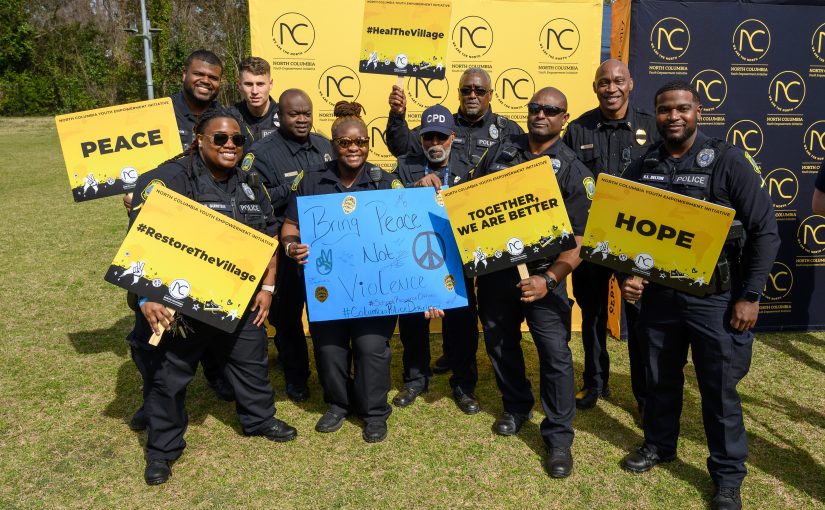
At the heart of this collaboration are the North Columbia Peace Teams, neighborhood-based groups of residents who meet monthly with officers and partners to develop grassroots initiatives. These meetings give residents real influence in shaping safety strategies. Participants report feeling heard, respected, and empowered. Projects such as school backpack drives and neighborhood cleanups have not only met immediate needs but also symbolized a shift toward shared ownership of safety.
Youth Programs
Recognizing that preventing youth involvement in violence was paramount, the NCYEI developed a suite of programs specifically for young community members.
- Police Activities League (PAL): Officers mentor youth through sports, gardening, and after-school activities, building positive relationships beyond enforcement encounters.
- Students Ignite: An after-school leadership program embeds police as mentors while equipping youth to design community change projects.
- Credible Messengers: Trusted community figures engage high-risk youth and connect them to resources.
- Operation B.R.I.D.G.E. (Building Resilience through Intervention, Development, Guidance and Empowerment): This is a focused deterrence initiative adapted for young people, balancing accountability with support services.
Community Events
 Large-scale gatherings like the annual Empowerment for Peace Walk and the Be Safe Block Parties have brought hundreds of residents and officers together for food, games, and fellowship. These events are not mere outreach activities—they are opportunities to normalize peace, shift social norms, and make police approachable partners.
Community Violence Intervention Summits
Another critical piece of the NCYEI strategy has been the Community Violence Intervention (CVI) Summits, held annually since 2021. These summits convene residents, service providers, city leaders, and police to learn about evidence-based approaches to violence reduction and to co-develop community-driven solutions. The summits serve as both training grounds and rallying points, equipping participants with practical tools for intervention while reinforcing a shared vision of peace. Each summit has drawn more than 150 attendees, with sessions led by national CVI experts as well as local practitioners.
Community Policing Initiatives
Additional community policing initiatives complement these engagement strategies. One of the most visible is Greg’s Groceries, a Serve & Connect program equipping officers with boxes of nonperishable food to distribute to people in need. CPD officers handed out Greg’s Groceries boxes during calls for service, through referrals, and at strategic outreach events. For example, over the holidays, officers and residents packed Thanksgiving-themed Greg’s Groceries boxes together, which were then distributed at a community event that included a resource fair, family activities, and opportunities for fellowship. These small but tangible acts of service reinforced officers’ roles as trusted neighbors while meeting immediate needs that often fuel community instability.
Impact: Trust, Safety, and Crime Reduction
The evaluation of North Columbia’s Compass work between 2018 and 2024 reveals profound progress:11
- Violent Crime Reduction. CPD reported a 42 percent reduction in fatal and nonfatal shootings in 2024 relative to 2023. In Booker Washington Heights, a high-crime hotspot for North Columbia, Part I crimes, including homicides, forcible rape, robbery, aggravated assault, and other violent crimes, dropped by 15.9 percent, and Part II crimes, including simple assaults, vandalism, drug abuse violations, and other nonviolent crimes, dropped by 29.1 percent between mid-2024 reporting periods.
- Trust in Police. Community surveys show trust in CPD rose from 63.6 percent to 80.5 percent. Trust in neighbors climbed from 54.8 percent to 70.1 percent, and 78.1 percent of residents reported feeling part of the community, up from 63.6 percent.
- Sense of Safety. The percentage of residents who said they felt safe doubled, from under 15 percent at baseline to more than 30 percent in 2024.
- Resource Access. Perceptions of available community resources grew from 50.4 percent to 70.1 percent.
- Police Readiness. CPD officers reported higher motivation for community policing, increased confidence in their ability to improve quality of life, and greater belief in mutual trust between police and residents.
These outcomes did not occur in isolation. They were the product of combining enforcement operations with community-driven strategies. CPD continued robust patrol, investigation, and deterrence efforts throughout, but Compass ensured these were embedded in a broader ecosystem of trust, prevention, and support.
Lessons for Chiefs
The experience in Columbia offers critical insights for police leaders elsewhere.
- Partnerships Are Force Multipliers. When 47 community organizations coordinate alongside police, the reach of the police extends far beyond what they can achieve alone.
- Youth Engagement Is Crime Prevention. Investing in mentorship, after-school programs, and leadership opportunities addresses root causes and diverts young people from cycles of violence.
- Community Trust Is Measurable—and Changeable. Increases in trust and perceptions of safety are not abstract concepts; they can be quantified and linked to reductions in crime.
- Sustainability Must Be Built In. Partnerships, once formed, need structure to endure. Peace Teams and leadership councils provide that backbone.
- Enforcement and Engagement Work Best Together. Police leaders need not fear that community partnerships dilute deterrence. On the contrary, enforcement gains legitimacy when paired with prevention and collaboration.
A Roadmap for the Future
The Compass framework is not a program to be copied wholesale. It is a roadmap that helps police leaders tailor evidence-based practices to the unique needs and assets of their communities. Whether an agency serves a rural county or a major metropolitan city, Compass provides a step-by-step guide for building partnerships, mobilizing stakeholders, implementing strategies, and sustaining success.
For chiefs wrestling with rising violence, strained legitimacy, and resource constraints, Columbia’s story offers hope and direction. It demonstrates that partnerships are not a luxury or a public relations strategy—they are central to saving lives.
That lesson is now available to police leaders everywhere: crime reduction is rooted in enforcement, strengthened by partnership, and sustained by community trust. d
Notes:
1Serve & Connect website.
2Stephen D. Mastrofski, James J. Willis, and Tracey L. Kochel, “The Challenges of Implementing Community Policing in the United States,” Policing: A Journal of Policy and Practice 1, no. 2 (2007): 223–234.
3Andrea N. Muchow, “Community-Oriented Policing and Violent Crime: Evidence from the Los Angeles Community Safety Partnership,” Police Quarterly 26, no. 4 (2023): 545–572.
Andrew V. Papachristos and David S. Kirk, “Changing the Street Dynamic: Evaluating Chicago’s Group Violence Reduction Strategy,” Criminology & Public Policy 14, no. 3 (2015): 525–558.
4National League of Cities, Boston, MA: Group Violence Intervention (Washington, DC: National League of Cities, 2024),.
5Laura Hajjar et al., “Readiness and Relationships Are Crucial for Coalitions and Collaboratives: Concepts and Evaluation Tools,” New Directions for Evaluation 2020, no. 165 (2020): 103–122.
6Abraham Wandersman et al., “Getting to Outcomes: A Results-Based Approach to Accountability,” Evaluation and Program Planning 23, no. 3 (2000): 389–395.
7Robert J. Sampson, Stephen W. Raudenbush, and Felton Earls, “Neighborhoods and Violent Crime: A Multilevel Study of Collective Efficacy,” Science 277, no. 5328 (1997): 918–924; David O’Mahony and Kevin Quinn, “Fear of Crime and Locale: The Impact of Community Related Factors upon Fear of Crime,” International Review of Victimology 6, no. 3 (1999): 231–251; Susan Saegert and Gary Winkel, “Crime, Social Capital, and Community Participation,” American Journal of Community Psychology 34 (2004): 219–233.
8Columbia Police Department, Columbia Police Department Annual Report: 2018 (Columbia, SC: Columbia Police Department, 2018); Columbia Police Department, Columbia Police Department Annual Report: 2019 (Columbia, SC: Columbia Police Department, 2019).
9United States Census Bureau, American Community Survey Data for 29203 (2019); Children’s Trust of South Carolina, South Carolina Adverse Childhood Experience (ACE) Data Profile: Richland County (2017).
10Serve & Connect, NCYEI Year 1 Report (Columbia, SC: Serve & Connect, June 2025).
11Serve & Connect, North Columbia COMPASS 2024 Report (Columbia, SC: Serve & Connect, 2024).
Please cite as
Kassy Alia Ray et al., “A Framework for Collaborative Crime Prevention: Community-Police Partnerships That Save Lives,” Police Chief Online, November 12, 2025.