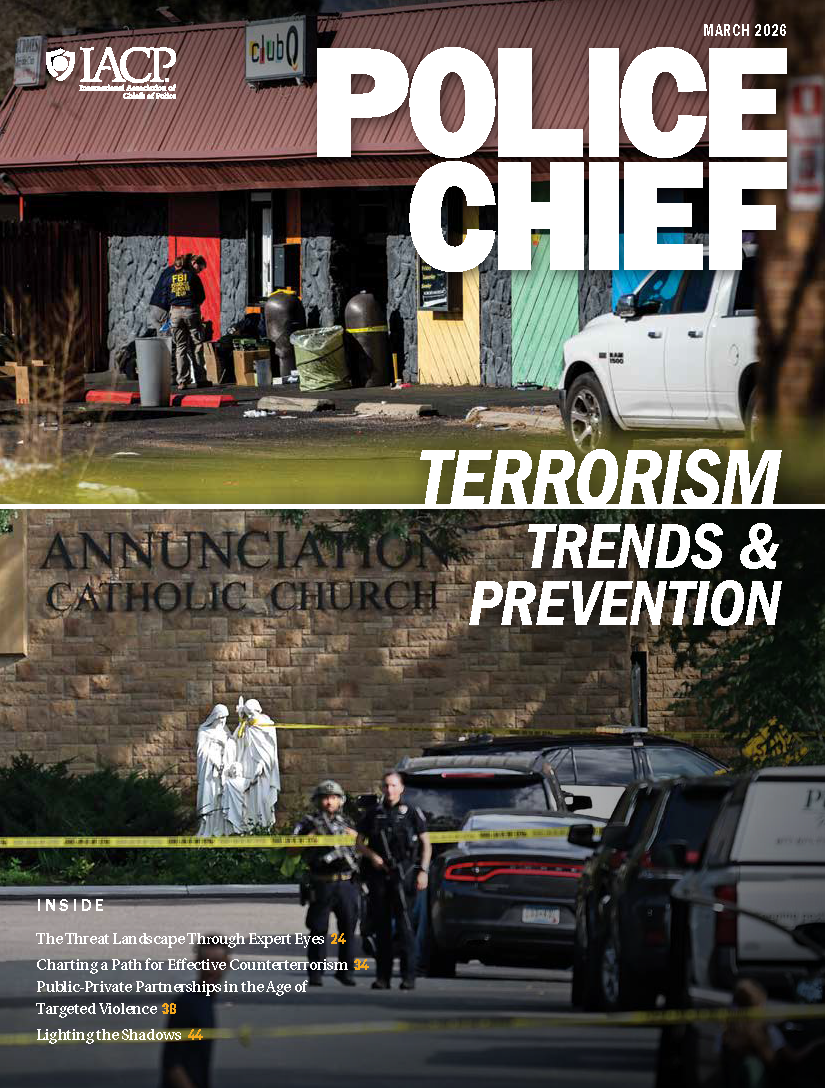


Terrorism is a topic that elicits many differing responses when discussed. Depending on where you sit, your thoughts may go immediately to an incident or an organization.
In my tenure on the IACP Executive Board, I have had the honor of serving as the IACP representative on the State and Local Intelligence Council (SLIC) for the U.S. Department of Homeland Security Intelligence and Analysis (DHS I&A), and as the chair for the IACP National Security/Transnational Crime Policy Council These opportunities have informed my understanding of the topic of terrorism. The SLIC includes various association representatives that provide information and insights to the DHS Undersecretary of I&A as well as insights into critical efforts to protect the United States. The IACP National Security/Transnational Crime Policy Council includes six working groups: the Terrorism Committee, Committee on Homeland Security, Transnational Crime Committee, Narcotics and Dangerous Drugs Committee, Civilian Law Enforcement and Military Cooperation Committee, and the Defense Chiefs of Police Section. These groups focus on addressing challenges and issues in their respective arenas, as well as collaborating efforts to identify and develop promising practices and policy guidance. They are highly functioning teams that work closely with IACP staff to provide a global perspective for the profession.
The IACP has recently created another critical section to address an identified need to have space for coordinated collaborative communication around information and intelligence gathering and sharing. This new IACP Intelligence & Information Sharing Section was announced at the IACP 2025 Annual Conference in Denver, Colorado, and is being led by an expert that brings impressive tenured experience and skill, Russ Porter. Russ has complete support from the IACP team and Board of Directors in the effort to build a space for all who want to engage in the critical understanding of where we are and where we need to be with information and intelligence gathering and dissemination.
Terrorism prevention is the responsibility of all of us in this profession.
The Intelligence & Information Sharing Section is not about intelligence operations but about highlighting gaps, needs, and opportunities to enhance efforts to support operations. One common comment made regarding terrorism is that the lights are blinking RED again, as they were prior to the attacks on 9/11. While there are pockets of efforts to address the void in this space of intelligence and information, there is a lack of coordinated focus. If this is an area of interest for you, I encourage you to join the new section and work with Russ to help us prepare for and prevent the next attack, wherever in the world it may appear.
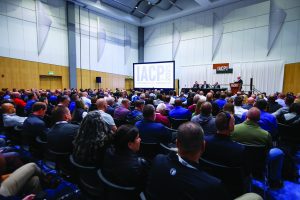
At this year’s North Carolina Chiefs of Police Association annual meeting, they had a presentation on the pending threats and what local and state authorities should be doing to prepare and prevent potential attacks. It was both informative and harrowing—a stark exclamation point on the notion that THE LIGHTS ARE BLINKING RED! For our police leaders planning for large-scale events, the IACP is working to ensure you have the information and resources you need to enhance your efforts to ensure the safety of all event participants and attendees. Terrorism prevention is the responsibility of all of us in this profession, and the IACP is dedicated to gathering expertise and experience from around the globe to assist in this arena.d
Please cite as
David Rausch, “Fostering Information and Intelligence Sharing,” President’s Message, Police Chief 93, no. 3 (March 2026): 6–7.