

The landscape of policing has shifted from paper records and routine patrols to a profession powered by data. Biometric technology has emerged as the foundation of the transformation, turning fingerprints, video, and images into actionable evidence.
The advances in biometrics now enable agencies to identify suspects faster, connect evidence more reliably, and serve communities with greater precision.
Yet, the rise of biometrics brings new responsibilities. As digital evidence volumes surge and public scrutiny intensifies, agencies must adopt technologies that are powerful, scalable, and ethically sound.
Investigative Search
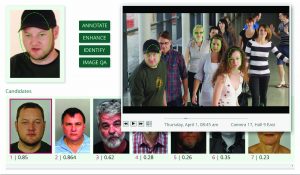
When investigators need to identify a suspect quickly—often in the critical hours following a crime—facial recognition technology can be a game changer. Cognitec’s FaceVACS-DBScan LE is designed specifically for this purpose, offering automated face matching across vast image databases. Whether the source is a surveillance camera, social media post, or mobile device, any facial image can be used to search for matches in local or central repositories.
The system uses a sophisticated algorithm to generate a ranked list of potential matches, allowing investigators to assess whether the probe and candidate images belong to the same individual. What sets FaceVACS-DBScan LE apart is its ability to handle massive volumes of data with speed and precision. Investigators can search millions of images in seconds, dramatically reducing the time and labor required for manual review.
Beyond raw matching, the platform includes a suite of forensic tools. Users can enhance image quality, compare faces side by side, and measure facial features to verify identification. The software also clusters appearances of the same person across multiple video files, tracking their movements and helping to reconstruct timelines. This functionality is especially valuable in complex cases involving multiple scenes or suspects.
FaceVACS-DBScan LE is used by police agencies across Europe and the United States, with measurable impact. Investigators report faster case progression, reduced workloads, and improved accuracy in suspect identification. In a policing landscape where time is often the difference between resolution and escalation, FaceVACS-DBScan LE offers a powerful tool for accelerating investigations and delivering justice.1

While facial recognition has become a staple in many departments, tattoos remain an underutilized biometric identifier despite their prevalence in arrest photos and surveillance footage. Face Forensics addresses this gap with its f2 Image Recognition Suite, a purpose-built platform for full and partial tattoo and face recognition. Unlike generic matching models, f2’s algorithms were developed specifically to handle the complexity of tattoos. “While faces have consistent features—such as eyes, nose, and mouth—tattoos can depict almost anything, appear anywhere in an image, [and] be rotated, faded, or obscured by clothing or other people,” said Face Forensics CEO Iain Drummond.2
When a suspect with tattoos is booked, images of their tattoos are captured and stored in the offender database, alongside other personal details. The f2 system analyzes geometric characteristics of the tattoo to create a numeric string that serves as a unique identifier. To search for an unidentified tattoo, the platform distributes searches across multiple servers, allowing agencies to process unlimited database sizes without compromising speed.
One of the suite’s most notable deployments was the ChildBase system for the UK National Crime Squad (now the NCA), which matched up to 7 million images. Other agencies, such as the Royal Canadian Mounted Police and the International Committee of the Red Cross, have also adopted the technology, recognizing its value in forensic and humanitarian contexts.
Tattoo recognition is especially useful in cases involving gang affiliations, repeat offenders, or covert identifiers. The f2 suite allows investigators to leverage biometric traits that are often captured but rarely analyzed, turning overlooked evidence into actionable intelligence. Its automated enrollment and matching processes make implementation straightforward, and its flexibility ensures compatibility with existing investigative workflows.
Face Forensics offers a critical advantage in the biometric landscape, expanding the scope of identification beyond faces and fingerprints to include the rich, complex data embedded in tattoos.
Video Intelligence
As agencies grapple with an explosion of video evidence from CCTV, body-worn cameras, and mobile devices, the need for automated video analysis has become imperative. IDEMIA’s Augmented Vision was developed to meet this challenge.
The platform ingests video and image streams from a wide range of sources and applies advanced analytics to detect faces, track persons of interest, identify vehicles and objects, and reconstruct events across time and location. It integrates seamlessly with existing video management systems and supports on-premises, edge, and hybrid deployments, making it adaptable to diverse agency infrastructures.
One of Augmented Vision’s most compelling features is its ability to process up to 10 hours of footage in just a single hour. In a documented case, investigators used the platform to analyze more than 3,000 hours of video in 10 hours, revealing a suspect’s repeated appearances and establishing timeline evidence that advanced the prosecution.3 Without automation, the same task would have taken weeks and required extensive personnel resources.
The system also supports watchlist comparisons and alerting, enabling real-time identification of persons of interest. Its unified visualization tools allow investigators to track individuals across multiple camera feeds, reconstruct event sequences, and gain a clearer understanding of suspect movement and behavior. This not only accelerates case progression but also improves tactical response and situational awareness.
Augmented Vision turns video from a passive archive into a dynamic investigative asset. It helps agencies reduce backlog, maintain case integrity, and protect communities with greater confidence. Digital media can be both a challenge and an opportunity, but IDEMIA’s Augmented Vision ensures that police can stay ahead.
Compliance, Interoperability, and Public Trust
All biometric solutions must meet rigorous standards for quality, privacy, and interoperability. For example, IDEMIA’s TPE LiveScan was developed to meet these needs by replacing outdated fingerprint systems with a future-ready biometric capture platform. Designed in collaboration with frontline officers and system administrators, TPE LiveScan streamlines fingerprint and palm print enrollment, verification, and transmission to state and federal databases.
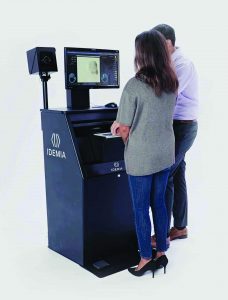
The system’s intuitive interface guides users through the capture process, providing real-time feedback on image quality and reducing the likelihood of errors or rejected submissions. Its modular design supports both desktop and cabinet configurations, making it adaptable to a variety of agency environments. ADA-compliant and CJIS-certified, TPE LiveScan ensures that every capture meets U.S. national standards for biometric quality and data protection. Remote management tools even allow agencies to perform diagnostics and updates without dispatching technicians, saving time and reducing downtime.
By ensuring high-quality biometric data at the point of intake, it enhances interoperability with forensic labs and criminal justice systems. “With TPE LiveScan, agencies are achieving faster and more reliable identification,” said Product Owner Yasmine Guelmi. “This enhances operational continuity from street to forensic laboratories and strengthens confidence in the records shared across jurisdictions.”4 Officers can focus on policing rather than troubleshooting technology. In an era of increasing demands on law enforcement, TPE LiveScan offers a scalable, secure, and efficient solution for biometric intake.
While reliable data is of paramount importance, public scrutiny requires agencies to address additional critical concerns:
-
-
- Data security: how biometric data is stored and accessed
- Bias and accuracy: ensuring fair and reliable results across demographics
- Transparency: explaining how decisions are made and technologies are used
- Oversight: implementing safeguards to prevent misuse
-
Vendors like Cognitec, Face Forensics, and IDEMIA support agencies in addressing these considerations by offering training, documentation, and governance frameworks that promote ethical use and build community trust.
The Road Ahead
Biometric technology is not a silver bullet, but it is another tool to add to the belt. As policing continues to evolve, biometrics will play a key role in shaping safer, smarter, and more accountable policing practices. The challenge is to harness this technology responsibly, with a commitment to transparency, fairness, and public trust.d
Notes:
1Elke Oberg (marketing manager, Cognitec Systems), email interview, October 27, 2025.
2Iain Drummond (chief executive officer, Face Forensics, Inc.), email interview, October 27, 2025.
3Marwan Klnakat (technology & marketing strategy manager, IDEMIA Public Security), email interview, October 31, 2025.
4Yasmine Guelmi (product owner, IDEMIA), email interview, October 31, 2025.
Source ListPlease click on the companies’ names to go to the companies’ websites. |
|
|
MorphoTrak
|
|
Please cite as:
“The Power of Recognition,” Product Feature, Police Chief 92, no. 12 (December 2025): 56–59.