
Do not leave your bags unattended.
If you see something, say something.
These phrases remain on a constant loop throughout airports, train stations, and stadiums. In today’s world, the threat of explosives—whether real or perceived—demands constant vigilance.
Explosives have long been a weapon of choice for those seeking to cause mass disruption. Events like the 2013 Boston Marathon bombing, the 2005 London Underground, and the 2015 Paris terror attacks revealed how vulnerable public spaces can be. Beyond the high-profile events, police agencies regularly respond to suspicious packages, bomb threats, and the discovery of unexploded ordnance. The threats vary, but the stakes remain the same.
Tactics Meet Technology
As explosive threats evolve, the importance of a hazardous devices unit has never been greater. Courage and training are essential, but technicians are only as effective as the tools they wield.
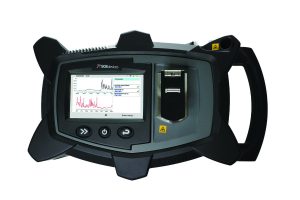
Explosives present unique dangers, and when left unidentified (or misidentified), officers face a far greater risk of injury or fatality. 908 Devices delivers advanced handheld tools that enable police and explosive ordnance disposal (EOD) professionals to rapidly identify explosives, narcotics, and other hazardous materials in the field. The MX908, in particular, is valued not only for detecting trace-level explosives but also for identifying dangerous substances that may accompany explosive use, such as chemical warfare agents or pharmaceutical-based threats like synthetic opioids.
Building on the success of the MX908, 908 Devices’ VipIR represents a leap forward. VipIR integrates Raman spectroscopy and FTIR (Fourier Transform Infrared spectroscopy) into a single device, which is enhanced with a proprietary Smart Spectral Processing (SSP) engine. This innovation allows an officer to perform a single scan, capture data from both technologies at once, and receive a fused analysis that delivers faster, more accurate identification of explosives. “Traditionally, EOD teams carry Raman and FTIR instruments separately,” said John Johnson, vice president of North American sales and strategic marketing at 908 Devices. “Each worked well but required independent scans and never ‘spoke’ to one another. VipIR was developed to close that gap.”1 Users will receive a fused analysis that delivers faster, more accurate identification of explosives and mixtures.
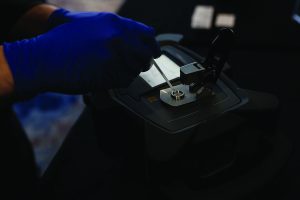
VipIR was put to the test during a training event in Australia with special operations personnel. Students produced mercury fulminate, which is a sensitive primary explosive that conventional Raman devices cannot identify. It often detonates during analysis. Using VipIR’s unique sampling approach, a small sample was analyzed safely. The Raman laser passed through a diamond ATR crystal, while the FTIR interface simultaneously collected its spectrum. VipIR’s SSP then merged the two datasets, and the system successfully identified the mercury fulminate.
“By reducing the need for multiple instruments, speeding analysis, and expanding the range of detectable explosives, [VipIR] is expected to raise confidence in field identification and streamline EOD workflows,” said Johnson. 908 Devices offers an innovative tool that reduces risk to police and bomb technicians, allowing them to handle hazardous materials appropriately.
Once handheld analyzers confirm the presence of explosive materials, containment chambers become the next critical line of defense—providing a secure environment to isolate and neutralize the threat without endangering lives. Dynasafe has supported this effort for decades. The DynaSEALR Q5 Explosive Containment Chamber was developed in direct response to the needs of police and EOD teams who required a cost-effective, mobile, and versatile alternative to larger containment vessels.
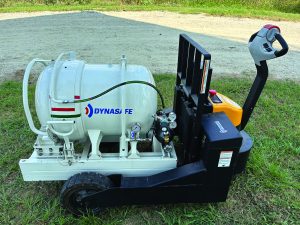
The Q5 is a compact, high-strength containment chamber engineered to safely contain and transport small suspicious packages that may hold explosives, such as pipe bombs, grenades, or small improvised explosive devices. It is tested for repeat detonations up to 2.2 lbs (1 kg) and a maximum one-time detonation of 4.4 lbs (2 kg) TNT-equivalent. Dynasafe’s patented CBRE pneumatic sealing system allows for total containment of devices, even those with biochemical hazards. A fragmentation shield, pipe bomb holder, and gas sampling unit are all additional features of the Q5, offering enhanced containment, threat assessment, and evidence collection.
Once a suspicious package is brought to the open chamber, blast and fragmentation hazards are neutralized in seconds after the chamber bell is pushed closed and the lever is pulled down to engage the locking ring. Gas-tight protection is then obtained by opening the nitrogen gas supply valve to pressurize the pneumatic seals.
“Explosive threats are unpredictable, and officers are often first on scene,” explained Area Sales Manager – Americas Joshua Reyes.2 “Having immediate access to safe, tested equipment like the Q5 ensures they can protect the public while minimizing personal risk.” Dynasafe focuses on practical, deployable tools that allow agencies to respond quickly and effectively. The Q5 was purposely designed for mechanical operation only, with no batteries or motors. This ensures peace of mind for first responders because they know the chamber is always ready for deployment. It can be mounted in a vehicle, on a robotic drive unit, small trailer, or pallet jack to be placed closer to the threat than ever before.
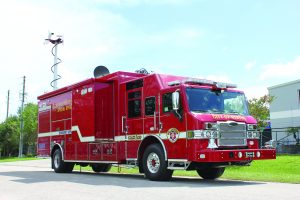
One place containment systems can also be found is within custom command vehicles. Frontline Communications plays a pivotal role in supporting EOD teams by integrating robotic systems into their custom vehicles, ensuring quick access and streamlining response during critical incidents. The designers work to understand each agency’s process to tailor the layout and design of the vehicle for their needs, often integrating the latest tools, robotics gear, and other technologies. Housing EOD equipment in a dedicated, climate-controlled environment ensures gear remains organized, protected, and mission ready.
Frontline Communications offers several key benefits for emergency management, law enforcement, and military operations. Their vehicles come equipped with advanced radio systems, satellite communications, and internet connectivity. With extensive customization capability, agencies can bring advance communication, surveillance, and operational tools directly to the scene. Purpose-built to act as a centralized hub for mission control, the command vehicles allow EOD teams to receive live updates, relay findings, and adjust tactics instantly. Every unit is manufactured in-house (without subcontracting) to ensure full control over quality, consistency, integration, and innovation.
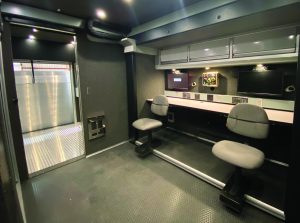
For over 35 years, Frontline Communications has been at the forefront of building highly specialized vehicles with precision and purpose. Beyond explosive threat response, their command platforms offer true multi-mission capability, supporting hazmat incidents, criminal investigations, and large-scale public events.3
Advancements in technology and integration have revolutionized explosives detection. These innovations don’t just improve accuracy and streamline workflows, they save lives. The true breakthrough, however, lies in how these tools work together. In the hands of trained professionals, technology becomes more than equipment—it becomes precision, protection, and prevention.
Conclusion
To keep pace with an evolving threat landscape, bomb squads and EOD units must rely on cutting-edge tools that combine speed, accuracy, and adaptability. The threats they face are not static or predictable, but shift with technology, ideology, and intent.
Officers must be equipped not only with courage and training but with a seamless integrated solution. It is this combination that allows skilled technicians to risk everything to ensure that the public can live in peace.d
Notes:
1John Johnson (vice president North American Sales & Strategic Marketing, 908 Devices), email interview, September 5, 2025.
2Joshua Reyes (area sales manager – Americas, Dynasafe), email interview, September 5, 2025.
3Marketing Team (Frontline Communications), email interview, September 5, 2025.
Source ListPlease click on the companies’ names to go to the companies’ websites. |
|
|
|
|
Please cite as:
“Precision Under Pressure,” Product Feature, Police Chief 92, no. 10 (October 2025): 74–76.