
In the aftermath of major disasters—whether natural or manmade—police agencies MUST quickly adapt to environments where traditional systems no longer function. Roads may become impassable, communication networks may fail, and entire areas may be cut off within hours.
In these conditions, effective response depends on the ability to quickly restore visibility, establish operational control, and reach affected communities—often across multiple domains simultaneously.
Increasingly, agencies are leveraging new technologies to integrate aerial intelligence, deployable infrastructure, and marine mobility into a coordinated response strategy across air, land, and water. Together, these tools allow officers to operate more safely, make better decisions, and sustain operations through recovery.
Gathering Aerial Intelligence
The importance of real-time situational awareness is not limited to natural disasters. In many cases, the need for immediate intelligence is most apparent during rapidly unfolding critical incidents. Aerial intelligence becomes one of the fastest and safest ways to regain situational awareness, but for aerial technology to be effective, it must also be reliable and capable of operating even when networks fail.
BRINC was founded in the aftermath of the Route 91 Harvest Festival shooting in Las Vegas, Nevada—the deadliest mass shooting in modern U.S. history. During this incident, delays in gathering situational awareness highlighted a critical gap in emergency response.1
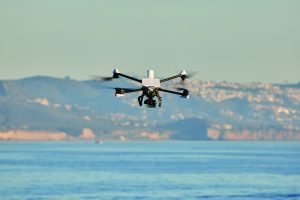
BRINC’s Guardian platform was built to close that gap. Developed with direct input from public safety agencies, it represents a shift from occasional drone deployments to persistent, always-ready aerial response. Designed as an outdoor drone as first responder (DFR) system, Guardian can autonomously deploy from a fixed location and respond to incidents up to eight miles away, allowing agencies to improve awareness across large geographic areas.
Through integrated Starlink satellite connectivity, Guardian maintains a secure data link even when cellular networks and ground-based communication systems are compromised. This ensures that command staff retain uninterrupted access to live intelligence, regardless of conditions on the ground.
Guardian’s operational endurance further supports extended deployments. With extended flight time, long-range coverage, and an automated docking station that enables rapid battery and payload swapping, the system can sustain continuous operation. This level of autonomy allows agencies to maintain a persistent aerial presence, tracking evolving conditions in real time rather than relying on intermittent observations.
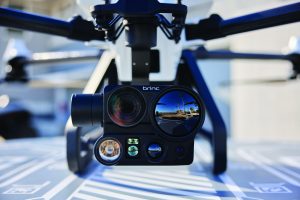
The drone’s advanced imaging and sensing capabilities, including high-resolution zoom, dual thermal cameras, and a spotlight, allow responders to identify hazards, locate individuals, and assess damage from a safe distance. Beyond observation, Guardian can be configured to actively support response efforts. Payload adaptability enables the delivery of critical equipment, such as defibrillators or flotation devices, allowing the DFR to assist in lifesaving operations even before personnel arrive.
In post-disaster environments, where conditions shift rapidly and access is limited, systems like Guardian provide a critical advantage: the ability to maintain visibility when it is most difficult—and most necessary—to do so.
Restoring Ground Control
While aerial platforms provide critical overhead awareness, maintaining visibility across key locations on the ground is equally important, particularly as response transitions into sustained recovery. In large-scale disaster events, such as hurricanes impacting entire regions or complex emergencies requiring widespread evacuations, maintaining visibility across multiple locations becomes a significant challenge for responding agencies. “When infrastructure is compromised, the first challenge is often visibility,” said Keith Crawford, manager of field marketing at Flock Safety. “Before agencies can allocate or repurpose resources, they need to understand what’s happening, where help is needed, and which areas remain accessible.”2
Flock Safety addresses this challenge by combining fixed and mobile video, license plate recognition, and DFR capabilities into a unified system. During disaster response, this integration allows agencies to quickly establish a real-time operational picture. Meanwhile, fixed cameras and mobile deployments help deliver ground-level visibility across critical areas, including evacuations routes, damaged infrastructure, and high-traffic zones.
When a 911 call or alert is received, the DFR system can automatically dispatch a drone from its dock. It flies to the scene, streams live aerial video back to officers, and maintains overwatch in real time.
Flock Safety’s Mobile Security Trailers are designed for rapid deployment without requiring external power or network infrastructure. The trailer is solar- and battery-powered, and equipped with high-resolution cameras and integrated lighting, which provides continuous monitoring in areas where traditional systems may be unavailable or damaged.
By feeding live video directly into the broader Flock Safety platform, the deployments of the DFR and trailers create a networked system of observation points that can be monitored centrally. For command staff, these capabilities transform how operations are managed. “Officers shouldn’t have to enter a structurally compromised building or a flooded street to understand what’s happening inside it,” said Crawford. Rather than relying on fragmented information, agencies can monitor conditions in real time and make informed decisions based on a complete operational picture.
Accessing Where Roads No Longer Exist
Even with strong situational awareness, disaster response ultimately depends on the ability to reach affected areas. In flood-prone and coastal environments, that responsibility often falls to marine units.
In severe flooding events—such as the July 2025 incident at Camp Mystic in Texas—roadways can quickly become waterways, leaving entire communities inaccessible by land and placing increased pressure on marine units to conduct rescue and recovery operations.
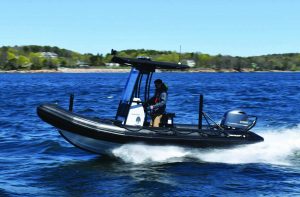
RIBCRAFT’s rigid inflatable boats (RIBs) are designed specifically for this role. The deep V-hull design enables the vessel to cut through waves and navigate rough water with greater control and reduced impact, while the inflatable collar provides additional buoyancy and stabilization. This combination ensures that the boat remains level and secure during operations.
“[The RIB] does two things in a disaster response,” said RIBCRAFT’s Chief Operating Officer Matthew Velluto. “[It] allows personnel to get to wherever may not be accessible via land… but then it also can be used for retrieval.”3 The operational benefits are particularly evident in rescue scenarios. High buoyancy allows the boats to carry significant weight, enabling officers to transport multiple individuals in a single trip. The inflatable collar acts as a built-in fendering system, allowing crews to safely approach structures, docks, or other vessels without causing damage.
The relatively lightweight construction makes the RIBs easy to transport by trailer, allowing agencies to deploy quickly to affected areas. RIBs range in size from 15 to 41 feet, expanding the opportunities for officers to navigate flooded neighborhoods, rescue stranded residents, support dive teams, and transport supplies in various environments. Just as importantly, they are often designed for simplicity, enabling one or two officers to operate them effectively without extensive training.
As agencies continue to prioritize purpose-built equipment, marine units like RIBs are becoming an essential component of disaster preparedness.
Achieving Disaster Readiness
For police leaders, the evolution of post-disaster response is clear. No single tool can address the complexity of modern disasters. Instead, success depends on the ability to integrate capabilities across multiple domains—air, land, and water.
By investing in solutions that provide visibility, mobility, and operational resilience, agencies can better protect their personnel, respond more effectively to changing conditions, and support communities through recovery.
When disaster disrupts everything else, the ability to operate across all three domains is no longer an advantage; it is essential.d
Notes:
1David Benowitz (vice president of strategy, BRINC), email interview, May 28, 2026.
2Keith Crawford (manager of field marketing, Flock Safety), email interview, June 5, 2026.
3Matthew Velluto (chief operating officer, RIBCRAFT), phone interview, May 28, 2026.
Source ListPlease click on the companies’ names to go to the companies’ websites. |
|
Please cite as
“When Disaster Strikes,” Product Feature, Police Chief 93, no. 7 (July 2026): 60–61.