
At the beginning of the 21st century, when the Specialized Police Stations for the Environment and Historical Heritage of the Federal Police (PF) were created, according to Ordinance No. 1,300 of September 4, 2003, the performance of organized criminal groups in various areas of environmental crime in the Brazilian state was already being mapped.1
Over the years, a dangerous binomial—high profits and low penalties related to environmental crimes—has driven the performance of organized crime in this arena, which is an unfortunate reality experienced in most countries today.
In an article published in January 2022, the president of the Financial Action Task Force, Dr. Marcus Pleyer, estimated that environmental crime is up to U.S. $281 billion annually, which at the current exchange rate, is equivalent to about R$1.6 trillion.2
According to a study published by the Igarapé Institute in April 2023, this figure ranks environmental crimes as the third most profitable criminal activity in the world, behind only drug trafficking and smuggling.3
After being elected in October 2022, Brazil President Luís Inácio Lula da Silva announced that he would implement the resumption of the environmental protection agenda in his government, and, in fact, on the first day of his third term as president of Brazil, Decree 11,348/2023 was issued, which restructured the Ministry of Justice and Public Security (MJSP) and took the first step toward the creation of a new public security system for the Legal Amazon, with the establishment of a new directorate within the PF with new attributions focused on environmental protection, especially in the Amazon.4
In addition to strengthening the PF’s own actions to combat environmental crimes, crimes against Indigenous peoples, and crimes against historical and cultural heritage, the Directorate of the Amazon and Environment of the Federal Police (DAMAZ/PF), was also tasked with articulating the public security actions of the three spheres of government and with other countries of the Pan-Amazônia region and coordinating integration units established by Brazil in this region.
AMAS Plan
After detailed planning and discussions carried out within the MJSP and with other portfolios, the Amazon Security and Sovereignty (AMAS) Plan was instituted in July 2023, through Decree 11,614/2023.5
This plan has three axes:
Axis 1: Governance—Establishment of a governance for the articulation, planning, and execution of the actions and investments necessary for public security in the Amazon biome, which includes the Management Committee, chaired by the Minister of Justice and Public Security and composed of the top leaders of the PF, the National Secretariat of Public Security (SENASP), the Federal Highway Police (PRF), representatives of the Ministries of Environment and Defense, and also representatives of the nine states of the Legal Amazon, in addition to a Technical Commission with the same representation as the Management Committee, in which the PF seat is occupied by DAMAZ/PF, and State Strategic Committees, where the federal forces present in the states and the state forces act jointly and permanently tracing the paths of execution of the AMAS Plan in each of the nine states of the Brazilian Legal Amazon.
Axis 2: Structure—Modernization of the legal framework that regulates environmental activities and the rules aimed at the prevention and repression of environmental crimes, in addition to the search for specific resources for investments in adequate infrastructure and funding of actions defined by the governance structure, seeking budgetary and extra-budgetary resources (such as the Amazon Fund, managed by the National Bank for Economic and Social Development) to strengthen the actions and infrastructure (e.g., units, equipment, new technologies) dedicated to combating organized crime that operates in the Amazon biome.
Axis 3: Operational—Agreement on operations and investigations against organized crime operating in the Amazon, creating a network for planning and executing integrated operations and investigations. In this axis, the Integrated Forces to Combat Organized Crime (FICCOs), established by the PF together with the Secretariats of Public Security in the Amazon states, play a fundamental role in the most complex investigations, which will be further enhanced with the beginning of the work of the Amazon Police Cooperation Center (CCPI Amazônia), a structure that will be detailed later in this article.
To guide the activities of the AMAS Plan, the Strategic Program for Security in the Amazon (PESPAM) was prepared and agreed upon, developed jointly by the PF, representatives of SENASP, PRF, the National Secretariat for Penal Policies, and the public security secretariats of the nine states of the Brazilian Legal Amazon and the work carried out following the determinations of MJSP Ordinance No. 503/2023 of October 3, 2023 (a regulation that defined guidelines for PESPAM and for the Integrated Tactical Public Security Plans for the Amazon [PTI Amazônia], within the scope of the AMAS Plan).6 Based on this strategic document, and during planning rounds held in each of the nine Federation Units, nine PTIs Amazônia were prepared and agreed upon (one for each state of the Legal Amazon), with the participation of the aforementioned federal forces and the public security secretariats of the states and their operational forces (military police, civil police, military fire departments, scientific police, and public security internal affairs offices).
Following the definitions of the PTIs Amazônia, Integrated Operational Plans are being built by the State Strategic Committees of the AMAS Plan (components of the governance structure) and in operation in each state of the Legal Amazon to face the geographic and thematic priorities mapped in the PTIs Amazônia and taking into account the specifics of each state.
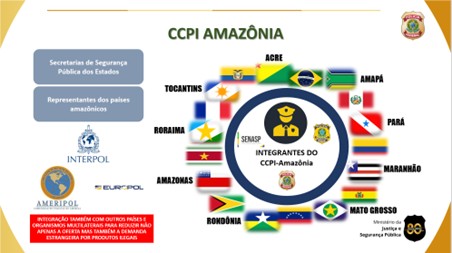
Decree 11,614/2023, which instituted the AMAS Plan, created the CCPI Amazônia within the scope of the PF, which is being implemented in the city of Manaus. The CCPI Amazônia will bring together the following stakeholders:
-
- the coordination team of the PF
- liaison officers from SENASP and PRF
- the public security secretariats of Acre, Amapá, Amazonas, Maranhão, Mato Grosso, Pará, Rondônia, Roraima, and Tocantins
- the public safety secretariats from the Pan-Amazônia countries of Bolivia, Colombia, Ecuador, France (French Guiana), Guyana, Peru, Suriname, and Venezuela
- guests from multilateral public security organizations such as INTERPOL, Ameripol, and Europol
The partners will all be working daily to exchange expertise and experiences, share intelligence and information, and carry out joint investigations and operations.
AMAS in Action
The AMAS Plan provided the raising of R$318 million from the Amazon Fund to strengthen the operational capacity of the PF and other public security institutions operating in the Legal Amazon, enabling the installation of the CCPI Amazônia, the expansion of aerotactical capacity, with the leasing of helicopters that will be based in Manaus and will operate exclusively in the Amazon, and the expansion of the TARGET GOLD Project for traceability of minerals through isotope reading, the opening of new PRF bases. The funds will also aid in the acquisition of new equipment and the implementation of the Environmental Operations Company of the National Public Security Force and the expansion of the operational capacity of the police forces of the states of the Legal Amazon, including the acquisition of new boats to operate in the rivers of the Brazilian Legal Amazon.
An important strategy of the AMAS Plan is to promote the reduction of intrusion from Indigenous lands (TIs), with the removal of non-Indigenous people, the vast majority of whom are dedicated to the illegal exploitation of nature in these areas. The practices of illegal mining, illegal logging, illegal occupation and deforestation of areas, and illegal use of these areas for agriculture and livestock are observed. Large swaths of Indigenous lands are being cleared, including land belonging to the Yanomami, Apyterewa, Karipuna, Trincheira-Bacajá, Alto Rio Guamá, Munduruku, Uru-Eu-Wau-Wau, Arariboia, and Kayapó peoples.
It is important to highlight that the PF has, in all states of the federation, Specialized Police Stations of Maio Ambiente, in addition to Environmental Groups in the decentralized police stations where these crimes are most common. These units, with the support of the DAMAZ/PF, have improved their investigations of environmental crimes, focusing on the decapitalization of criminal groups. As a result of this articulation and coordination work, in 2024, the investigations linked to DAMAZ/PF were responsible for the seizure of R$1,649,114,587.69 and another R$365,527,950.87 in decapitalization of crime derived from the disabling of machinery used in environmental crimes (e.g., dredges, tractors, backhoes, planes, helicopters), totaling more than 2 billion reais of decapitalization of organized environmental crime, in the last year alone.
A good example of this improvement was Operation Greenwashing, which investigated fraud and other crimes related to the carbon credit market, demonstrating that, although organized crime is already operating in this relatively new market, public security is also attentive and acting to repress such crimes.7
Another front of action of DAMAZ/PF has been the fight against criminal fires through ostensive actions and investigations carried out by special police teams deployed to act in the states that concentrate the most cases of these fires (Mato Grosso and Mato Grosso do Sul in the Pantanal, and Acre, Amazonas, Pará, and Rondônia in the Amazon biome). The work began in 2024 and actions promoting the prevention and mitigation of the problem continued in 2025.
Beyond the Amazon
Additionally, with the advancement of discussions for the creation of Plans to Prevent and Combat Deforestation for the other biomes in Brazil, strategies similar to the AMAS Plan can be used to preserve and protect other vulnerable regions.8
Within the scope of the PF, DAMAZ/PF has already been preparing to hold discussions with federal and state public security forces impacted by each of these biomes for the preparation of strategic and tactical public security plans, along the lines of what was done with PESPAM and the Amazon PTIs. With this, the objective is that all biomes in Brazil will have their integrated public security plans to combat deforestation in the strategic, tactical, and operational spheres—thus, better directing operational efforts and investment and funding resources.
Finally, it is worth mentioning the performance of DAMAZ/PF in the fight against crimes against the historical and cultural heritage of Brazil, which is also part of the national environment. Partnerships have been sought between the PF and the National Institute of Historical and Artistic Heritage, as well as with other related cultural institutions, in order to enhance investigations related to money laundering involving works of art, as well as crimes involving sacred art and illegal trade in fossils, among others. It is important to emphasize that the repatriation of elements of the culture and history of Brazil has been a constant pursuit of DAMAZ/PF, with successful cases of repatriation of these illegally traded goods. Including the recovery of some items removed from the country and located in other nations and continents.9
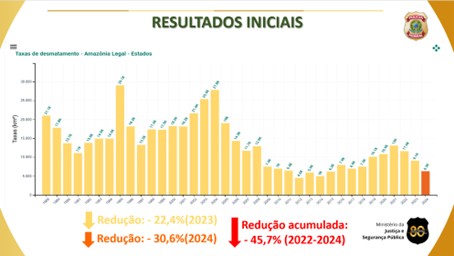
The resumption of the environmental agenda in all its aspects, notably the fight against environmental crimes, has already begun showing encouraging initial results, as evidenced by the graph containing the deforestation rate in the Legal Amazon, which in the first two years of this work has already achieved significant reductions.10
The satellite images of the Brasil MAIS Program relating to the areas especially affected by illegal mining corroborate this movement, either by changing the color of the waters of some rivers previously heavily contaminated by illegal mining, or by the resumption of vegetation in places previously occupied by mining activity.11
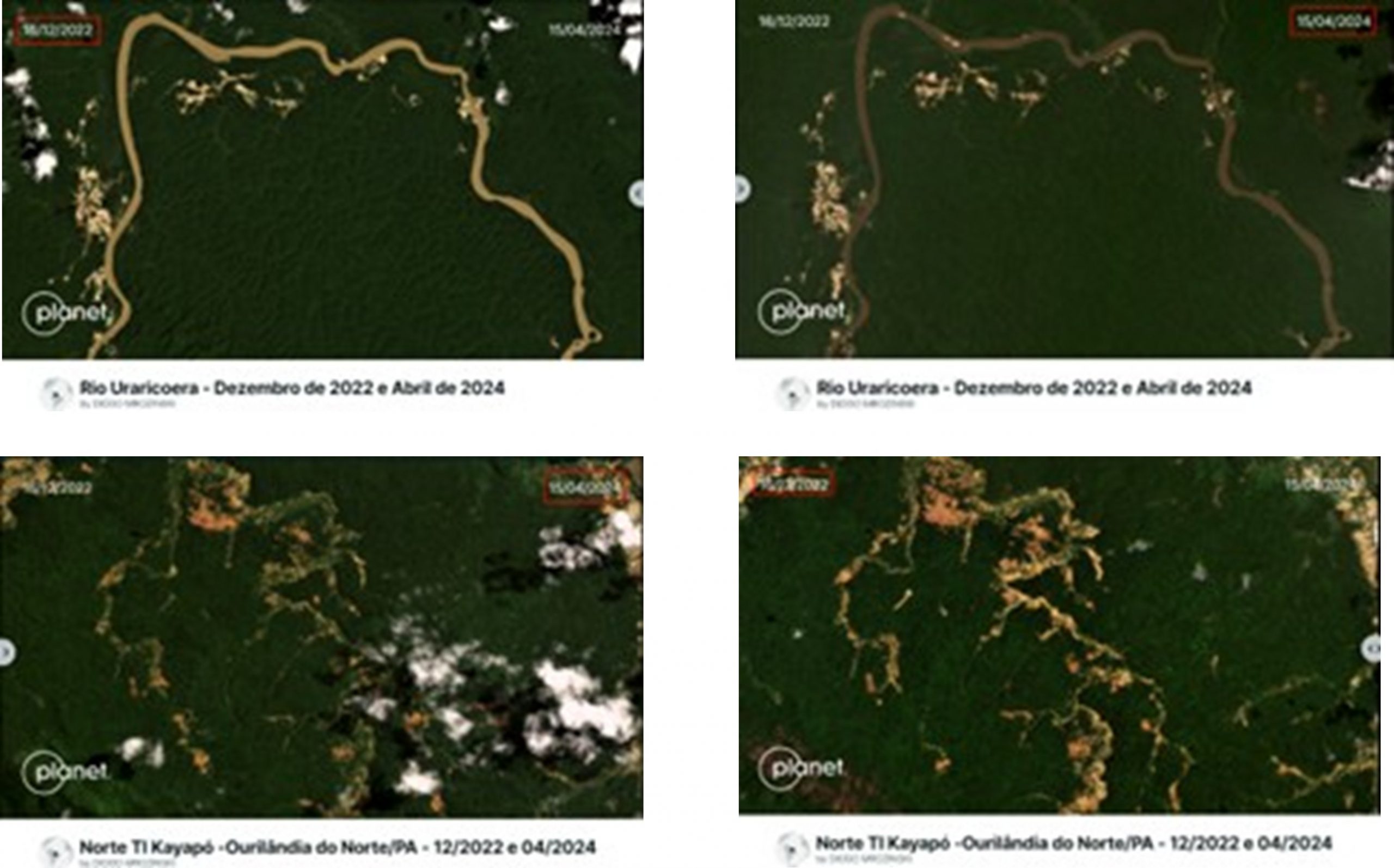
These initial results demonstrate that the decision made during the government transition phase, which took place between November and December 2022, and was effective as of January 2023, was the right one and that strengthening the integration between the public security forces of Brazil and neighboring countries is fundamental to safeguard the future of the planet for future generations.
Notes:
1Federal Official Gazette No. 172, §1, 17 (September 5, 2003).
2Marcus Pleyer, “Opinion: In This Exclusive Article for AML Intelligence, FATF President Dr. Marcus Pleyer Warns of the Devastating Impact of Environmental Crime, Says Governments Must Act Now to Tackle the $281BN Illegal Activity,” AML Intelligence, January 12, 2022.
3Siga o Dinheiro: Conectando Sistemas de Proteção Contra a Lavagem de Dinheiro para Combater a Prática de Crime Ambiental na Amazônia (Rio de Janeiro: Instituto Igarapé, 2023).
4Official Gazette of the Union, Special Edition, §1, 197, January 1, 2023.
5Federal Official Gazette No. 138-B, §1, 1, July 21, 2023.
6Official Gazette of the Union No. 190, §1, 45, Nvember 4, 2023.
7Federal Police, “Brazilian Federal Police Launch Operation Greenwashing To Investigate The Illegal Sale Of Carbon Credits,” news release, June 5, 2024.
8Reinstated through Decree No. 11,367, Federal Official Gazette No. 1-A,§1, 2, February 1, 2023.
9Agência Brasil, “Historical Book Stolen from Pará Museum Is Located in London,” news release, May 4, 2024.