

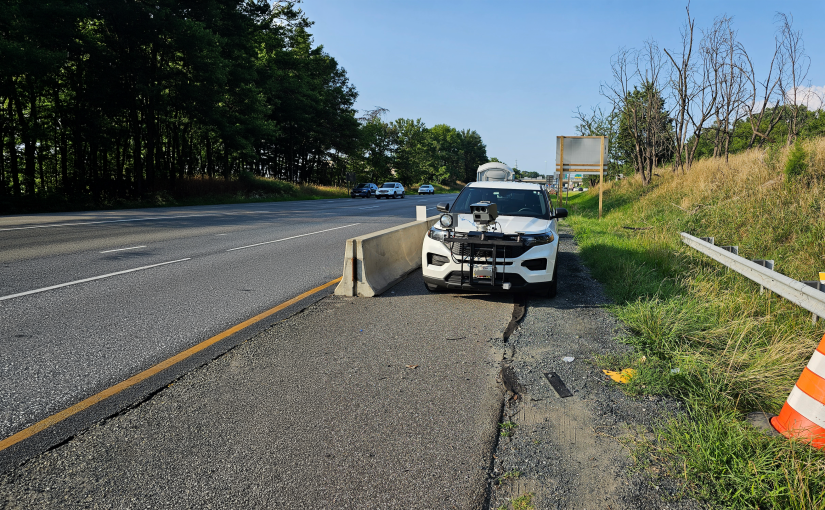
Every patrol officer knows the moment. You pull to the shoulder, step out of your vehicle, and walk toward an unknown driver—with traffic moving at highway speed just feet behind you. Distracted driving is at epidemic levels, and driver behavior toward law enforcement has grown increasingly unpredictable. What looks routine from the outside is, statistically, one of the most hazardous things a police officer does. That hazard is quantifiable: According to the National Law Enforcement Officers Memorial Fund, traffic-related incidents have been the leading or co-leading cause of officer line-of-duty deaths in 15 of the past 20 years.1 In 2024, traffic fatalities increased 48 percent over the prior year, claiming 46 officers.2 The Centers for Disease Control and Prevention (CDC) and the National Institute for Occupational Safety and Health (NIOSH) tracked officer line-of-duty deaths over a recent 10-year period and found that traffic-related causes—vehicle crashes and being struck by vehicles on foot—accounted for nearly 28 percent of all police officer fatalities.3 One officer per week, on average, was killed on U.S. roads during that time span.
Against this backdrop, automated traffic enforcement deserves serious operational consideration as a targeted safety tool that removes officers from high-risk, low-discretion enforcement scenarios and returns that capacity to the complex, human-judgment work where sworn personnel have the greatest impact.
The Stop That Wasn’t
A speed or red-light camera has no body stepping out into traffic, no presence that can be ambushed or struck, no families to console when their loved one doesn’t make it home, no commands that carry the potential for escalation.
The operational significance of that difference is substantial. A significant share of officer contact with the public occurs during routine traffic enforcement, and those encounters carry risk in both directions. Research from the Officer Down Memorial Page and the FBI’s Law Enforcement Officers Killed and Assaulted data covering felonious officer deaths from 1990 to 2021 found that the overwhelming majority of officers killed during traffic stops were killed during the stop itself, most during the initial approach.3 Nearly half were killed during the stop itself, most during the initial approach. Twenty-five percent were killed in roadside altercations. Across all cases, the study found that offenders intended to kill the officer in 60 percent of incidents.4
Separately, NIOSH found that struck-by incidents—officers on foot hit by passing vehicles while conducting stops, directing traffic, or assisting motorists at crash scenes—accounted for 131 line-of-duty deaths over a recent decade. In the first three quarters of 2021 alone, more than half of all traffic-related officer fatalities were struck-by incidents.5
These are the predictable outcomes of placing a human being in the roadway to enforce rules that, in specific high-hazard circumstances, can be enforced another way.
Force Multiplication, Not Replacement
Automated enforcement makes the most operational sense when applied selectively at designated locations where the violation type is well-defined and the hazard to officers is disproportionately high. Automated enforcement deployed as fixed infrastructure at a school zone or red-light intersection or as mobile trailer units at work zones that shift with construction activity can be a good fit for these types of high-volume, low-discretion events. A vehicle either exceeded the speed threshold, or it did not. A driver drove through the red light or did not. There is no investigative judgment required at the point of detection.
Deploying sworn personnel to these locations to write speed citations is, from a workforce planning standpoint, a poor return on the scarcest resource in law enforcement. According to a 2024 IACP survey of 1,158 agencies, more than 70 percent reported that recruitment has become more difficult compared to five years ago.6 A Police Executive Research Forum tracking survey found that total sworn staffing at surveyed agencies declined approximately 5 percent between 2019 and 2023.7 Agencies across the United States—from major cities to small towns—are running short-staffed, asking officers to cover extra shifts, and delaying response to calls.
Automated enforcement at designated hazard locations changes that equation. A camera operates around the clock, requires no shift coverage or overtime authorization, and delivers consistent detection at the same location day after day. At locations where speed and red-light violations are the primary public safety concern, the detection process is fully objective, with no officer discretion required at the point of capture.
The result is recovered patrol capacity. Officers previously assigned to school zone speed detail or work zone enforcement can be redeployed to calls requiring human presence, community engagement, investigative follow-up, or crisis response. In jurisdictions running well-designed automated traffic enforcement programs, this reallocation is a planned feature of the program architecture.
Defensibility and the Bias Problem
Police leaders face a second, related challenge: Every discretionary traffic stop carries exposure to accusations of selective or biased enforcement. The data on racial disparities in traffic stops is well-documented and difficult to dismiss. A 2024 study published in the Proceedings of the National Academy of Sciences compared camera-generated speeding tickets against officer-initiated traffic stops and found that camera tickets showed smaller racial disparities than officer-initiated stops and officer stops showed consistent disparities that could not be fully explained by other variables.8
For command staff managing community trust and internal affairs workloads, this disparity creates real institutional risk. Every stop becomes a data point in a pattern that advocates, journalists, and city councils can aggregate and examine.
Automated enforcement at fixed, data-justified locations offers a structurally different enforcement model: consistent, location-based detection grounded in crash history rather than officer discretion. Site selection based on collision data and hazard analysis is the standard practice for well-run programs. When a camera is placed at a school zone because a child was struck crossing that street, the program carries a defensible, documented rationale.
Camera programs still require thoughtful design, clear fine structures, accessible challenge processes, and regular equity auditing to deliver on that promise. For agencies under sustained pressure to demonstrate fair enforcement, a well-governed automated program provides documented, auditable records that support both public accountability and legal defensibility.
The Work Zone as a Case Study
Work zone enforcement illustrates the force multiplier argument most clearly. In the United States, police officers detailed to work zones are among the most exposed personnel in the profession as they may be required to stand or direct traffic in active travel lanes, often adjacent to high-speed traffic, with minimal physical protection.
Washington State’s Work Zone Speed Camera Program, launched in April 2025 through a partnership between the Washington State Department of Transportation and Washington State Patrol, offers early but compelling data. Trailer-mounted cameras rotating across active work zones produced measurable behavior change: On Interstate 5 near Joint Base Lewis-McChord, the share of drivers speeding through the work zone dropped from more than 60 percent to as low as 30 percent during enforcement periods.9 At a separate site on SR 522, the number of drivers speeding continued to decline even after the camera rotated out—a sustained deterrence effect that speaks directly to the program’s occupational safety rationale.
The outcome for troopers is equally direct: Every speeding vehicle deterred by a mobile camera unit is a vehicle that never required an officer to step into a live travel lane to address.
What Implementation Requires
Automated enforcement programs do not run themselves. The agencies that see durable results—continued public acceptance and trust, sustained compliance, clean legal records—treat program management as seriously as they treat hardware selection. Strong program governance includes an independent technical review of citations before issuance, clear and accessible challenge processes, regular audits, transparent public reporting, and sustained community communication.
For police leaders, the administrative burden of a poorly designed program is real. Citation processing backlogs, constitutional challenges, and speed trap narratives in local media have derailed programs in multiple jurisdictions. Programs that endure over time succeed because of governance quality—the operational discipline applied to citation review, public communication, and legal compliance—well above and beyond the hardware itself.
Police leaders evaluating automated enforcement should ask who is managing the program end-to-end and what experience they bring to that role. End-to-end program management—citation processing, public education, legal compliance, equity reporting, and court coordination—requires specialized operational experience that a hardware-only vendor or a generalist agency typically cannot provide.
The Case for Smarter Deployment
The staffing challenges facing police agencies will take years to fully resolve. In the meantime, agencies are managing a wide set of simultaneous demands—patrol coverage, complex incident response, community trust, and equitable enforcement documentation—with constrained personnel resources.
Automated enforcement, deployed thoughtfully at high-hazard locations, addresses one part of that equation directly. It moves sworn personnel out of one of the most physically dangerous and legally exposed activities in patrol work, returns that capacity to assignments where human judgment is essential, and introduces an enforcement methodology with a clear, auditable evidentiary record. For agencies working toward stronger safety outcomes and more sustainable operations, the path forward is as simple as it is compelling: Put the technology where the hazard is and put your people where the judgment is. Every officer who steps out of that vehicle deserves nothing less.
 Tim Bigwood is chief operating officer at Elovate. A former U.S. Army Officer and active member of veteran advocacy groups, he brings 25+ years of leadership across technology, highly engineered systems, and large-scale operations. His career spans roles as CEO and COO in industries where system reliability, regulatory compliance, and operational precision are mission critical.
|
Elovate provides advanced automated traffic enforcement solutions designed to improve road safety and community well-being. With a focus on innovation and transparency, Elovate’s technologies support municipalities in enforcing traffic laws effectively and equitably. |
Notes:
1National Law Enforcement Officers Memorial Fund (NLEOMF), Law Enforcement Fatalities Report (2025).
2NLEOMF, Law Enforcement Fatalities Report.
3Michelle Rippy and Summer Jackson, “Education, (Re)training, and Traffic Stops: Felonious Law Enforcement Officer Deaths in the United States,” International Journal of Law, Crime and Justice 74 (2023): 100618.
4Office of Justice Programs (OJP), National Criminal Justice Reference Service (NCJRS), “Traffic Stops: An Analysis of Officers Killed,” training videotape (OJP/NCJRS, 1989).
5Melanie L. Fowler and Rebecca Knuth, “Prevent Struck-By Incidents at Crash Scenes,” Focus on Officer Wellness, Police Chief 89, no. 1 (2022): 16–17.
6IACP, The State of Recruitment & Retention: A Continuing Crisis for Policing – 2024 Survey Results (IACP, 2024).
7Police Executive Research Forum (PERF) “PERF Survey Shows Police Staffing Increased Slightly in 2024 But Still Lower Than 2019,” PERF, July 5, 2025.
8Wenfei Xu et al., “The Racial Composition of Road Users, Traffic Citations, and Police Stops,” Proceedings of the National Academy of Sciences 121, no. 24 (2024): e2402547121.
9Federal Highway Administration, “Work Zone Safety.”