


If one enjoys history, or perhaps just being a student of human nature, it’s easy to see that humans are often more in love with the idea of a possible solution than understanding the problem itself. For generations, police agencies and officers alike have witnessed a recurring tragedy play out. When a crisis occurs, a legislative mandate is handed down, or a community outcry peaks, the immediate reflex is to draft a new policy. There is a belief that by codifying a behavior, the ailment is cured. So much time and energy is spent on trying to shape a solution that very little time or attention is given to discovering the right problem.
More often than not, agencies are simply decorating the problem. The term “decorating” in this context describes the act of applying surface-level fixes to systemic, murky issues. Administrators dress up a broken process in new language, call it “change,” and then are amazed when the problems persist. To truly innovate in the realm of policy, leadership must stop asking “What should the policy say?” and start asking “What is the real problem being solved with this policy?” By merging cognitive discipline and humility, problem reframing techniques, rigorous systems thinking, disruptive questioning, and other rethinking frameworks, policing can move beyond performative policymaking into actual operational excellence.
The Mental Model of Bad Policy
The greatest obstacle to any solution—including effective policy—generally isn’t a lack of resources, it’s the architecture of the individual or collective mind. Many problems aren’t solved by looking for solutions; they’re solved by examining the problem. Sadly, policing has a history of leaning on “the way we’ve always done it,” and the culture often prizes certainty over curiosity. This makes policing uniquely susceptible to several cognitive biases that sabotage novel policymaking and training efforts from the start:
• Confirmation Bias: Administrators tend to draft policies that support preexisting beliefs about what works, while ignoring data that suggest current methods might be ineffective. For example, many agencies maintain policies that require new recruits to memorize 10 codes and street maps through rote memorization—essentially staring at lists and maps until they can be recited. Some might believe this is the common and accepted way and ignore the data suggesting that rote memorization is one of the least effective ways for the human brain to retain complex spatial or visual coded information. This is amplified by the fact that ordered memorization was never the actual point or objective, but visual recall was.
• Status Quo Bias: Leaders might resist change because the familiar feels safe. Outdated firearms and use-of-force policies or training are kept simply because they have been on the books for decades, even when accepted modern best practices and human performance science render them obsolete.
• The Sunk Cost Fallacy: Administrators might continue to invest in failing policy initiatives—like expensive, ineffective software or units—simply because the money and political capital has already been spent, effectively doubling down on a bad path.
• Groupthink: Within command structures, the desire for harmony often outweighs the need for critical inquiry. If a chief wants a specific policy, supporters ensure it passes without the rigorous opposition necessary to find its flaws and ensure success. There is a plethora of safeguards to prevent this, including anonymous feedback and voting or assigning a “rotating devil’s advocate” to challenge assumptions and present counter arguments. However, those safeguards are rarely implemented.
To challenge mental mapping and overcome these very human issues requires cultivating intellectual humility—the recognition that one’s current knowledge or view might be flawed. Consider high failure rates in a defensive tactics program. A standard reflex is to mandate more hours of the same training. However, by practicing rethinking, the question is asked: Is the goal for officers to pass a test or to build real-world competency under high stress? This might shift the policy from rote repetitions and more mandated hours (which create training issues and a host of morale and staffing issues) to a progressive performance coaching and mentoring program that uses reality-based training and mimics the actual field environment, effectively building better skill retention and overall enjoyment of the program.
Reframing the Objective
When discussing innovation, finding actual objectives, and problem reframing, the analogy of a “hand turkey” (the simple drawings children make in elementary school) is often helpful. If the goal is to create a beautiful painted masterpiece of a wild turkey, no amount of practicing the hand turkey will get someone there. The fundamentals are entirely different. An artist will never get so good at tracing their hand that it becomes a beautiful rendition of a painted turkey.
This cultural training shift is currently happening in firearms training; however, it could be implemented in policymaking just as easily. In problem reframing, it is important to distinguish between simply fixing a problem and fundamentally rethinking it. How a problem is framed does matter, and all too often a solution is simply framed as a problem. “We need to increase training” is not a problem; it’s a solution disguised as a problem. In reframing, it is possible to both explore a frame or break a frame to allow someone to correctly view the issue. When successful reframing occurs, it’s discovered that the most valuable breakthroughs generally aren’t technical (adding more resources, rules, or oversight), they are the mental breakthroughs that happen when examining a problem, not a solution.
Take the example of a policy objective that states, “to build better servant leaders and to empower our youngest leaders,” but the policies surrounding it focus entirely on control, organization, and obedience. Those words and policies have a difficult time coexisting.
If a public issue is framed as a lack of transparency from the very beginning, the policy draft might require more body-worn cameras. However, if an agency is willing to consider the framing of the problem as a lack of shared trust, rather than simple transparency, leaders might realize body-worn cameras are just a tool and the real policy shift might need to be in patrol, recruitment, and promotional processes. Before drafting a line of policy, it is important to intentionally ask: What exactly is the objective? Is the objective to reduce foot pursuits or to reduce the risk associated with them? This frame matters. One might lead to a restrictive ban; the other leads to better containment training and suspect management. Is the objective to increase recruitment numbers or to improve the quality of candidates who stay? Policies focused only on numbers might lead to lower standards, whereas focusing on retention can lead to improved training, mentorship, and culture—solving the recruitment issues by solving the actual problem.
Finding the Constraint
When a policy isn’t working, the instinct is to often add more: more rules, more oversight, more resources. Proponents of the Theory of Constraints and thought leaders like Kristin Cox would suggest that this is often wasted effort.1 In any system, there is generally one true constraint (the bottleneck). If an agency is improving anything other than that constraint, then administrators are just “decorating.”
Consider a policy to speed up the hiring process to address a staffing crisis. Many agencies might policy-push for more recruiters, but if the real constraint is a limited number of field training officers, adding recruiters and more new officers just piles more work onto a unit that can’t handle it, effectively changing nothing and, in many cases, worsening the situation.
The Pareto Principle suggests that 80 percent of problems come from 20 percent of causes.2 If a department sees a spike in “rudeness” complaints, the policy reflex might be a mandatory customer service class for everyone. Innovative policymakers might ask if 80 percent of those complaints are coming from 20 percent of officers or specific call types. The true constraint may not be a lack of manners but burnout. If those 20percent of officers are working excessive overtime due to flawed staffing policies, the rudeness is a system symptom, not a character flaw. After consideration, the policy change might be correcting the staffing and wellness issues (the true constraint) rather than decorating with ineffective training and exacerbating the current issues.
To help find the true root issue, bottleneck, or constraint in an agency’s policy problem, it’s helpful to use a psychological tool often overlooked in policing: the Johari Window. This technique allows users to categorize what is known and unknown, helping leaders to move past the mirage of reform and change by identifying whether the issue is a lack of information or a failure to see flaws. The Johari Window breaks information into four quadrants: the open area (what is known to both leadership and the front line); the blind spot (what others see about an agency that leaders are unaware of); the hidden area (what officers or the community know but are hesitant to share with administration); and the unknown area (the assumptions and issues that no one has addressed or identified yet).
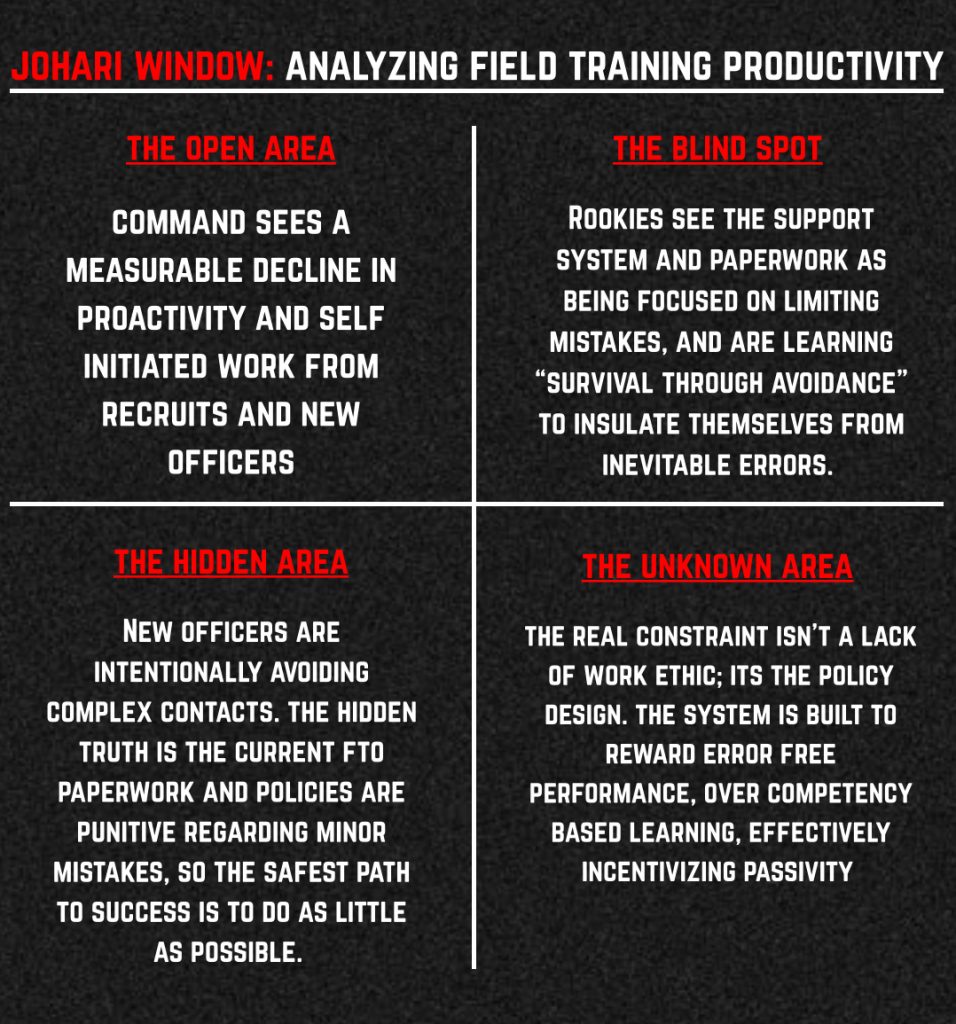
The open area is obvious, but the unknown areas, although discoverable, can be difficult to explore. For high-value policymaking and problem-solving, spending time in the blind and hidden areas generally yields the best results. There is always information waiting to be discovered, if one has the willingness and humility to search for it.
Figure 1 highlights an actual policy example that was discovered during collaboration with a local department. By using the Johari Window, the department moved from “decorating” to solving the actual constraint. The status quo bias of the new generation is lazy or unmotivated was rejected, and the focus was on an intent-based reframe: What do we actually want to see, and is it possible that our field training policy punishes initiative? The outcome was a policy of promoting competent, proactive problem-solving in which the purpose of field training is field-readiness rather than administrative perfection.
Command to Intent, Control to Support
One of the most powerful tools for policy implementation is a concept that has been utilized in the United States Marine Corps for generations: commander’s intent (CI). Standard policy often tells an officer exactly what to do—or, more often, what not to do—in a specific situation. However, the world is too complex for a manual to cover every variable. CI provides the task, the purpose, and the end state. It allows those in the field who are making the decisions to exercise judgment and initiative—to depart from an original plan when the unforeseen occurs—consistent with higher aims.
To truly leverage this tool, however, police leadership must adopt a radical mental reframe similar to the Marine Corps’ doctrinal philosophy—the idea that every occupational field is structured to support the front line. For this framework, the frontline officer answering calls for service should be recognized as the “main effort” of the organization. Every administrator, chief, and specialized unit exists for the primary purpose of supporting that officer’s mission. When leadership views themselves as a support element rather than a rigid command and control element, policy can shift from being a cage to a framework for excellence.
Take the example of policymakers focusing on rigid performance metrics. They may inadvertently create a system that prioritizes quantity over quality and not only fail to meet but actually endanger the desired purpose. An agency might implement a policy focusing on proactive productivity measured by self-initiated contacts per month. While well-intended to ensure visibility or public trust, it could lead to officers targeting low-value, high-volume violations to reach promotable metrics. This results in a situation where stats look high, but community trust is eroding and the root causes of crime remain untouched. If leadership were to adopt the model that their primary purpose is to provide resources and intent for officers to solve complex crimes and problems, clarify that the end state is a measurable reduction in high-harm crime and an increase in community-reported safety and trust, and communicate that the purpose is to proactively deter criminal activity and build collaborative public trust, where could that policy lead? It could result officers feeling empowered to spend time on a deep-dive investigation into a specific neighborhood crime issue, locating and building informants, or conducting high-quality community engagement, rather than chasing metrics. Because the end state (crime reduction and trust) takes precedence over the original task (some arbitrary number), the officer is empowered to make better, more adaptive decisions with regard to their unique skills and environment.
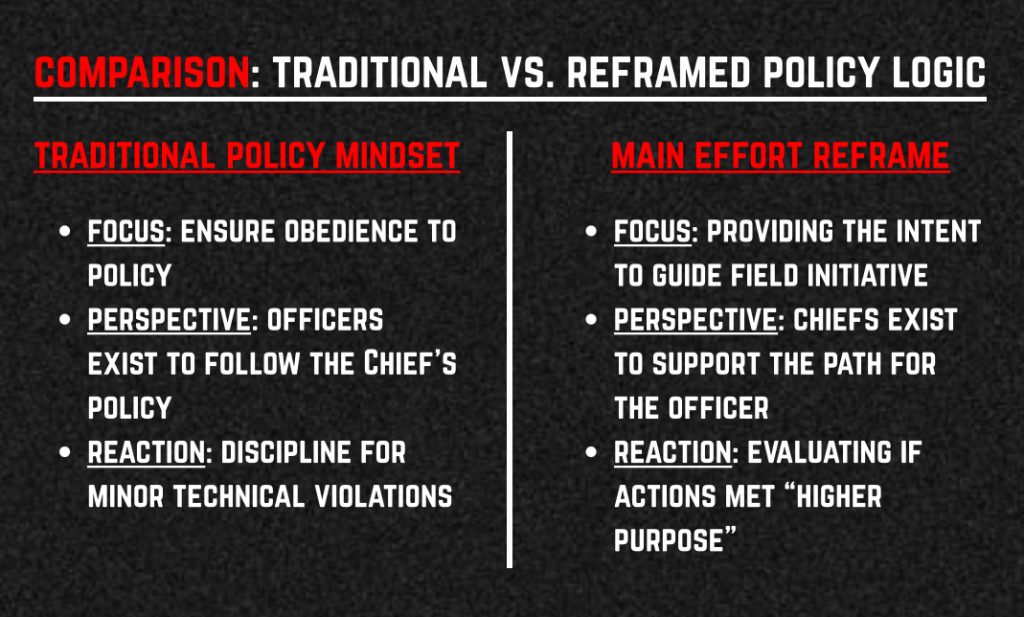
This shift requires administrators to recognize (and believe) that their role is to protect the officer’s time and focus. Both in policy and practice, if leadership acknowledges and reframes their objective from only command and control to supporting competency and ensuring success of frontline officers—and in doing so, the higher mission—policy then becomes an enhancing framework. By viewing the chief’s role as the support structure for the officer’s mission, “disciplined, but unregimented” thinkers—the mavericks—are created.3 These are individuals who thrive as adaptive decision-makers in the field.
Overcoming the Pitfalls
To implement innovative policy, leaders must lean into disruption—the willingness to challenge assumptions with tough questions.
• Slay the sacred cows: Identify policies that exist “because we’ve always done it that way” and ask: If starting from scratch today, would it be done this way? Many agencies mandate five years of patrol for promotional eligibility. It’s assumed that time on the calendar equals leadership wisdom—a classic confirmation bias. However, policymakers might ask if the objective is experience or leadership competency. An innovative policy might shift from time-in-grade to a competency-based track and include certifications, peer and subordinate evaluations, mentorship of peers, and demonstration of problem-solving success as the primary metrics for promotion.
• Expand the window and reframe the objective: Policymakers must stop asking “What should the policy say?” and instead ask “What is the real problem to be solved?” Before drafting a single line, explicitly define the objective with precision. To find these answers, use the Johari Window to expand the open area by seeking honest feedback. What do the rookies see that administrators don’t? By intentionally looking into blind spots, leadership can identify if an issue is a lack of known information or a failure to see due to a cognitive bias. This allows policymakers to move beyond fixing a problem to fundamentally rethinking it, ensuring leaders aren’t just framing a solution as the problem itself, and attempting to solve the wrong problem repeatedly.
• Cultivate unlearning and rethinking: Cultivate an environment where it is safe to admit when an old way of thinking is no longer valid, a policy or policy outcome is no longer desired, or when something doesn’t serve its intended purpose. Policy should be a living document subject to an ideal outcome, and if a policy doesn’t move an agency toward that goal, it is a candidate for trimming.
Policy shouldn’t be a trap; it should be a guide for excellence in performance. Even this statement requires a cognitive shift for many. By rethinking cognitive biases, challenging mental models and frameworks, reframing problems, and disruptively questioning objectives, problems can stop being decorated and a professional culture can be built instead—a culture that is as resilient and innovative as officers truly are when given the chance. d
Notes:
1Kristin Cox and Yishai Ashlag, Stop Decorating the Fish: Which Strategy Is Your Strategy? (North Charleston: CreateSpace, 2020).
2Clinical Excellence Commission, “Pareto Charts & 80-20 Rule,” New South Wales Government.
3James Mattis and Bing West, Call Sign Chaos: Learning to Lead (New York: Random House, 2019).
Please cite as
Myles Cook, “Don’t Draft Policy, Innovate It,” Police Chief Online, June 24, 2026.