
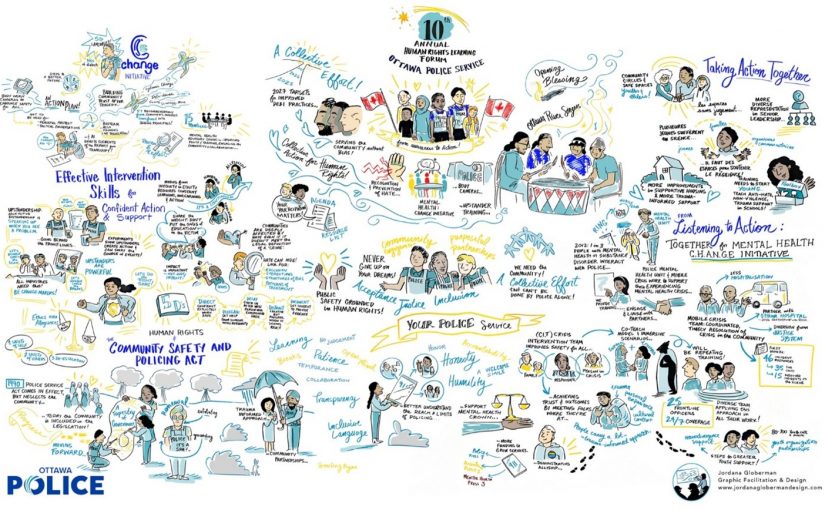
On December 4, 2025, the Ottawa Police Service (OPS) in Ontario, Canada, marked a significant milestone by hosting its 10th Annual Human Rights Learning Forum. The theme “From Awareness to Action: Advancing Human Rights and Policing—Collaboration for Safer, More Inclusive Communities” captured both the urgency of the moment and the evolution of policing over the past decade.
In a time of growing political polarization, where policing is often framed through extremes, the Forum offered something increasingly rare: a space for constructive, evidence-based dialogue grounded in shared responsibility. More than 300 participants—police professionals, community leaders, mental health experts, advocates, public servants, elected officials, and members of the public—gathered with a common understanding: Public safety and human rights are not competing priorities but mutually reinforcing ones.
From Dialogue to Practice
The 2025 Forum focused deliberately on practical collaboration. Sessions moved beyond theory to examine how human rights are operationalized in modern policing.
Participants explored how Ontario’s 2019 Community Safety and Policing Act (CSPA) embeds human rights and anti-racism obligations directly into police governance and training.1 Mental health professionals and OPS members also showcased new co-response models through the Mental Health C.H.A.N.G.E. Initiative (Community, Healing, Accountability, Nexus, Growth, Engagement/Evolution), highlighting the importance of partnerships with health and social services when responding to individuals in crisis.2 Additionally, a hands-on body-worn camera demonstration illustrated how transparency and accountability can be strengthened in daily police interactions. The camera’s instant translation capabilities impressed Forum attendees and were a further demonstration of how putting equity into practice can strengthen community-police interactions.
Workshops on hate crime prevention, crisis de-escalation, and bystander and upstander intervention equipped both officers and community members with practical tools. The consistent message was clear: Community safety is a shared responsibility, and sustainable solutions require collaboration across sectors.
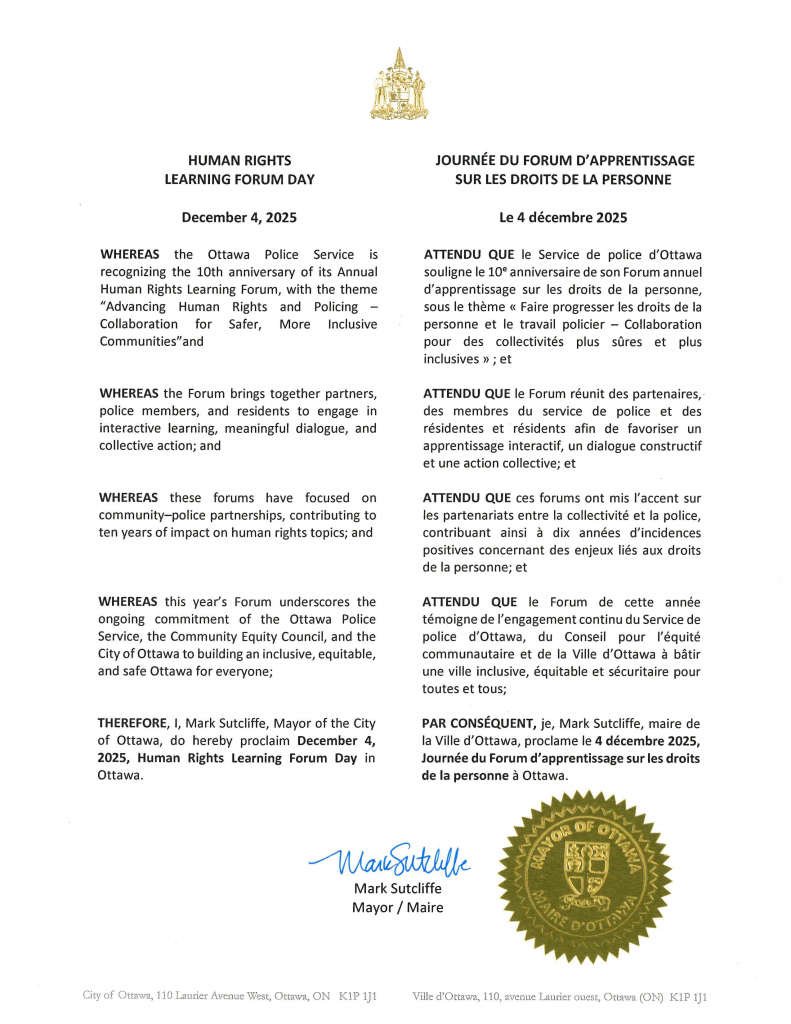
The City of Ottawa formally recognized the Forum’s 10-year legacy through a proclamation presented by Mayor Mark Sutcliffe, affirming that public trust is built through strong and lasting community-police partnerships. This recognition underscored that the Human Rights Learning Forum is not merely symbolic—it is a cornerstone of Ottawa’s approach to inclusive public safety.
A Decade of Evolution
Since its inception in 2015, the Human Rights Learning Forum has evolved alongside the communities it serves. Early forums focused on foundational awareness introducing human rights principles, exploring the science of bias, and advancing understanding of Indigenous history and reconciliation. Over time, the Forum explored additional important topics affecting local communities, including hate crime, systemic racism, race-based data, trauma-informed policing, and collective healing.
In recent years, the focus has shifted decisively toward action. Themes emphasizing partnership, restoration, and accountability reflect a broader transformation in policing: Human rights are no longer viewed as abstract ideals but are recognized for their quasi-constitutional stature and therefore as operational imperatives that shape legitimacy and effectiveness.
This progression mirrors global trends. Police services worldwide recognize that legitimacy is the cornerstone of public safety and legitimacy is earned through fairness, transparency, and respect for human dignity.
The Central Role of Human Rights
Human rights are not an “add-on” to policing; they are foundational to democratic law enforcement. The United Nations’ Universal Declaration of Human Rights (1948) affirms the inherent dignity and equality of all people, principles that underpin international law, constitutional protections, and domestic policing standards across democratic societies.3
In Canada, human rights are protected under quasi-constitutional law—meaning that human rights legislation must be complied with before other laws, unless there is a specific exemption. In Ontario, for instance, the Human Rights Code supersedes the CSPA. When there is a conflict between the Human Rights Code (the Code) and the CSPA, the Code will prevail.
Research consistently demonstrates that rights-respecting policing improves outcomes. When communities trust that police will act fairly and proportionately, they are more likely to report crime, cooperate with investigations, and support crime prevention efforts. Trust, in this sense, is not a public relations goal—it is an operational necessity.
Ontario’s CSPA reflects this reality. In force since April 2024, the act mandates training in human rights and systemic racism, strengthens civilian oversight, and establishes independent bodies such as the Law Enforcement Complaints Agency and the Inspector General of Policing. These reforms reinforce a clear principle: Accountability and transparency are essential components of professional policing, not optional enhancements.
For police leaders internationally, the message is instructive. Upholding human rights is not a political trend—it is a legal, ethical, and professional obligation that strengthens public safety.
Embedding Equity and Inclusion in Practice
At the organizational level, OPS has taken deliberate steps to embed human rights into culture, strategy, and operations. The Ottawa Police Service Board Strategic Plan 2024–2027 articulates a clear vision: to be “a trusted partner in building an inclusive, equitable, and safe Ottawa.”4
OPS’s multi-year Equity, Diversity, and Inclusion (EDI) Action Plan, developed with community partners, led to the creation of a dedicated EDI team, a human rights policy, and an EDI lens applied to policies, programs, and operational decisions.5 This approach ensures equity considerations are integrated into decision-making from the outset.
The Service’s DRIVE² (Diversity, Respect, Inclusion, Values, Equity, and Engagement) Strategy 2023–2027 further reinforces these commitments. Developed with input from the Community Equity Council, DRIVE² frames EDI as a shared responsibility across the organization from leadership accountability and recruitment to service delivery and performance measurement.6
These efforts are producing tangible change, including but not limited to more diverse recruitment cohorts, expanded body-worn camera deployment, strengthened mental health partnerships, improved bias-reporting processes, and enhanced support for communities affected by hate. Importantly, OPS views these initiatives not as endpoints, but as part of an ongoing process of learning, evaluation, and adaptation.
Navigating Critique in a Polarized Climate
Progress has not been without challenges. Community advocates and oversight bodies continue to raise concerns about disproportional outcomes in certain areas of policing. Race-based data have highlighted disparities that cannot be ignored.
OPS leadership and community partners have acknowledged that such findings are troubling and risk undermining trust if left unaddressed. At the same time, there is recognition that systemic change requires sustained effort, honest evaluation, and willingness to adjust course.
The Human Rights Learning Forum plays a critical role in this context. By creating structured spaces for candid dialogue—including criticism—the Forum reinforces a culture of accountability. Listening to difficult feedback is not a weakness in policing leadership; it is a prerequisite for legitimacy.
In an era where policing debates are often polarized, the Forum offers a constructive alternative: one grounded in evidence, partnership, and shared commitment to democratic values.
Looking Ahead
After 10 years, Ottawa’s Human Rights Learning Forum stands as both a marker of progress and a reminder of unfinished work. Turning awareness into action requires continuous effort embedding human rights into training, policy, leadership decisions, and frontline practice.
For police professionals, the challenge is to operationalize human rights daily. For communities, it is to remain engaged in dialogue and oversight. For policymakers, it is to ensure that legal frameworks and compliance mechanisms support transparency and continuous improvement.
In a divided world, Ottawa’s experience offers a hopeful lesson: When policing is grounded in human rights, partnership, and accountability, trust can be rebuilt and public safety strengthened. The journey from awareness to action is not easy but it is essential. d
Notes:
1Community Safety and Policing Act, S.O. 2019, c. 1, Sched. 1.
2Ottawa Police Service, “Mental Health C.H.A.N.G.E. Initiative.”
3United Nations (UN), Universal Declaration of Human Rights (UN General Assembly, 1948).
4Ottawa Police Service Board, Strategic Plan 2024–2027, 5.
5Ottawa Police Service, “Equity, Diversity and Inclusion Action Plan.”
6Ottawa Police Service, The Ottawa Police Service Roadmap to Change: DRIVE2 Strategy 2023–2027, Ver. 2.1 (2024).
Please cite as
David Zackrias, “From Awareness to Action: A Decade of Advancing Human Rights in Policing,” Police Chief Online, May 1, 2026.