


This issue of Police Chief is focused on policy in policing. I had a recent opportunity to consider the impact of policy and law from a national government that resulted in the most tragic outcome in history.
In April, I was invited to participate in a program led by the University of Virginia’s Center for Public Safety and Justice and the Rutgers University Miller Center on Policing and Community Resilience, in conjunction with the annual International March of the Living event in Krakow, Poland. The program, Operationalizing Never Again, culminates with a symbolic march from Auschwitz to Birkenau. The purpose of the educational program is to bring individuals from around the world to study the history of the Holocaust and to examine the roots of prejudice, intolerance, and hatred. The goal is to inspire participants to fight intolerance, racism, and injustice by witnessing the atrocities of the Holocaust. What the Nazi regime did in state-sponsored operations to attempt to eliminate the Jewish people was unforgiving.
I was one of 130 police officials from around the world who spent time learning about the role police played in those atrocities. The police were not just complacent; they participated in the murders of innocent families. They worked side by side with the murderous SS arm of the Nazi Party. The lessons that were presented to us clearly identified the process and pathway that led to the acceptance and actions of officers sworn to protect and defend their communities. The blurring of the lines of what became law and policy—and what was right—is clear when we look back at history. The burning question is how they missed it and why few pushed back. Over six million Jews and others were killed because of a lack of courage and response by those who should have done better. We spent time learning what history identifies as the critical points when this could have been prevented. We walked through the grounds of those hallowed spaces where lives were ruthlessly taken. We experienced the impact of a hate so deep and shared widely that a nation mobilized against their neighbors. We heard the stories of survivors and the few Germans who placed their lives on the line to protect the victims. Most importantly, we learned that, as leaders in policing, we are in a role that requires us to ensure that injustice created by government for government never happens again in any manner. We must never allow law, policy, and action to align to harm anyone in our communities. We must remain vigilant and committed to our core role as protectors of everyone. In policing, we are apolitical, nonpartisan, guardians of peace.
“The role of policing [is] not compliance, not complacency, not cooperation, but courage to stand up and step in to serve when needed the most.”
This experience taught me how easy it can be for a nation to turn on a population based on the rhetoric of its elected officials. The concern about divisive and dangerous rhetoric is what motivated the IACP Board of Directors to issue the Resolution Condemning Incitement of Violence in 2025. A moment of clarity washed through me as I contemplated the impact of rhetoric and the action of our board.
At the same time, I reflected on additional work underway at the IACP to strengthen our profession’s commitment to principled, collaborative public safety. I also reflected on the work we had recently completed such as the Shared Principles of Agreement, which was the result of the Public Safety Leadership Convening at the IACP, where 16 national associations agreed upon four key principles on the future of intergovernmental public safety cooperation. This work builds a foundation to address the operational atmosphere to ensure this history is not repeated.
I was humbled to join my law enforcement colleagues in a position of honor, leading the over 7,000 marchers on the day of the International March of the Living from Auschwitz to Birkenau. Then, I joined my peer leaders from the National Sheriffs Association, the Small and Rural Law Enforcement Executives Association, the International Association of Campus Law Enforcement Administrators, and the German Police Union to be the first policing group to ever light one of the symbolic flames, the Torch of Protection, during the solemn ceremony at Birkenau. I will always remember the pride I felt for our profession looking out over the crowd that included 50 survivors and their families as we changed the outlook for the future with hope and assurance that the women and men in policing will never again stand idly by, nor participate in, harming our Jewish families or any others during our watch.
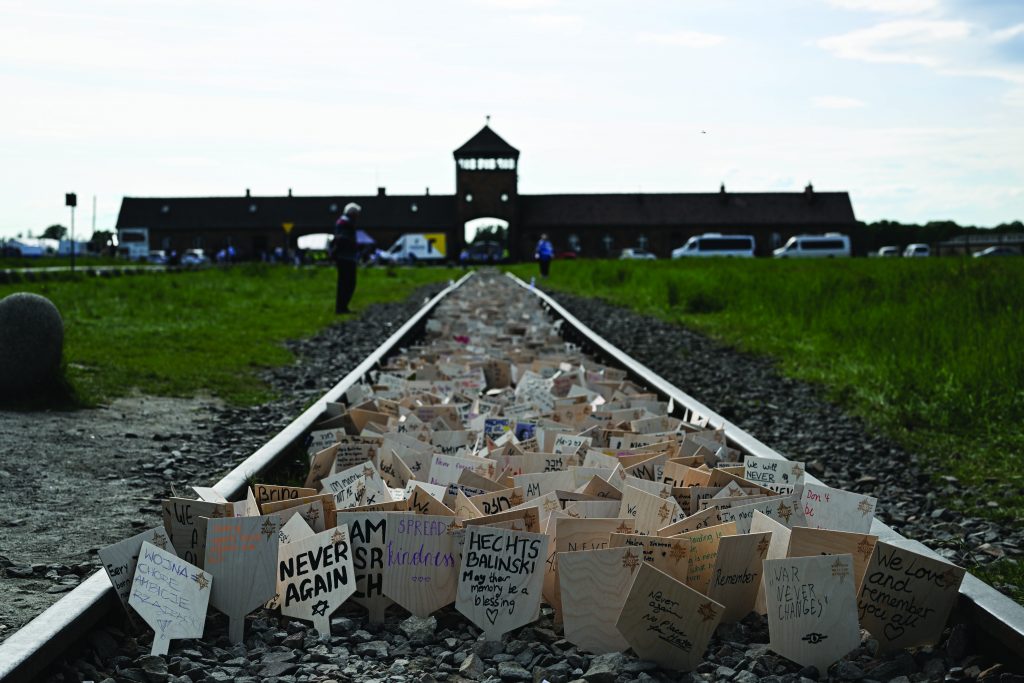
Operationalizing Never Again is more than a program; it is an experience that I believe all in positions of influence and power should participate in. Not just those of us in police leadership but our elected officials and community leaders need the insights provided by this great program. Weeks after, I am still reflecting on the lessons learned and how to meet the challenge and charge we were given to ensure that what happened during this dark time in history is never repeated in any manner. That hate, intolerance, and prejudice is called out in all its forms and halted immediately because of courageous protectors with the power to stop the behavior and to shield those it is directed toward. That is the role of policing, not compliance, not complacency, not cooperation, but courage to stand up and step in to serve when needed the most. To learn more about the program, check out www.scps.virginia.edu and www.motl.org. d
Please cite as
David Rausch, “Courage Over Compliance,” President’s Message, Police Chief 93, no. 6 (June 2026): 6–7.