

Crime is a phenomenon that I have always found to be interesting. It is ever changing and adapts based on the trends of society.
As police leaders, we are expected to remain focused on what those latest trends are and be ready to address the criminal activities and protect the public. With emerging technologies, this gets more and more complex. A recent example is one that has impacted an overwhelming number of senior citizens and vulnerable adults—financial fraud. This population is targeted because of their values, which are based in trust and a need for connection. The world population of those over 60 years of age has exploded and is projected to continue to grow exponentially. While financial exploitation of this population is not new, many of the tactics are.
Recent figures from the FBI show the reported amount of fraud to this population in the United States to be over $7.7 billion in 2025, representing a 59 percent increase in total losses.1 The scams vary, but there exists a new method that has rapidly spread throughout the world—cryptocurrency has entered the financial scene as an alternative financial market. The emergence of cryptocurrency has introduced the option to deposit paper currency into ATM kiosks to purchase cryptocurrency. These kiosks suddenly began appearing in convenience stores, quick markets, gas stations, grocery stores, and many other high-traffic retail locations, creating widespread access points for the immediate conversion of cash into largely irreversible and untraceable cryptocurrency transactions. One owner of these machines has done many media interviews, and when asked about the placing of these machines, he has stated that they are placed in these locations so that the “unbanked” can have an opportunity to participate in this market.2 These machines have come to the attention of law enforcement because of exponential increases in reports of fraudulent criminal activity and because of the increased use of them in illegal narcotic cases. One only needs to closely review recent narcotics investigations to see how these machines have been used. They are primarily used for three purposes: fraud, fraud, and fraud.
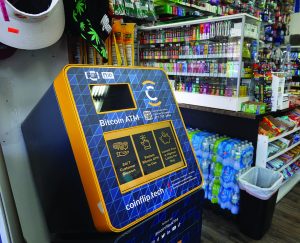
Seniors and vulnerable adults have been scammed out of millions of dollars by criminal actors, posing as trustworthy individuals, who direct the scam victim to deposit cash into the kiosks and then send their wallet identification information to the scammer. Once this is done, funds are immediately stolen. As mentioned, another use of the machines is by individuals involved in the illegal narcotics trade as they deposit cash proceeds immediately to avoid carrying the cash and having it seized if they are intercepted by the police. Yet another documented use is laundering funds by transnational criminal organizations to send the money internationally to their networks. It is well documented that these devices are rarely used for legal purposes.
As this information has become known, communities are mobilizing to address this issue. In the United States, Indiana and Tennessee have led the way by banning these machines in their states and more states are moving in that direction.3 Others have tried to regulate them but are finding that the criminal behavior and victimization are not slowing down. In conversations with peers throughout the world, we have learned that this is not just a problem in the United States. The IACP Executive Board has acted quickly on recognizing this immediate threat and recently passed a resolution identifying the threat posed by these devices and the recommended actions to address them, titled “Addressing the Public Safety Threat Posed by Crypto ATM (Convertible Virtual Currency Kiosks) Use in Crime, Fraud, Money Laundering, the Illegal Narcotics Trade, and Elder Victimization.” Details of the threat and recommendations are provided in the resolution.
We in policing must do all we can to protect this population from the predators that lurk in fraudulent spaces to take advantage of the vulnerable.
Elder financial fraud is an area that continues to grow, and the threat will become more prevalent with the growth of the aging population. We in policing must do all we can to protect this population from the predators that
lurk in fraudulent spaces and take advantage of the vulnerable, like we have seen with these crypto ATM kiosks. We all know that when finances have been stolen, it is difficult to recover them, so we must do all we can to prevent the crime from ever happening. We know that prevention is our primary purpose in policing. There are many valuable resources that exist to assist law enforcement on elder justice through the U.S. Department of Justice website at www.justice.gov/elderjustice/lawenforcement-1. They include EAGLE (Elder Abuse Guide for Law Enforcement), an online tool to support officers in quickly identifying, intervening, and resolving elder abuse situations; SAFE Training (Safe Accessible Forensic Interviewing for Elders); Elder Abuse Training for Law Enforcement (23 modules) that consists of short (15–20 minute) e-learning modules for law enforcement to enhance investigative skills, assist law enforcement to work effectively with older victims, and provide tools that can help keeps victims safe and hold offenders accountable; and many other resources. Mahatma Gandhi is attributed with saying, “The true measure of any society can be found in how it treats its most vulnerable members.”4 This is a charge to all of us to do all we can to protect our elder populations.d
Notes:
1Internet Crime Report 2025 (Federal Bureau of Investigation, Internet Crime Complaint Center, 2026).
2“Interview with Daniel Polotsky, CEO of Coinflip Bitcoin ATMs,” Coin ATM Radar Blog, October 24, 2019.
3Jordan Green, “Tennessee Just Became the Second State to Ban ‘Crypto ATMs.’ Here’s Why,” Nashville Tennessean, April 29, 2026.
4“Quotes by Mahatma Ghandi,” Theosophy World, December 11, 2016.
Please cite as
David Rausch, “The Growing Threat of Elder Fraud,” President’s Message, Police Chief 93, no. 7 (July 2026): 6–7.