

In the middle of a crowded public event, a police officer is attempting to stream live video, access records, and coordinate with multiple agencies—all while network congestion builds and radio traffic intensifies. In moments like these, communication is not just a tool; it is a lifeline.
Today’s police technologies promise real-time connectivity, secure data sharing, and seamless coordination. As these capabilities become standard, many solutions may appear remarkably similar at first glance. However, beneath that surface lies a more complex reality. While companies are addressing the same core need—keeping officers connected—they are doing so from very different perspectives. From large-scale network infrastructure to field-level equipment and officer-specific tools, each approach reflects a distinct role in modern policing.
Connection Across the Entire Ecosystem
At the highest level, communication begins with the network itself. FirstNet, Built with AT&T, represents a foundational shift in how connectivity is delivered to public safety. Developed as a public-private partnership with the U.S. federal government in the aftermath of the 9/11 attacks, FirstNet was designed specifically to address longstanding challenges around interoperability, reliability, and priority access for first responders. It provides a dedicated infrastructure with its own secure core, specialized spectrum, and always-on priority and preemption, ensuring that first responders maintain connectivity even during times of extreme congestion.
This foundation is reinforced through layered coverage strategies, including in-building solutions, deployable assets, and emerging satellite capabilities. Building on this infrastructure, FirstNet is introducing FirstNet Fusion through a controlled rollout to select agencies. “Fusion will make it easier than ever to unite first responders across jurisdictions, carriers, and technologies,” said Matt Walsh, assistant vice president of FirstNet and NextGen 9-1-1 Products.1
The platform allows first responders to create and manage talkgroups in seconds—something that traditionally could take hours or even days on legacy radio systems. These groups can include participants across different carriers, devices, and jurisdictions, reducing the friction that often slows multiagency collaboration. Fusion also brings together push-to-talk communication, Next Generation 911 capabilities, and access to real-time data within a single interface. By integrating with existing public safety systems, it moves beyond basic connectivity toward a more unified operational environment.
Building on this network layer, platforms like Leonardo’s move communication beyond connectivity into real-time operational control. Drawing on decades of experience delivering mission-critical systems, Leonardo focuses on unifying traditionally fragmented technologies, such as land mobile radio and broadband networks, into a single coordinated environment. Its Mosaic platform acts as a communications backbone, allowing officers using radios and those using LTE or 5G devices to operate within the same ecosystem while sharing voice, video, and data.
At the command level, Leonardo’s Mission Critical Control Room brings these capabilities together into a unified interface for dispatchers and supervisors. This allows agencies to not only stay connected but to actively direct and manage operations with greater visibility. Instead of relying on voice-only communication, departments can track personnel, monitor incidents, and deploy resources in real time.2 This reflects a broader evolution in policing—a shift from reactive coordination to data-driven command, particularly in complex, multiagency environments where speed and clarity are critical.
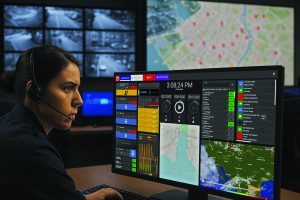
While large-scale systems and platforms enable this level of coordination, the operational core of communication still depends heavily on dispatch. InterTalk focuses on this critical puzzle piece by rethinking how dispatch systems are deployed and managed. The Enlite Cloud Ready Dispatch console allows operators to monitor and manage radio communications; coordinate with field units; and access integrated tools such as mapping, logging, and computer-aided dispatch systems from virtually any location.
Delivered as a browser-based platform, Enlite allows secure access to radio communications from virtually any location, without requiring specialized hardware. Agencies can deploy it in cloud, on-premise, hybrid, or even air-gapped configurations, depending on their operational and security requirements. This flexibility enables a shift away from traditional, fixed dispatch models toward more resilient, distributed operations. “The traditional model of a fixed facility, fixed team… is giving way to something more resilient and financially sustainable,” said InterTalk’s Marketing Manager Nicholas Blackmore.3
In practice, Enlite can have a significant impact on workforce management. For example, agencies can retain experienced personnel who may no longer be able to work on-site or use remote access to cover difficult shifts without increasing staffing levels. These capabilities highlight how communication technology is not only evolving but also influencing how public safety organizations operate and sustain their workforce.
Beyond systems and coordination, communication technology must also function reliably in the field. Many agencies face the challenge of modernizing connectivity without replacing existing equipment, particularly when budgets are limited. Pegatron addresses this issue with a solution focused on upgrading performance rather than infrastructure. The Pegatron 5G Dongle is designed to deliver high-speed connectivity through a simple, plug-and-play device that connects directly to existing laptops and field systems. With no software installation required, officers can quickly access real-time data, stream video, and upload evidence directly from the field. This approach allows departments to extend the life of their current hardware while benefiting from modern network capabilities.
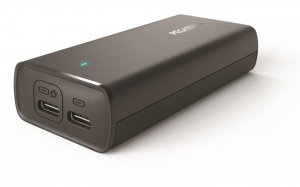
The importance of reliable connectivity becomes clear in high-demand situations, such as large public events where network congestion can disrupt operations. With the integration of priority network services like T-Mobile’s T-Priority, solutions like Pegatron’s help ensure that officers remain connected when it matters most. This shift also reflects a broader change in expectations in the field. “You’re not working around your connection anymore—the connection actually keeps up with you,” explained Albert Ju, Pegatron USA’s senior director of product management.4 By focusing on practical deployment and cost-effective upgrades, Pegatron highlights how incremental improvements can have a meaningful impact on day-to-day policing.
At the most granular level, communication technology ultimately comes down to the individual officer’s experience. PRYME Audio Accessories approaches this space with a focus on user-driven design, developing equipment based directly on feedback from first responders.
This approach is shaped by the challenges officers encounter in the field. Officers often need to manage multiple communication systems at once, whether coordinating across agencies with different radio networks or balancing traditional radios with smart devices. It is not uncommon for an officer to carry two radios on separate networks or to use both a traditional radio and a smart device. Managing these systems can be cumbersome, especially in high-noise or tactical environments where officers are also wearing helmets, using noise-canceling headsets, and have limited ability to manage cables or controls.
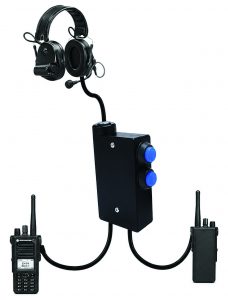
Products like the PRYME PTT-172 and PTT-173 address this issue directly. Both are rugged, field-ready adapters that connect multiple communication devices into a single headset using industry-standard connectors.
The PTT-172 allows users to combine two separate radios into one headset, with dual push-to-talk buttons that let them select which network to transmit on. This is particularly valuable in regions where different agencies operate on different radio systems, requiring officers in multiagency operations to monitor and communicate across both.
The PTT-173 builds on the concept of the PTT-172 by integrating a traditional radio with a smart device such as a smartphone or tablet. In addition to dual connectivity, it includes a programmable control interface that allows officers to manage functions like push-to-talk apps, calls, or other device-specific features from a single unit. By consolidating these controls, the adapter reduces complexity and improves usability under pressure.5
As communication continues to span both traditional radio systems and mobile platforms, solutions like these help ensure that technology remains practical and effective at the user level.
Conclusion
While today’s public safety communication technologies may appear similar at a glance, the differences become clearer when viewed across the full spectrum of policing. From foundational connectivity and integrated platforms to dispatch systems, field upgrades, and end-user equipment, each solution plays a distinct role in enabling effective communication.
As agencies evaluate their options, the challenge is no longer simply identifying available technology but understanding how these layers work together. In the end, communication remains at the core of policing How agencies choose to build, integrate, and support these tools will continue to shape the safety, efficiency, and responsiveness of policing in the years ahead.d
Notes:
1Matt Walsh (assistant vice president, FirstNet and NextGen 9-1-1 Products, AT&T), email interview, April 30, 2026.
2Nate Maloney (vice president of marketing & communications, Leonardo), email interview, May 7, 2026.
3Nicholas Blackmore (marketing manager, InterTalk), email interview, May 8, 2026.
4Albert Ju (senior director of product management, Pegatron USA), email interview, May 5, 2026.
5Dave George (president and chief technologist, PRYME Audio Accessories), phone interview, April 27, 2026.
Source ListPlease click on the companies’ names to go to the companies’ websites. |
|
Please cite as
“More Than a Signal,” Product Feature, Police Chief 93, no. 6 (June 2026): 48–50.