
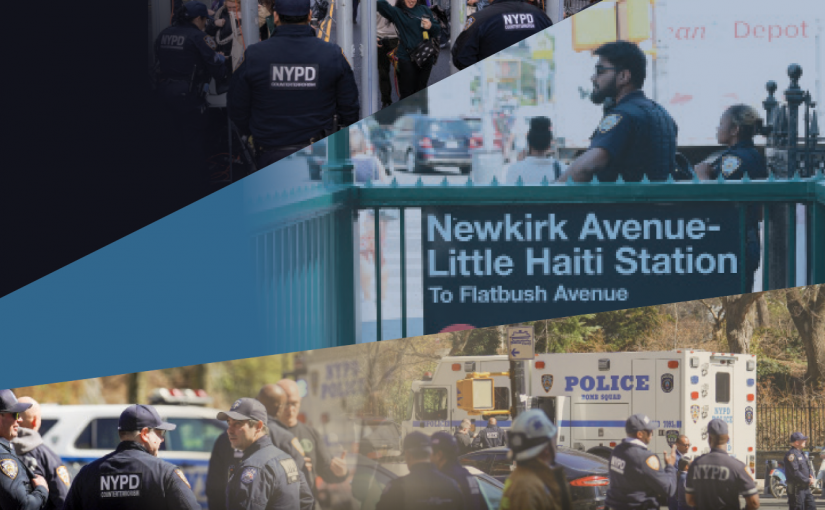
It is early March 2026. Outside the residence of New York City’s first Muslim mayor, a known agitator is leading a small anti-Islam protest that has drawn more than five times as many counter-demonstrators. The war in Iran is just a week old. Tensions are high as protesters shout across police barriers and New York City Police Department (NYPD) officers work to keep the opposing sides apart.
As alleged in court documents and media reports, two young men drive from Pennsylvania to New York City and park near Gracie Mansion. They get out of the vehicle and walk to the demonstration. Moments later, one ignites and hurls an object into the crowd before running down the block, where he lights and drops another device near several police officers. Officers give chase and tackle him, arresting his accomplice nearby. The devices, glass jars wrapped in duct tape and packed with nuts, bolts, and TATP—an explosive compound known as “the Mother of Satan”—are improvised explosive devices that thankfully do not detonate.
When a bystander asks him why he did it, one of the men shouts “ISIS.” The other asks for a pen and paper at the police precinct and writes, “I pledge my allegiance to the Islamic State.” He tells investigators he hoped to carry out an attack bigger than the Boston Marathon bombing.
While the case remains under investigation and the suspects have not yet had their day in court, several things are already clear. Twenty-five years after the 9/11 attacks, foreign terrorist organizations (FTOs) like al Qaeda and ISIS continue to inspire and seek violence in New York City. And would-be terrorists remain preoccupied by making bombs to attack soft targets in those organizations’ names.
But the alleged Gracie Mansion attackers are equally a product of the current moment. They chose to target a politically charged protest unfolding amid widespread domestic polarization and unrest surrounding conflict in the Middle East. Early indications suggest they radicalized quickly, with little to no warning, and online—where today’s pathways to violence increasingly begin.
The Gracie Mansion attack was the 72nd of 75 disrupted plots and incidents of terrorism and targeted violence in New York City since 9/11. It had elements both familiar and novel, and like the dozens of incidents that preceded it, it is illustrative of a threat that has sustained and evolved over the past 25 years.
These 75 incidents exemplify a threat that has fragmented and morphed over time, becoming less predictable and more varied. They demonstrate how the threat has adapted to advances in technology, responded to counterterrorism pressure, and shifted with the political, geopolitical, and societal currents of the time. They also illustrate how relentless perseverance, collaboration, and innovation within the law enforcement community have kept our city safe for the past quarter century.
The Early Years—From Imported to Homegrown
Looking back through these cases over the past 25 years, certain trends are starkly apparent in retrospect, even if they were less recognizable as we policed our way through them in real time. A plot to bomb the Herald Square subway station—involving suspects without ties to terrorist groups overseas—seemed like an aberration when the NYPD disrupted it in 2004. It didn’t involve material support, training, or travel to a conflict zone. Years later, we understand it as an early example of homegrown violent extremism—the threat that remains our most enduring and pernicious, and the one we have become most adept at disrupting.
Terrorism plots from the years immediately following 9/11 were sophisticated, centrally coordinated, and externally directed, usually by al Qaeda. They were premised on recruiting, training, and deploying operatives from elsewhere into the city. Most plots at the time looked something like Iyman Faris’s plot to cut the support cables of the Brooklyn Bridge or the “mubtakkar” plot to release chemical agents in the New York City subway by remotely detonating hydrogen- cyanide gas dispersal devices. Thanks to sustained counterterrorism efforts from federal agencies and nascent efforts by newly established programs at the NYPD, these plots did not come to fruition.
Starting in 2007, we began to confront a steady stream of al Qaeda–linked activity that followed a familiar pattern. Would-be terrorists traveled from the New York area to the Afghanistan-Pakistan region, received tactical training, and returned to the United States with plans to attack critical infrastructure and iconic landmarks. This was the first significant wave of travelers from the New York region seeking out overseas training to enable attacks at home.
Bryant Neal Vinas, for instance, traveled to Pakistan from Long Island in 2007, where he trained with al Qaeda and helped develop a plot to bomb the Long Island Railroad as it entered Manhattan. Queens residents Najibullah Zazi, Zarein Ahmedzay, and Adis Medunjanin attended al Qaeda training camp in Pakistan and returned with plans to carry out a subway suicide bombing that was disrupted in 2009. Faisal Shahzad trained with Tehrik-e-Taliban Pakistan in Waziristan before attempting to detonate a vehicle-borne improvised explosive device in Times Square in 2010. The bomb failed because of faulty construction, and the FBI and NYPD identified and arrested Shahzad within 53 hours.
Rise of the Digital Battlefield
While these classic FTO-linked cases continued to consume significant resources from across the city and the federal agencies located within it, a very important shift was underway. Social media platforms like Myspace and Paltalk allowed new virtual pathways of singular and collective radicalization that transformed how terrorist organizations recruited, radicalized, and mobilized supporters—and ultimately how individuals did, simply by engaging with violent content.
Radicalization no longer needed to begin with an extremist organization or a coherent ideology, nor did it need reinforcement through in-person engagement with like-minded people. Instead, it became individualized, unfolding within online ecosystems that shaped identities, accelerated grievance formation, and connected vulnerable individuals to virtual violence.
Terrorist organizations and their supporters quickly adapted to this new environment. Queens native Samir Khan helped pioneer English-language jihadist propaganda through online zines like Jihad Recollections before moving to Yemen in 2009 and launching al Qaeda’s infamous Inspire magazine in partnership with al Qaeda ideologue Anwar al-Awlaki. This new style of propaganda sought to inspire and enable homegrown violent extremists through graphics-heavy, accessible messaging and detailed attack guidance. It survived long after its architects were killed in drone strikes in Yemen in 2010 and continues to resonate with aspiring terrorists to this day.
ISIS took this model to a new level. When it declared its caliphate in 2014, the impact on New York City’s threat environment was immediate. ISIS propaganda was slick, video game–like, and easy to digest. ISIS doubled down on the message that “you can attack from wherever you are” and paired it with unprecedented online outreach. In an image emblematic of the heyday of ISIS and Al Qaeda propaganda, a camera sits on an AK-47 as a tripod, captioned, “A gun can stop a heartbeat, but a camera can give life to a thousand hearts.” ISIS invested heavily in both.
What followed in New York City was a spate of attacks and disrupted plots inspired by ISIS, and a second wave of foreign fighter travelers, this time journeying to Syria. Queens resident Munther Saleh and Staten Island resident Fareed Mumuni were arrested in 2015 for plotting an ISIS-inspired pressure cooker bombing before attempting to travel overseas to join the group. They were part of a wide-ranging network of individuals linked to core ISIS leaders in Syria who were digitally enabling attack plotting from afar.
Three ISIS-inspired attacks occurred over 15 months between 2016 and 2017: multiphase bombings in Seaside Park, New Jersey, and Manhattan’s Chelsea neighborhood; a deadly vehicle ramming on the West Side Highway; and an attempted suicide bombing in the Port Authority Bus Terminal.
Other ISIS supporters from New York City sought to join the fight abroad. Two young men from Brooklyn, Mirsad Kandic and Ruslan Asainov, separately made their way to Syria just as ISIS established its foothold there. Kandic was a prolific recruiter of global foreign fighters, while Asainov rose through ISIS’s ranks as a sniper, eventually becoming a lead weapons trainer. During the height of ISIS’s caliphate, the NYPD and our partners disrupted at least 20 would-be ISIS travelers or supporters.
Asocial Networks: Diversification and Acceleration
As the initial ISIS wave began to crest, other threats grounded in different violent ideologies began to manifest in New York City. In 2017, James Harris Jackson traveled from Baltimore, Maryland, to fatally stab a Black man with a sword in midtown Manhattan in a white supremacist act of domestic terrorism. This murder foreshadowed a series of racially or ethnically motivated violent extremist attacks across the West, fueled by an ascendant strain of transnational white supremacism.
The dynamics of this strain—that would soon be commonly referred to as accelerationism—took many of the hallmarks of ISIS’s social media strategy to new levels, by offering live-streamed lone-actor violence to thousands of online supporters in real time. As they sought to accelerate the collapse of modern society and its replacement with a white ethnostate, accelerationists replaced membership in formal organizations with shared online memes and trope-like manifestos that recited common grievances, imagery of assailants as saints, or gamified promotion of attacks.
Payton Gendron’s racially motivated mass shooting at a grocery store in Buffalo, New York, was an example of this paradigm. Mimicking earlier perpetrators, Gendron live-streamed his attack on the gaming platform Twitch to ensure the graphic footage would be shared and glorified online, wrote white supremacist symbols and slogans on his assault rifle, and released a manifesto, replete with references to the Great Replacement theory that foretold the extinction of the white race. He enumerated a list of familiar enemies, including minorities, Jews, and immigrants. In his manifesto, Gendron self-diagnosed his radicalization as a product of isolation during the pandemic and time spent on Reddit, 4chan, and other fringe platforms, where he engaged with voluminous amounts of hateful and violent content. In this respect, he was not alone.
Anarchy, Nihilism, and Contagion
If the advent of social media was the primary driver of the changing terrorism threat in New York City over the last 25 years, the second was the impact of the COVID-19 pandemic. The city was the epicenter of the pandemic for months. Tens of thousands of people died, and millions were confined to their homes. Children and teens were physically isolated, remotely schooled, and spent unprecedented amounts of time online. For many, virtual communities became their primary social environment. Society is still contending with the consequences.
Lurking beneath the TikTok dances and sourdough recipes was a darker reality. Online engagement and social isolation compounded opportunities for exposure to extremist content all while violent propaganda proliferated. Algorithmic nudging increasingly personalized users’ online experiences, steering some toward progressively more extreme content facilitating participation in harmful virtual subcultures.
It is against this backdrop that nihilistic violent extremist (NVE) networks like 764, No Lives Matter, and Maniac Murder Cult emerged. Members of these online networks embrace extreme violence, pain, and chaos as ends unto themselves, unmoored from specific extremist ideologies. Preying on susceptible youths who are chronically online, members of these networks groom and coerce victims into escalating acts of self-harm, child sexual exploitation, animal torture, and even livestreaming their own suicides. Victims often become perpetrators, perpetuating cycles of violence for power and clout.
One of the first glimpses into the NVE threat in New York City occurred in 2021, when the FBI arrested Angel Almeida on firearms charges in Queens, only to find hundreds of thousands of alarming files containing child sexual abuse material, Satanic and neo-Nazi imagery, and chats with 764 members on his devices. In the years that have followed, the NYPD and its partners have opened hundreds of cases into members and leaders of 764, its predecessors, and offshoots in New York City and across the United States.
Violent anti-government extremism also resurged during the pandemic amid widespread protests following the murder of George Floyd. During the summer of 2020, riots erupted out of lockdowns into spasms of civil unrest that the city hadn’t experienced in decades. A mix of anarchists and opportunists looted businesses, set fires, vandalized property, assaulted officers, and threw Molotov cocktails at patrol vehicles. Over the last six years, that threat has morphed into episodic threats of targeted violence against law enforcement officers and infrastructure and symbolic acts of property destruction grounded in opposition to U.S. domestic and foreign policy.
Amid these widely divergent ideologically driven incidents of targeted violence, New York City has grappled with a recent rise in attacks that don’t fit into any broader ideology, driven by personal grievances and conspiracies. These incidents often include tactics and targeting typically associated with terrorism but are animated by idiosyncratic motivations that confound easy categorization.
Take, for instance, the case of Frank James, who wounded 10 people in a mass shooting on the subway in 2022. He had posted hundreds of videos online drawing from accelerationism, Black nationalism, eco-fascism, and conspiracy theories.
Or take Luigi Mangione’s alleged assassination of the UnitedHealthcare CEO in late 2024—a brazen, cinematic, targeted shooting in midtown Manhattan just before the morning rush hour. His message of hostility toward the U.S. health care industry and wealthy corporate executives was met with widespread echoes of support across the internet, turning him into an international cult hero. It unleashed a torrent of threats that persist to this day and inspired multiple follow-on acts of violence across the United States. Mangione brought home how a single, symbolic act of targeted violence can reverberate across social media, inspire copycats, intimidate entire professions or communities, and generate fear far beyond its immediate victims.
What’s Now, and What’s Next
Today’s threat is a fragmented collection of old and new threat actors, simple and sophisticated tactics, and complex motivations that blur the lines between terrorism, targeted violence, and criminality. Pathways to violence are individualized and shaped online, making threats more difficult to categorize and even harder to detect. They require those combating violence to be everywhere all at once, remaining agile enough to adapt to emerging challenges while drawing on the experiences, capabilities, and partnerships that have enabled the disruption of successive generations of terrorist threats.
The Gracie Mansion attack was just one of several incidents of targeted violence the NYPD has confronted so far this year. A member of the extremist group the Jewish Defense League sought to attack a prominent pro-Palestinian activist. The Islamic Revolutionary Guard Corps plotted to attack a New York City synagogue. A video simulation of a Roblox character armed with a rifle conducting a mass shooting in a Manhattan school made the rounds online. An individual ignited incendiary material on the threshold of 26 Federal Plaza in protest of U.S. Immigration and Customs Enforcement.
2027 will be no different. We expect anti-technology violence, and violence leveraging technology—especially AI and drones. Geopolitical tensions and global hotspots will continue to inspire targeted violence here at home. And, somewhere, a lone assailant will undoubtedly attempt to commit an attack that others seek to emulate. But if the past quarter century has offered any lessons, it is that the way to stay ready is by learning from history and imagining the future. d
Please cite as
Rebecca Ulam Weiner and Meghann Teubner, “The Threat That Never Sleeps: 25 Years of Terrorism and Targeted Violence in NYC,” Police Chief 93, no. 9 (September 2026): 26–32.